

Miner Hashrate Slump & AI Infrastructure Shift: Inside Bitcoin’s Great Grid Migration
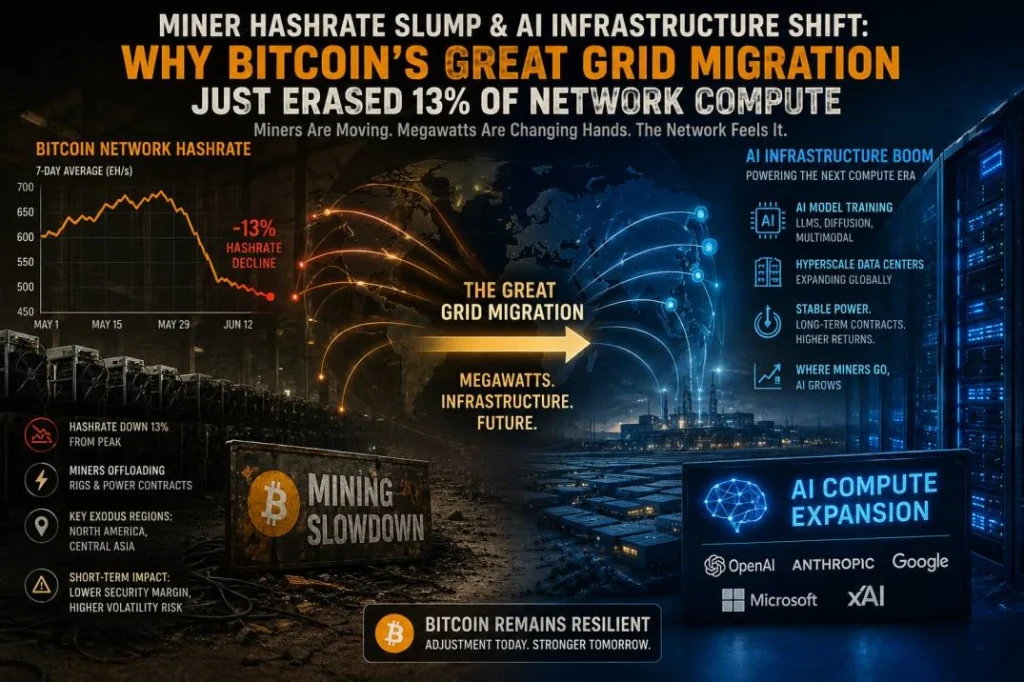
The structural foundations of the Bitcoin network are undergoing a permanent realignment. Between May 10 and May 15, 2026, on-chain network data confirmed a sharp -13.2% drop in the 30-day moving average hashrate. This historic contraction did not stem from a sudden drop in asset price or an energy crisis. Instead, it coincided directly with mid-month operational updates from major public miners formalizing their power capacity pivot toward high-performance computing and AI leases.
The industry is caught in a high-stakes migration. The halving cycles that once defined miner capitulation have evolved into a permanent capital reallocation program. Publicly traded digital asset infrastructure companies are pulling plug loads from application-specific integrated circuits (ASICs) and assigning their hard-won gigawatts of power capacity to institutional artificial intelligence workloads. This Miner Hashrate Slump & AI Infrastructure Shift represents the most radical transformation of digital infrastructure since the Chinese mining ban of 2021.
The On-Chain Reality: Deconstructing the 13.2% Drop
The mid-May hashrate drawdown represents more than a temporary blip. According to data tracked via the VanEck Mid-May 2026 Bitcoin ChainCheck, the public mining sector shed roughly 7 exahashes per second (EH/s) of pure compute from the U.S. grid in a matter of weeks. As megawatt capacity was pulled offline to begin site remediation for hyperscaler tenants, network difficulty responded with a -12.7% downward reset, offering a brief margin breathing room for the pure-play operators left behind.
Bitcoin Network Metrics: May 2026 Structural Reset
├── 30-Day Moving Avg. Hashrate:  ██████████████████░░░ (-13.2%)
├── Network Difficulty Reset:     ████████████████░░░░░ (-12.7%)
└── Public Fleet Power Shift:     Estimated 700MW+ Redirected to AI/HPC
This on-chain adjustment stems from a stark reality in unit economics. Following the last halving event, the cost to extract a single Bitcoin for legacy, unhedged public miners spiked significantly. With the average cost of production for older fleets lingering near unsustainable thresholds, the opportunity cost of burning power on low-margin SHA-256 compute became too high to ignore.
When a miner can lease a megawatt of high-density power to an enterprise AI client at a predictable, multi-year recurring revenue multiple, running a variable-margin ASIC fleet turns into an unnecessary fiduciary risk.
Megawatt Monetization: The Math Forcing the AI Pivot
The core of this structural shift lies in corporate balance sheets. In the current capital environment, the public market values predictable, long-term contracted cash flows far more than volatile, spot-dependent asset production. Over $70 billion in total contractual value has been committed to AI and high-performance computing (HPC) agreements across the listed digital asset infrastructure sector.
The variance in revenue density per megawatt between the two computing archetypes explains this capital flight:
| Operating Metric | Pure-Play Bitcoin Mining (SHA-256) | High-Performance Computing & AI Cloud |
| Primary Compute Unit | ASIC (Application-Specific Integrated Circuit) | Enterprise GPU (Nvidia H100 / Blackwell B200) |
| Power Density Requirement | 30–50 kW per rack | 80–120+ kW per rack |
| Revenue Structure | Volatile spot rewards + Network fees | 10-to-15-year fixed-rate enterprise leases |
| Cooling Architecture | Standard air-cooled / Basic immersion | Advanced closed-loop direct liquid cooling (DLC) |
| Uptime SLA Requirement | ~95% (Highly interruptible/Curtailable) | 99.999% (“Five Nines” absolute reliability) |
| Capital Efficiency Ratio | 10 MW produces base block rewards | 10 MW of H100/B200 generates equivalent top-line revenue to 100 MW of ASICs |
Comparative Analysis of Enterprise Approaches
Public operators are moving at different speeds down this path, creating a clear split in how the market values their equity:
- Core Scientific ($CORZ): A clear leader in structural adaptation, securing a landmark $10.2 billion, 12-year hosting partnership with CoreWeave. Core Scientific has aggressively converted its existing operational footprint into high-density HPC space, with AI hosting now commanding more than 39% of its consolidated corporate revenue mix.
- IREN (Iris Energy): Armed with an upsized $3 billion capital raises via convertible note offerings, IREN is scaling its purpose-built data center designs in North America to target hyperscale cloud clients directly.
- TeraWulf ($WULF): Leveraging low-cost, zero-carbon nuclear and hydro power configurations, TeraWulf has converted roughly 27% of its top-line revenue structure to HPC hosting, capitalizing on the massive corporate demand for green AI infrastructure.
- HIVE Digital Technologies: Utilizing its specialized BUZZ AI Cloud subsidiary, HIVE has built an operational engine running a mix of Nvidia H200s and next-generation Blackwell B200 architectures. By securing fixed-term enterprise cloud contracts, HIVE has generated an annualized revenue run rate (ARR) approaching $35 million from its specialized computing segment alone.
The Technical Execution: Real-World Conversion Friction
While the macro narrative looks smooth on paper, transitioning an active digital asset site into a Tier 3 enterprise-grade data center is a brutal engineering and financial challenge. The structural requirements of the two environments are radically different.
         THE INFRASTRUCTURE TRANSFORMATION PIPELINE

  [Step 1: Decommissioning] ──► [Step 2: Grid Upgrades] ──► [Step 3: Thermal Upgrades]
  Remove SHA-256 ASIC fleets    Re-engineer switchgear;      Install closed-loop
  and high-variance mining racks  install redundant substations liquid cooling systems
                                                                      │
  [Step 6: Revenue Readiness] ◄── [Step 5: Fiber & Tech] ◄── [Step 4: SLA Compliance]
  Achieve stable enterprise ARR   Deploy redundant transit    Meet 99.999% uptime via
  via long-term AI cloud leases   and low-latency networking   secondary backup generators
Public infrastructure companies face severe friction points during this multi-month transformation process:
1.Decommissioning and Airflow Stripping :Months 1–2.
Mining operators must completely strip out the high-variance, open-air intake designs typical of legacy ASIC configurations. These sites are optimized for ambient air movement and are highly susceptible to dust, humidity, and atmospheric contamination—contaminants that would destroy an enterprise GPU cluster within hours.
2.Electrical Switchgear and Transformer Re-Engineering :Months 2–4.
Bitcoin mining utilizes highly interruptible loads; if power prices spike, miners can drop their load to zero instantly. AI clusters, by contrast, require completely steady, unyielding power delivery. Substation facilities must be overhauled to install massive Uninterruptible Power Supply (UPS) systems and secondary backup diesel generators to guarantee uninterrupted processing.
3.Thermal Remediation and Liquid Cooling Integration :Months 4–6.
Next-generation computing hardware like the Nvidia Blackwell B200 platform generates thermal loads that cannot be managed by traditional fans. Facilities must build out complex, closed-loop direct liquid cooling (DLC) loops or secondary chilled-water distribution frameworks, demanding vast amounts of upfront capital expenditure.
4.Network Topology and Fiber Redundancy Overhaul :Months 6–7.
A crypto mining facility requires minimal bandwidth—just enough to receive a block template and broadcast a valid hash proof. An AI training facility requires massive, multi-petabit, low-latency backhaul pipelines. Operators must pay millions to bring multiple, physically separate fiber optic pathways from tier-1 telecom networks directly into the server halls.
Analyst Note from the Trading Desk: This conversion process creates an extended pre-revenue gap that catches unprepared operators off guard. Companies like Keel Infrastructure Corp. ($KEEL) serve as a cautionary tale: their strategic shift away from legacy mining caused an immediate 23% year-over-year revenue drop to $37 million, leading to a negative 71% gross margin and a net loss widening to $145 million due to infrastructure expenses and asset write-downs. Survival in this space demands deep capital reserves.
The Strategic Trade-Off: Pros, Cons, and Systemic Risk
The Miner Hashrate Slump & AI Infrastructure Shift is not a guaranteed win. It is a fundamental shift in a company’s business model, replacing high-risk, high-reward asset production with utility-style real estate infrastructure playbooks.
The Advantages
- Dampened Cyclical Volatility: By pegging revenues to 10-to-15-year enterprise leases, public infrastructure operators remove their direct exposure to Bitcoin’s four-year halving and subsequent drawdown cycles.
- Equity Valuation Multiples: Public equity markets accord significantly higher valuation multiples (Price-to-Sales and EV/EBITDA) to enterprise cloud providers and data center REITs than to speculative digital asset miners.
- Institutional Credit Access: Debt capital markets that refuse to lend against volatile cryptocurrency balances are eager to provide low-cost asset-backed loans when secured by a multi-billion-dollar lease from an enterprise technology tenant.
The Disadvantages & Structural Risks
- The CapEx Cash Drain: As observed across corporate filings, re-architecting a standard 100 MW mining warehouse into an enterprise GPU center requires huge upfront capital, often forcing dilutive equity raises or high-yield convertible note debt.
- Severe Tenant Concentration: Winning a contract with a single hyperscaler or specialized cloud provider can secure a company’s future, but losing that relationship or experiencing a counterparty default can instantly compromise the underlying infrastructure asset.
- Technology Obsolescence Risk: Unlike an ASIC fleet, which can be run until the machine’s efficiency drops below electricity costs, AI compute infrastructure demands continuous, multi-million-dollar capital investments to keep pace with relentless chip upgrades.
The Sovereign Counter-Move: Who is Buying the Scraps?
As Western public companies pull power away from the Bitcoin network to capture AI premiums, raw cryptographic compute power is shifting geographically. The hashrate exiting the United States grid is not disappearing; it is being bought up by sovereign funds and low-cost international operators.
Sovereign states and state-backed entities in regions with massive, unmonetized energy resources—such as hydro-rich Paraguay or the stranded gas fields of Russia—are snapping up discounted Western ASICs.
For instance, HIVE Digital’s rapid expansion of its 200 MW hydro-powered Yguazú facility and its 100 MW Valenzuela site in Paraguay demonstrates how institutional miners are separating their businesses. They are keeping their high-margin AI compute operations inside North American jurisdictions while moving their pure-play Bitcoin mining operations to areas with low power costs and supportive local regulatory environments.
This migration means the Bitcoin network is becoming more decentralized at a geopolitical level. Even as domestic capital markets push public miners to serve the needs of Western AI firms, the global security architecture of the blockchain is adjusting, shifting block production into areas less vulnerable to domestic grid constraints or western regulatory crackdowns.
Frequently Asked Questions
– Why did the Bitcoin hashrate drop by 13.2% in May 2026?
- The drop was primarily driven by major public mining firms intentionally taking large portions of their ASIC fleets offline. This move allowed them to begin retrofitting their data center facilities and reallocating their power capacity to support enterprise AI and high-performance computing (HPC) lease agreements.
– What is driving Bitcoin miners to shift toward AI infrastructure?
- The shift is driven by unit economics. Following the 2024 halving and subsequent difficulty increases, the profit margins for mining Bitcoin have become highly variable. In contrast, leasing power capacity to AI companies offers stable, predictable revenues via 10-to-15-year enterprise contracts, which command much higher valuation multiples in public equity markets.
– Can any crypto mining facility be easily converted into an AI data center?
- No. Converting a site requires extensive and costly engineering overhauls. Legacy mining sites are built for variable, interruptible power and simple air cooling. AI data centers demand highly steady power with 99.999% uptime guarantees, complex direct liquid cooling (DLC) systems, and redundant fiber optic connectivity to manage massive data sets.
– Which public companies are leading the Miner Hashrate Slump & AI Infrastructure Shift?
- Core Scientific ($CORZ) is a leading player, highlighted by its major long-term hosting agreement with CoreWeave. Other prominent public operators driving this transition include IREN, TeraWulf ($WULF), and HIVE Digital Technologies, all of whom have committed significant portions of their available power capacity to AI and HPC cloud workloads.
– Does this infrastructure pivot pose any risks to public mining companies?
- Yes. The conversion process requires immense upfront capital expenditure, which can drain corporate liquidity and dilute shareholder equity before generating meaningful revenue. Additionally, operators face technology obsolescence risks and high tenant concentration risks by relying on a small number of artificial intelligence clients.
Financial Disclaimer: This article is provided for informational and analytical purposes only. It does not constitute investment, financial, legal, or tax advice. The digital asset infrastructure and artificial intelligence sectors are subject to significant operational, regulatory, and market risks. Public equity investments in mining and high-performance computing corporations carry a high risk of capital loss. Past performance of network metrics or corporate equity is not indicative of future results. Readers must conduct their own due diligence and consult with a licensed financial advisor before making any investment decisions.