

Bitcoin is approaching $80,000—but this is not a retail-driven rally. It’s a structural shift.
As of April 27, 2026, the Bitcoin price is consolidating between $77,991 and $79,488, marking its highest range in over three months. Unlike previous cycles fueled by speculative enthusiasm, this upward momentum is being driven by institutional capital flows, structured financial products, and macroeconomic alignment.
In practical terms:
Bitcoin is rising because supply is being absorbed by long-term institutional buyers while global financial conditions are becoming more stable and predictable.
This article breaks down the real drivers behind Bitcoin’s current price action using market data, institutional strategies, and macro insights—not surface-level speculation.
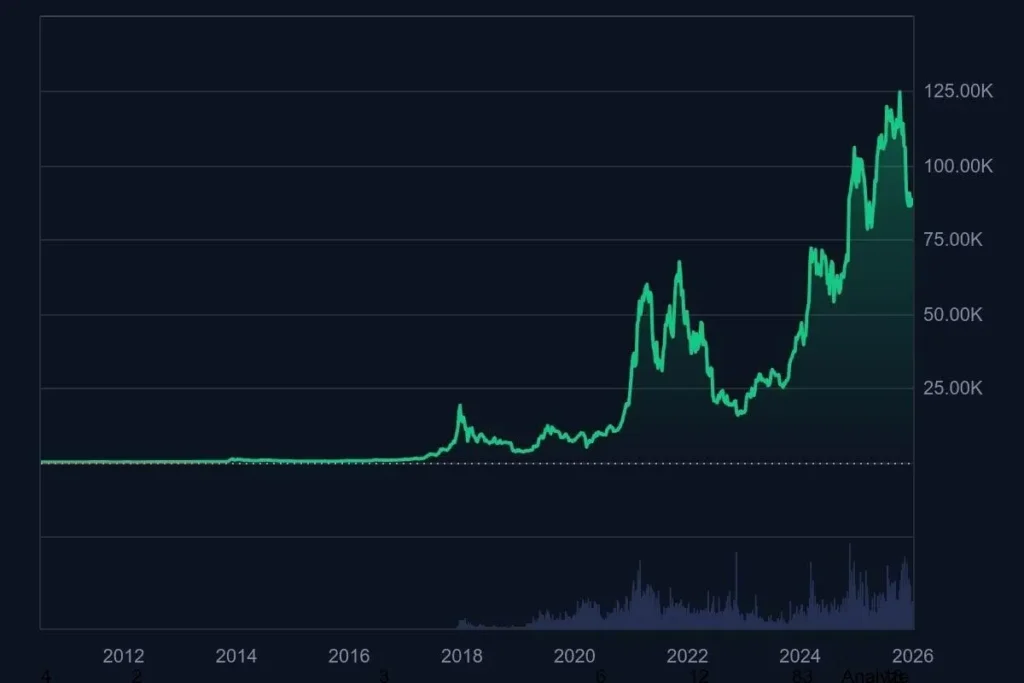
The Core Driver: Institutional Accumulation Is Reshaping Supply Dynamics
1. Bitcoin Is Experiencing a Structural Supply Shock
The most critical force behind Bitcoin’s price appreciation is large-scale accumulation by institutional players—particularly Strategy Inc.
Institutional Benchmark Data (April 2026)
| Metric | Value | Context |
|---|---|---|
| Total BTC Holdings | 815,061 BTC | Corporate filings |
| Average Purchase Price | $75,527 | Internal accounting |
| Market Value | ~$64.39 Billion | Spot price |
| Share of Total Supply | ~3.8% | Blockchain data |
| Unrealized Profit | ~$31.4 Billion | Market analysis |
Why This Matters
This level of accumulation has direct implications for price structure:
- Liquid supply on exchanges is decreasing
- Long-term holding behavior is increasing
- Market depth is tightening
The Strategy Inc Effect: Financial Engineering Meets Bitcoin
2. The Rise of the Bitcoin Treasury Model
Strategy Inc has pioneered a model that is now influencing the broader market.
How the Model Works
- Issue equity (MSTR / STRC shares)
- Raise capital from traditional investors
- Deploy capital into Bitcoin
April 2026 Transaction Snapshot
- Capital raised: $2.54 billion
- BTC acquired: 34,164 BTC
- Average purchase price: $74,395
Why This Model Is So Powerful
- Converts stock market demand into Bitcoin demand
- Operates independently of crypto-native liquidity cycles
- Reinforces long-term accumulation
BTC Yield Growth (2025): +22.8%
Advanced Insight
Higher Bitcoin price → higher stock premium → more capital raised → more BTC purchased
Macro Environment: Bitcoin as a Geopolitical Asset
3. Bitcoin Is Now Sensitive to Global Events
Bitcoin’s approach toward $80K is partially correlated with:
- Potential diplomatic progress between the U.S. and Iran
- Reopening of the Strait of Hormuz
- Stabilization in global energy markets
Why Energy Markets Matter
Bitcoin mining depends heavily on energy costs. When:
- Energy prices stabilize → mining becomes predictable
- Geopolitical risks decline → institutional confidence increases
The result is capital inflow into Bitcoin as a macro hedge.
Bitcoin vs Gold: Converging Narratives
Bitcoin is increasingly behaving like:
- A store of value
- A hedge against macro uncertainty
- A liquidity-sensitive global asset
This reinforces the “Digital Gold” thesis—but with higher upside volatility.
Institutional Flows Are Now Global
4. Europe and Asia Are Driving the Next Phase
🇪🇺 European Market Trends
- €83.13 million in weekly ETF inflows
- Increasing demand for regulated crypto exposure
- Growth in structured investment vehicles
Asian Market Dynamics
- Strong correlation between Bitcoin and equity indices
- Increased participation from sovereign and institutional desks
- Rising demand for alternative assets
Insight:
Bitcoin has officially transitioned into a:
- Global macro asset
- Cross-border investment instrument
- Core component of diversified portfolios
Financial Innovation: The Securitization of Bitcoin
5. Structured Products Are Changing Investor Behavior
Asset manager Calamos introduced a groundbreaking product:
Autocallable UCITS ETF (Launched April 27, 2026)
| Category | Details |
|---|---|
| Target Markets | Europe, Asia, Middle East |
| Expected Yield | ~14% annually |
| Firm AUM | $47 Billion |
What Makes This Important
This product:
- Provides income exposure to Bitcoin
- Uses derivatives to manage downside risk
- Makes Bitcoin accessible to conservative investors
Key Insight:
This marks the beginning of Bitcoin securitization, where:
Bitcoin is no longer just held—it is packaged, structured, and distributed through traditional financial systems.
On-Chain & Market Structure Signals (Advanced Layer)
6. Supply, Liquidity, and Holder Behavior
Although institutional accumulation dominates headlines, on-chain data suggests:
- Exchange reserves are trending downward
- Long-term holders are increasing accumulation
- Short-term volatility is compressing
What This Indicates
- Strong hands are replacing weak hands
- Market cycles are becoming more mature
- Price movements are becoming more data-driven
Bitcoin Price Forecast: Scenarios for 2026
Short-Term (Weeks to Months)
Bullish Scenario:
- Break above $80K
- Target range: $85K–$92K
- Trigger: Continued ETF inflows + institutional buying
Bearish Scenario:
- Rejection at resistance
- Pullback to $72K–$75K
- Trigger: Profit-taking + macro uncertainty
Mid-to-Long Term (2026–2027)
Bitcoin is evolving into:
- A strategic reserve asset
- A digital alternative to gold
- A core institutional allocation
Expert-Level Insight
This cycle differs from 2021 in three major ways:
| 2021 Cycle | 2026 Cycle |
|---|---|
| Retail-driven | Institution-driven |
| High speculation | Structured capital |
| Extreme volatility | Controlled expansion |
Result: Slower rallies—but significantly more sustainable growth
Risks to Watch
To maintain credibility, it’s important to acknowledge risks:
- Over-concentration by large holders (e.g., Strategy Inc)
- Regulatory tightening in key markets
- Macro shocks (interest rates, liquidity crises)
These factors could temporarily disrupt bullish momentum.
FAQ
– Why is Bitcoin rising in April 2026?
- Because institutional investors are accumulating Bitcoin while macro conditions improve.
– Can Bitcoin reach $100,000?
- Yes, if institutional demand and ETF inflows remain strong.
– What is a Bitcoin Treasury Company?
- A company that holds Bitcoin as a primary reserve asset, like Strategy Inc.
– Is Bitcoin becoming less volatile?
- Yes, due to long-term institutional holding and reduced liquid supply.
– What makes this cycle different?
- Institutional dominance, financial structuring, and macro-driven demand.
– Should beginners invest now?
- It depends on risk tolerance, but long-term trends remain structurally bullish.
Conclusion
Bitcoin’s rise toward $80K is not a short-term anomaly—it is the result of a fundamental transformation in market structure.
Institutional capital, innovative financial vehicles, and global macro alignment are reshaping Bitcoin into a core financial asset.
FINANCIAL DISCLAIMER
This article is provided for informational and analytical purposes only. It does not constitute investment, financial, legal, or tax advice. Digital assets are subject to high market volatility and structural risks. Institutional fund flows and historical performance metrics are not reliable indicators of future price performance. Consult a qualified financial advisor before making any investment decisions.