

Blockchain for Beginners: How It Works and Why It Matters 2026 Guide
The global financial system relies heavily on centralized intermediaries. Central banks issue currency, commercial institutions clear transactions, and clearinghouses reconcile ledger discrepancies. While this framework has managed global commerce for centuries, it introduces structural inefficiencies: systemic single points of failure, multi-day settlement delays, opaque fee structures, and rent-seeking intermediaries.
The emergence of distributed ledger technology offers a paradigm shift. At the core of this transformation is a specific technology: a decentralized, immutable, cryptographically secured ledger.
This comprehensive guide to Blockchain for Beginners: How It Works and Why It Matters breaks down the architectural mechanics, cryptographic foundations, and institutional implications of this foundational technology.
1. What is Blockchain? Demystifying the Distributed Ledger
At its architectural core, a blockchain is a peer-to-peer, decentralized database that maintains a continuously growing list of data entries. Unlike a traditional relational database managed by a single corporate or state entity, a blockchain distributes its database across an open network of independent computers, known as nodes.
To understand the core paradigm shift, it is helpful to compare it directly to traditional data storage architectures:
| Architectural Metric | Centralized Relational Database (e.g., SQL, Oracle) | Distributed Ledger Technology (Blockchain) |
| Data Control | Single administrative entity controls all permissions. | Distributed across an open or permissioned peer-to-peer network. |
| Immutability | Entries can be modified or deleted by administrators (CRUD). | Append-only; historical entries cannot be altered without consensus. |
| Trust Model | Requires complete trust in the hosting entity and their security. | Cryptographically enforced; relies on mathematics and network incentives. |
| Settlement Speed | Fast internal processing, but cross-organization reconciliation takes days. | Real-time or near-instantaneous programmatic settlement. |
| Failure Vulnerability | High vulnerability to single-point hardware failures or targeted hacks. | Resilient; requires compromising a majority of distributed network nodes. |
The Separation of Blockchain and Bitcoin
A common misconception among market participants is equating blockchain directly with Bitcoin.
To put it simply: Blockchain is the underlying infrastructure, whereas Bitcoin is the first application built upon that infrastructure. Think of blockchain as the fundamental internet protocols (TCP/IP), and Bitcoin as email (SMTP)—a highly disruptive, pioneering use case, but merely one branch of a much larger architectural tree. Today, modern networks support thousands of distinct applications, from tokenized corporate bonds to sovereign identity solutions.
Key Insight: Triple-Entry Accounting
Traditional commerce operates on double-entry bookkeeping (debits and credits recorded independently by both counterparties). Blockchain introduces triple-entry accounting. The transaction is written directly into a shared, public ledger as a cryptographically signed receipt. This entry is simultaneously verified by the network, eliminating the need for independent, post-transaction manual reconciliation.
2. Structural Mechanics: How Blockchain Works Step-by-Step
To grasp how blockchain works, you must examine the specific mechanics that govern an asset transfer or data update. Every entry on a blockchain undergoes a strict sequence of cryptographic validation and network propagation.
+--------------------+      +-----------------------+      +-----------------------+
|  1. User Signs     |      |  2. Transaction Sent  |      |  3. Validated by      |
|  Transaction with  | ---> |  to the Memory Pool   | ---> |  Distributed Nodes    |
|  Private Key       |      |  (Mempool)            |      |  via Consensus        |
+--------------------+      +-----------------------+      +-----------------------+
                                                                       |
+--------------------+      +-----------------------+                  |
|  6. Ledger Updated |      |  5. Block Appended    |                  v
|  Permanently and   | <--- |  with Previous        | <--- |  4. Transactions      |
|  Broadcasted       |      |  Block's Hash         |      |  Bundled into a Block |
+--------------------+      +-----------------------+      +-----------------------+
Step 1: The Transaction Initiation and Digital Signing
When a user initiates an entry—such as sending a digital asset—they generate a transaction payload detailing the sender, receiver, and amount. This payload must be digitally signed using asymmetric key cryptography. The user utilizes their secret private key to generate a unique digital signature. This signature proves ownership without revealing the underlying private key to the open network.
Step 2: Propagation to the Memory Pool (Mempool)
Once signed, the transaction is broadcasted to the peer-to-peer network. Independent nodes receive the transaction and run initial validation checks to ensure the sending address holds sufficient balance and the digital signature is valid. If these criteria are met, the transaction enters a holding area known as the mempool (memory pool), awaiting inclusion in a future block.
Step 3: Bundling and Block Construction
Network validators (miners or stakers, depending on the network type) aggregate unconfirmed transactions from the mempool and bundle them into a proposed structural unit called a block. Each block has a hard-coded storage capacity limit.
Step 4: Achieving Network Consensus
Before the proposed block can be appended to the ledger, validators must solve a protocol-defined mathematical problem or allocate capital to prove validity. This process is governed by a consensus mechanism. Once a validator successfully proves the block’s validity, the solution is propagated to all other nodes across the network for instant verification.
Step 5: The Cryptographic Chain Formation
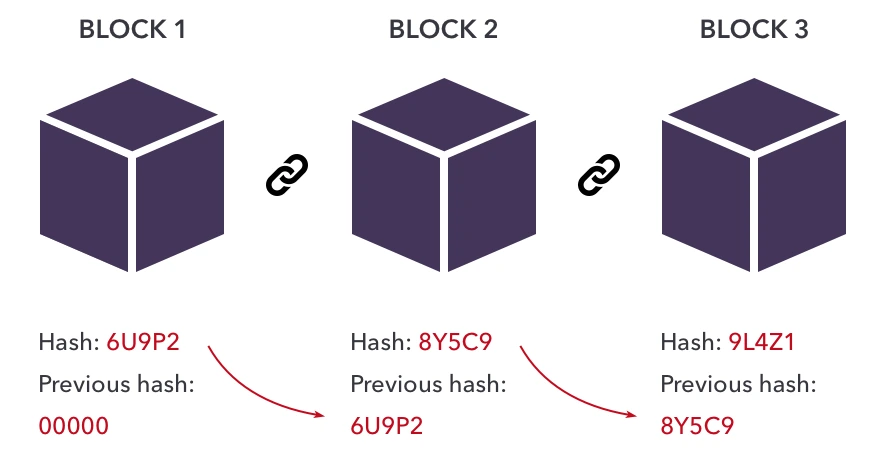
When nodes verify the block, it is permanently appended to the tip of the ledger. Crucially, the header of this new block contains a unique cryptographic hash—a definitive mathematical fingerprint—of the exact block that came immediately before it. This back-linking mechanism creates an unbroken, linear chronological chain of data.
3. Cryptographic Foundations: Hashes and Immutability
The core security architecture of a blockchain depends entirely on advanced mathematics rather than institutional trust or physical security guards.
Cryptographic Hash Functions
A hash function (such as SHA-256) takes an input string of any arbitrary data size and converts it into a fixed-length alphanumeric string.
[Image illustrating the SHA-256 hashing process: an arbitrary text input yielding a unique 64-character hexadecimal output]
This mathematical conversion features three critical characteristics:
- Deterministic Output: The exact same input will always generate the exact same alphanumeric hash string.
- Pre-image Resistance: It is mathematically impossible to reverse-engineer the original input data by analyzing the resulting hash output.
- The Avalanche Effect: If you alter a single character, punctuation mark, or digit in the input data, the resulting hash output changes entirely.
Input A: "Blockchain for Beginners"
SHA-256 Hash: 8f4e2...3a9f (Example string)

Input B: "blockchain for Beginners" (Lowercase 'b')
SHA-256 Hash: c2b1a...9e4d (Completely different string)
The Mathematics of Immutability
This cryptographic chaining explains why historical blockchain data is effectively immutable (tamper-proof).
If a malicious actor attempts to alter a transaction that occurred three years ago in Block 100, the hash of Block 100 changes instantly due to the avalanche effect. Because Block 101 contains the original hash of Block 100 within its structural header, Block 101 becomes invalid. This invalidation cascades sequentially down the entire chain to the current block.
To make the network accept this fraudulent alteration, the attacker would need to recalculate the cryptographic proofs for every single block appended after Block 100, while simultaneously outpacing the computational power of the rest of the distributed network.
4. Consensus Mechanisms: How a Global Network Agrees
A distributed network requires an objective, mathematical method to agree on the true state of the ledger without relying on a central coordinator. This is accomplished via consensus mechanisms. While dozens of variants exist, two dominant frameworks support the modern digital asset ecosystem.
Proof of Work (PoW)
Proof of Work is the consensus mechanism pioneered by the Bitcoin network.
- The Process: Specialized hardware nodes (miners) compete against one another to solve a complex, resource-intensive cryptographic puzzle. The first miner to find the valid solution wins the right to append the next block to the ledger and receives a native protocol reward.
- Security Logic: PoW forces validators to expend real-world capital in the form of electricity and specialized computing hardware. This dynamic makes attacking the ledger prohibitively expensive. To alter history, an attacker must control more than 51% of the network’s total computational power (hash rate).
- Limitations: High energy consumption and physical hardware bottlenecks that restrict transaction throughput.
Proof of Stake (PoS)
Proof of Stake is a modern, energy-efficient consensus mechanism utilized by networks like Ethereum and Solana.
- The Process: The protocol eliminates energy-intensive mining hardware entirely. Instead, participants secure the network by locking up a specific amount of the network’s native cryptocurrency as collateral—a process known as staking. The protocol programmatically selects validators to propose and verify blocks based on the amount of capital they have staked.
- Security Logic: If a validator attempts to approve fraudulent transactions or double-spend assets, a portion or the entirety of their staked capital is permanently destroyed by the protocol through a mechanism called slashing.
- Benefits: Reduces energy requirements by over 99.9% and enables significantly higher transaction speeds and scalability.
5. Architectural Diversity: Types of Blockchain Networks
Not all distributed ledgers are open to the public. Depending on the governance structure, operational goals, and compliance requirements, blockchain networks generally fall into three distinct categories.
Public Blockchains
Public networks are entirely permissionless and open-source. Anyone can download the core node software, review the transaction history, submit transactions, and participate directly in the network’s consensus process. Examples include Bitcoin and Ethereum. These networks rely entirely on built-in economic incentives (tokens) to ensure security and prevent malicious behavior.
Private (Permissioned) Blockchains
Private networks operate under centralized or invite-only governance models. An organization or consortium defines exactly which specific entities are allowed to operate validation nodes, read ledger entries, or submit transactions. These frameworks are heavily utilized by enterprise institutions requiring strict compliance, confidentiality, and predictable performance without exposing sensitive data to the open market.
Hybrid and Consortium Networks
Consortium blockchains distribute governance across a pre-selected group of independent institutions (for example, ten global banks cooperating on an international payment network). This structure combines the architectural resilience of a distributed network with the privacy controls of a centralized system.
6. Beyond Currency: Programmable Infrastructure and Smart Contracts
The true utility of distributed ledger technology expanded dramatically with the introduction of smart contracts—a capability popularized by the launch of the Ethereum network.
Smart Contracts Explained
A smart contract is a self-executing piece of code stored directly on a blockchain. It automatically executes predefined actions when specific, verifiable conditions are met.
[Traditional Agreement] ---> Requires Attorney + Escrow Agent + Bank Reconciliation
[Smart Contract Code]   ---> If Buyer deposits X USD, transfer Digital Asset Y instantly.
Smart contracts eliminate counterparty risk by replacing human intermediaries with predictable code. If an agreement is structured as: “If Party A delivers Asset X by Date Y, then release Funds Z,” the blockchain verifies the fulfillment of the condition and executes the asset transfer automatically without requiring an escrow agent.
Core Ecosystem Applications
- Decentralized Finance (DeFi): Financial applications operating entirely via smart contracts. This allows users to trade, borrow, lend, and earn yield on assets globally without relying on a commercial bank or traditional brokerage house.
- Supply Chain Traceability: Global logistics providers use public or private networks to track products in real time from production to consumption. Every checkpoint, temperature shift, and ownership transfer is permanently recorded, which helps eliminate counterfeit goods and streamline compliance auditing.
- Real-World Asset (RWA) Tokenization: Traditional financial institutions are actively converting real-world assets—including commercial real estate, art, sovereign debt, and private equity—into digital tokens on distributed ledgers. This fractionalizes high-value assets, increases global liquidity, and automates clearinghouse settlement.
7. Operational Trade-offs: A Balanced Evaluation
An institutional-grade analysis requires acknowledging the design trade-offs and structural limitations inherent to distributed network architectures.
Pros: The Advantages of Decentralized Networks
- Trustless Security: Eliminates reliance on single corporate or state entities; the protocol’s integrity is protected by cryptography and decentralized consensus.
- Continuous Availability: Distributed node networks run 24/7/365, eliminating scheduled banking holidays and localized data center outages.
- Audit Efficiency: The immutable history allows regulatory bodies and corporate auditors to verify transactions in real time, drastically reducing backend accounting overhead.
Cons: The Structural Limitations
- The Scalability Trilemma: A foundational concept in computer science stating that a blockchain network can achieve only two of three key properties simultaneously: decentralization, security, or scalability. Maximizing decentralization and security typically results in lower transaction throughput compared to centralized cloud servers.
- Irreversibility Risks: The absence of a centralized customer service department means that if a user loses their private keys or accidentally sends funds to an incorrect address, the assets are permanently unrecoverable.
- Integration Hurdles: Connecting legacy enterprise software (like ERP or SWIFT systems) to decentralized environments requires complex middleware and can introduce operational friction.
FAQ SECTION
– What is blockchain in simple terms?
- A blockchain is a shared, digital ledger that securely records transactions across a distributed network of computers. Because the data is stored in chronological blocks and linked together using cryptography, entries cannot be altered or deleted once verified by the network.
– Is blockchain the same thing as cryptocurrency?
- No. Blockchain is the foundational database infrastructure, whereas cryptocurrency is a digital asset or token that runs on top of that infrastructure. Blockchain technology can store many types of data beyond financial transactions, including supply chain records, legal titles, and digital identity parameters.
– Can a blockchain be hacked?
- While individual smart contracts can contain software bugs and users can lose their private keys to phishing scams, the underlying core architecture of a major public blockchain is highly secure. Altering historical blocks requires a malicious actor to control a massive portion of the network’s validation power (such as a 51% attack), which is economically and logistically impractical on mature networks.
– What are smart contracts and how do they work?
- Smart contracts are self-executing digital agreements written in code and stored on a blockchain. They automatically execute transactions or transfer assets as soon as predefined conditions are met, eliminating the need for third-party intermediaries like lawyers, brokers, or escrow agents.
– Why do enterprises use private blockchains instead of public ones?
- Enterprises typically utilize private or permissioned blockchains because they require absolute data privacy, compliance with regulatory structures (such as GDPR), high transaction speeds, and strict control over who can view or validate network data.
FINANCIAL DISCLAIMER
Educational and Informational Disclaimer: The detailed material presented in this article is provided solely for educational, analytical, and informational purposes. This content does not constitute legal, tax, investment, or financial advice, nor does it represent an endorsement or recommendation to buy, sell, or hold any specific digital asset or participate in any particular investment strategy. Readers are urged to consult with certified professional financial advisors and conduct thorough due diligence before interacting with any digital asset protocols or financial instruments.