

Beyond Bitcoin: Understanding the True Potential of Blockchain Technology
For over a decade, mass media and retail investors have evaluated distributed ledger technology through a single, volatile prism: the spot price of Bitcoin. While cryptocurrency pioneered digital scarcity, viewing the underlying technology solely as a vehicle for speculative native tokens is equivalent to evaluating the early internet exclusively by its ability to send email.
The true potential of blockchain technology is not the creation of volatile alternative currencies; it is the fundamental restructuring of global financial market infrastructure, corporate supply chains, and digital identity management.
By analyzing the architecture of programmable distributed databases, we can see a profound shift occurring across enterprise networks. Speculative trading volumes are being eclipsed by a quieter, far more significant movement: the migration of real-world economic assets onto immutable, shared ledgers.
1. The Architectural Shift: Moving Beyond Speculative Rails
To evaluate the structural capacity of distributed ledgers, one must understand how they resolve the core friction of traditional enterprise database systems: the reconciliation problem.
In a traditional ecosystem, every institution maintains its own isolated database. When an asset changes hands, multiple back-office systems must execute independent adjustments, verify counterparties through intermediaries, and settle transactions over days. This latency introduces counterparty risk, ties up vast pools of capital, and requires intensive manual oversight.
Traditional IT:   [Bank A Database] <--> [Clearing House / Broker] <--> [Bank B Database]
Blockchain Infrastructure:             [Shared Immutable Ledger]
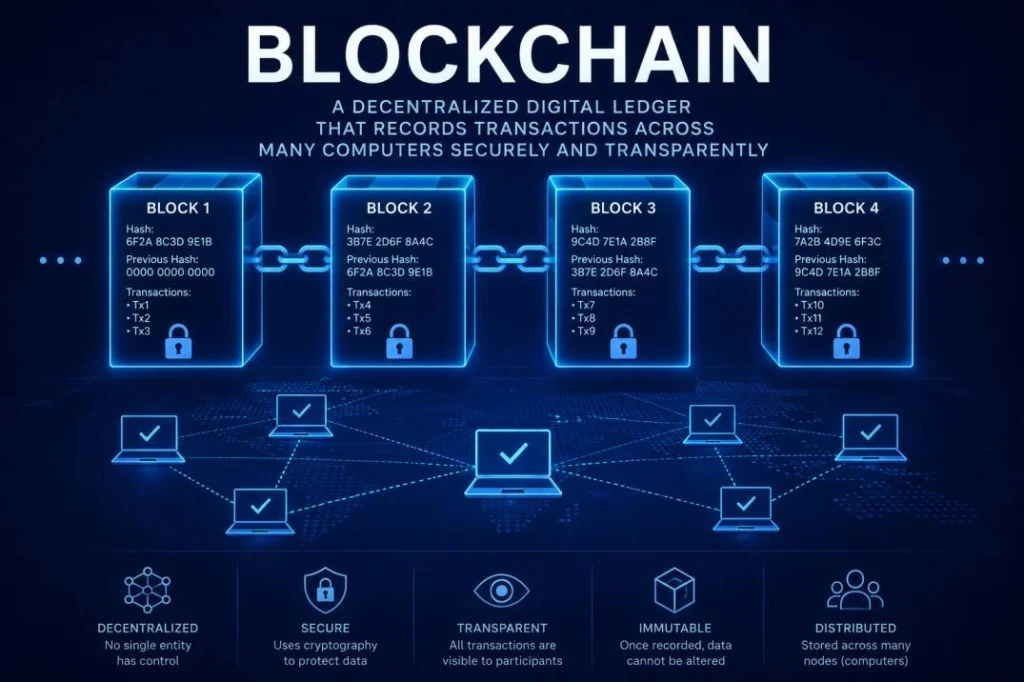
Blockchain transforms this paradigm by establishing a single, immutable source of truth shared among verified network participants. When an action occurs, the state change updates simultaneously across all participating nodes according to hardcoded consensus parameters. This eliminates the need for post-trade reconciliation entirely.
Public, Private, and the Modern Hybrid Reality
The early development phase of enterprise blockchain was characterized by a rigid ideological split between public, permissionless networks (like Ethereum and Solana) and private, permissioned ledgers (like Hyperledger Fabric and R3 Corda). Public networks offered maximum liquidity and global reach but suffered from volatile transaction fees and a lack of data privacy. Private ledgers offered strict compliance and high throughput but resulted in isolated ecosystems—essentially creating high-tech data silos.
In the current market landscape, this binary choice has resolved into a sophisticated hybrid architecture. Enterprises are increasingly deploying application-specific subnets or dedicated Layer-2 environments. These hybrid frameworks run on permissionless infrastructure but utilize a restricted validator set and advanced privacy layers. This allows a corporate treasury or global logistics provider to maintain absolute control over sensitive transaction data while retaining the ability to settle transactions instantly across the open internet.
2. Real-World Asset Tokenization: Unlocking On-Chain Liquidity
The clearest manifestation of blockchain moving beyond digital-native tokens is the exponential expansion of real-world asset tokenization. Tokenization is the process of converting ownership rights of a physical or traditional financial asset into a programmable digital token on a distributed ledger.
Rather than trading speculative memecoins, global financial institutions are tokenizing yield-bearing instruments that they already understand intimately: sovereign debt, commercial paper, private credit, and top-tier equities.
The Institutional On-Chain Landscape
The current distribution of non-crypto assets living on distributed ledgers demonstrates that tokenization is no longer an experimental pilot program. It has scaled into an institutional requirement driven by capital efficiency.
| Asset Category | Dominant On-Chain Underlying | Primary Strategic Driver | Key Infrastructure Providers |
| Sovereign Debt | U.S. Treasury Bills & Short-Term Bonds | Yield capture for on-chain cash, instant 24/7 liquid settlement | Franklin Templeton (Benji), BlackRock (BUIDL), Ondo Finance |
| Private Credit | Home equity loans, corporate credit facilities | Elimination of middle-tier originators, reduction of borrowing friction | Figure (Provenance Blockchain), Centrifuge |
| Commodities | LBMA-certified physical gold bars | Fractional ownership, eliminating physical custody friction for retail | Paxos (PAXG), Tether (XAUT) |
According to consolidated data from institutional analytics platform RWA.xyz, the total value of tokenized real-world assets (excluding fiat-backed stablecoins) has scaled aggressively, with tokenized U.S. Treasuries alone commanding approximately $9.6 billion in on-chain capital. This institutional interest is validated by the World Economic Forum’s digital asset framework, which highlights asset tokenization as a foundational pillar for next-generation capital markets.
Key Insight: Delivery-versus-Payment (DvP) Efficiency
In traditional finance, settling a bond trade requires coordinating the transfer of the security via a central depository while simultaneously moving cash over the SWIFT network or a domestic central bank wire system. This process exposes both parties to settlement risk.
Through blockchain tokenization, both the asset (the tokenized bond) and the payment rail (a regulated stablecoin or deposit token) live on the same ledger. The transaction executes via a smart contract that guarantees Delivery-versus-Payment (DvP): the asset transfers if and only if the payment clears in the exact same ledger block. Settlement latency drops from $T+2$ days to less than two seconds.
3. Programmable Smart Contracts as Automated Business Logic
The engine driving this operational efficiency is the programmable smart contract. Initially conceptualized as simple “if/then” scripts for transferring basic tokens, modern smart contracts function as highly secure, decentralized application servers capable of executing complex business agreements without manual intervention.
When applied to enterprise supply chains or complex financial derivative instruments, smart contracts remove structural friction by automating execution based on cryptographic data verifications.
[Oracle Data Input] ---> [Smart Contract Engine] ---> Auto-Executes:
                                                        - Automated Payment Release
                                                        - Immediate Title Transfer
                                                        - Dynamic Escrow Management
Consider the structuring of a syndicated corporate loan. In a legacy financial environment, distributing interest payments to dozens of institutional lenders requires an army of back-office administrators, compliance checks, and manual wire generations.
On a distributed ledger, the loan’s terms are codified directly into the asset’s architecture. The smart contract automatically calculates interest based on real-time market indexes, verifies the current address of the fractional token holders, handles compliance onboarding checks via digital identity registries, and distributes payments in a single automated step.
Real-World Case Study: Global Trade Logistics
Beyond the financial sector, global shipping lines and manufacturers use smart contracts to optimize multi-party supply chains. When cargo passes through an international port, an IoT (Internet of Things) sensor scans the container’s biological or environmental telemetry.
If the cargo meets the predefined temperature and safety thresholds, the cryptographic data is transmitted to the blockchain via a secure oracle network. The smart contract reads this entry, confirms delivery compliance, and instantaneously releases payment from an escrow account to the logistics provider.
This eliminates billing disputes, minimizes administrative delays at ports of entry, and provides an unalterable audit trail for global customs authorities.
4. The Enterprise Infrastructure Stack: Interoperability and Privacy
As corporations deploy distributed ledger applications at an industrial scale, they face a critical technical challenge: liquidity fragmentation. Because different institutions and jurisdictions build on different blockchain protocols, assets can become trapped within isolated networks.
A tokenized treasury bond minted on an Ethereum Layer-2 cannot natively interact with a trade finance platform running on a hyper-optimized alternate Layer-1 network.
To resolve this fragmentation, the enterprise blockchain stack has shifted its focus from building faster individual base layers to engineering universal interoperability frameworks.
The Interoperability Layer
Protocols such as Chainlink’s Cross-Chain Interoperability Protocol (CCIP) and architectural frameworks like the Canton Network function as secure messaging and capital transport layers between distinct ledgers. They allow institutional back-offices to interact with any public or permissioned blockchain through their existing legacy IT infrastructure.
                 +-----------------------+
                 | Existing Core Banking |
                 +-----------+-----------+
                             |
                             v
               +-------------+-------------+
               |  Interoperability Engine  |
               +------+--------------+-----+
                      |              |
                      v              v
               [Public L2 Network] [Private Ledger]
This structural evolution ensures that an asset manager can maintain an internal registry on a secure, private network while seamlessly broadcasting settlement instructions or pulling liquidity from public, global execution environments.
Overcoming the Corporate Privacy Hurdle via ZKPs
For years, the radical transparency of public blockchains was a non-starter for corporate legal departments. A public ledger meant that competitors could spy on volume metrics, supply costs, and settlement frequencies.
The implementation of Zero-Knowledge Proofs (ZKPs) has completely altered this dynamic. ZKPs are cryptographic protocols that allow one party to prove to another party that a statement is true without revealing any information beyond the validity of the statement itself.
- Corporate Application: A pharmaceutical manufacturer can utilize a zero-knowledge proof to demonstrate to a regulator that a shipped drug batch complies with precise temperature controls and safety mandates without revealing the proprietary chemical formula, the identity of the supplier, or the commercial value of the contract.
- Financial Application: A bank can verify that an investor meets stringent Know Your Customer (KYC) and Anti-Money Laundering (AML) thresholds before granting access to a tokenized bond pool without storing or exposing the investor’s sensitive personally identifiable information (PII) on a public ledger.
5. Systemic Risks, Technical Limitations, and Disadvantages
An institutional-grade evaluation of blockchain technology requires addressing its architectural limitations and structural risks. Distributed ledger technology is not a universal cure-all for enterprise IT inefficiency, and hasty deployments can introduce severe vulnerabilities.
Smart Contract Exploits and Code Vulnerability
Unlike legacy enterprise software which can be quickly patched behind a corporate firewall, smart contract code is public, immutable, and constantly exposed to adversarial analysis. If an engineering team deploys a contract with a subtle logical flaw, malicious actors can drain the underlying collateral pool within seconds. The immutability of the chain means that once capital is extracted via an exploit, it cannot be reversed through an administrative override.
Oracle Failure Modes
A smart contract is only as reliable as the data feeding it. The connection between off-chain physical events and on-chain execution relies on oracles—data aggregators that translate real-world information into cryptographic inputs.
If an oracle network experiences a malicious data injection, an API failure, or a coordination exploit, the dependent smart contract will execute flawlessly based on corrupted data. This creates an institutional vulnerability where attackers don’t exploit the blockchain itself, but rather manipulate the data feeds that trigger automation.
Balanced Architectural Assessment: Pros vs. Cons
PROS                                 CONS
----------------------------------   ----------------------------------
• Elimination of reconciliation costs • High upfront integration complexity
• Atomic settlement (Zero counter-    • Immutable code risks (Exploits
  party risk)                          cannot be easily rolled back)
• Enhanced compliance via on-chain   • Oracle dependencies create point-
  programmable restrictions            of-failure vulnerabilities
• Fractionalization unlocks asset    • Complex multichain governance and
  liquidity                            regulatory fragmentation
6. Regulatory Frameworks: The Catalyst for Enterprise Adoption
The historic barrier to institutional enterprise blockchain deployment was never technical capability; it was regulatory uncertainty. Compliance officers refused to allocate capital or migrate core operations to systems lacking clear legal definitions.
This structural bottleneck is dissolving due to the implementation of comprehensive, global digital asset frameworks.
In Europe, the Markets in Crypto-Assets (MiCA) regulation has established a clear, unified legal framework across member states. MiCA provides explicit guidelines for stablecoin issuers, asset tokenization structures, and crypto-asset service providers (CASPs). This comprehensive rulebook gives traditional asset managers the legal certainty required to launch production-grade on-chain products.
Simultaneously, in the United States, targeted regulatory actions and legislative updates, such as the joint SEC and CFTC interpretations categorizing digital tools and stablecoins, have provided a clearer operational path. Major banking entities are no longer operating in a legal vacuum; they are structuring digital asset treasuries and tokenization platforms under the explicit oversight of federal securities laws.
7. The Forward Outlook: A Multi-Trillion Dollar Infrastructure Migration
The true potential of blockchain technology lies in its capacity to serve as the unified, programmable ledger for global commerce. As legacy databases reach the limits of their efficiency, the transition to distributed, immutable infrastructure appears inevitable.
Over the coming cycle, we expect to see the consolidation of tokenization standards, the widespread adoption of zero-knowledge privacy layers by enterprise networks, and the routine use of atomic settlement for cross-border institutional payments.
Organizations that continue to view blockchain as a speculative sideshow risk falling behind an infrastructure overhaul that is quietly optimizing capital efficiency across the global economy.
8. Strategic Action Plan: Building Topical Authority
To position an enterprise publication or digital media ecosystem at the forefront of this structural transformation, content teams must move past retail-focused headlines and establish clear topical authority around deep infrastructure engineering.
Pillar Architecture & Cluster Map
                [PILLAR: Digital Financial Market Infrastructure]
                                   |
         +-------------------------+-------------------------+
         |                                                   |
         v                                                   v
[Cluster: Tokenization Mechanics]                 [Cluster: Cross-Chain Security]
- Atomic Settlement / DvP                         - Chainlink CCIP vs. Canton
- Legal SPV Structuring                           - Oracle Manipulation Defense
- Collateralization Metrics                       - Zero-Knowledge Compliance
Strategic Action Items:
- Prioritize Information Gain: Avoid publishing generic overviews of what a blockchain is. Instead, produce technical teardowns of live enterprise deployments, complete with network throughput metrics, gas optimization profiles, and structural risk models.
- Incorporate Enterprise Callouts: Frame content using real-world asset metrics, institutional distribution percentages, and direct references to established legislative acts (like MiCA).
- Optimize Internal Anchors: Ensure all cluster articles utilize keyword-rich anchor text linking back to the central infrastructure pillar to signal comprehensive topical depth to search engine crawlers.
FAQ SECTION
– What is the primary difference between a traditional database and a blockchain?
- A traditional database uses a centralized architecture where a single administrator controls, modifies, and validates entries. A blockchain uses a distributed ledger where data is replicated across an independent network of nodes. Changes are executed via cryptographically secure consensus mechanisms, producing an unalterable, shared source of truth that completely eliminates the need for post-trade manual reconciliation.
– How does asset tokenization create capital efficiency for institutions?
- Asset tokenization allows physical and financial assets to be split into digital tokens on a distributed ledger. This enables fractional ownership, reduces entry barriers for investors, and eliminates intermediaries. Most importantly, it supports atomic settlement via smart contracts—ensuring that assets and payments transfer simultaneously. This drives down settlement times from days ($T+2$) to seconds, unlocking vast pools of capital previously tied up in settlement queues.
– What are zero-knowledge proofs (ZKPs) and why do enterprises need them?
- Zero-knowledge proofs are advanced cryptographic protocols that allow one party to prove that a specific statement is true without revealing any underlying data. Enterprises require ZKPs to protect commercial privacy on shared ledgers. They allow companies to verify regulatory compliance, confirm financial transactions, or validate supply chain metrics without exposing sensitive proprietary data, pricing structures, or personally identifiable information to competitors.
– What is an oracle in blockchain technology and what risk does it introduce?
- An oracle is a bridge infrastructure that fetches, verifies, and delivers real-world data to a blockchain network, allowing smart contracts to interact with external events. The risk it introduces is known as the “oracle problem.” If an oracle feed is compromised, manipulated, or suffers an outage, the dependent smart contract will automatically execute based on that faulty data, creating a critical point of vulnerability for the system.
– How do global regulatory frameworks impact enterprise blockchain use?
- Global regulatory frameworks like Europe’s Markets in Crypto-Assets (MiCA) regulation provide clear, standardized rules for digital asset custody, token issuance, and compliance. This legal certainty eliminates the regulatory risks that previously prevented traditional institutions from deploying production-grade blockchain solutions, clearing the path for scaled enterprise integration and product development.
FINANCIAL DISCLAIMER
Professional Disclaimer: The analysis provided in this article is for informational, educational, and search engine optimization profiling purposes only. It does not constitute financial, legal, tax, or investment advice. Distributed ledger deployments and digital asset allocations involve substantial technological and regulatory risks. Readers should consult with accredited financial advisors and legal experts before making any structural enterprise infrastructure decisions or digital asset capital allocations.