The Mechanics of the Global Macro Liquidity Cycles
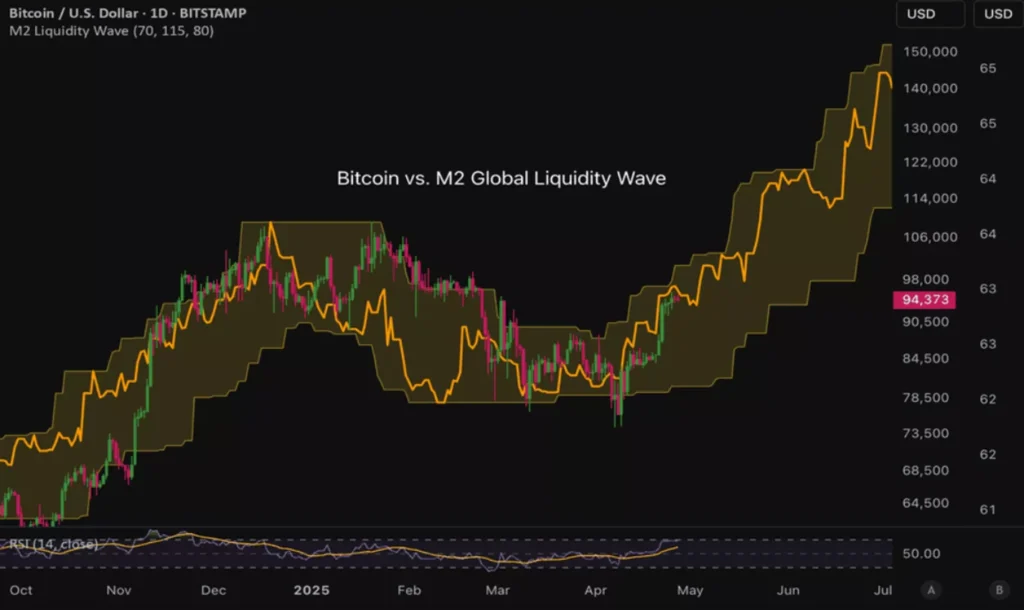
To analyze digital asset valuations through a macro lens, we must first break down the concept of global macro liquidity cycles. Aggregate global liquidity is not an abstract sentiment metric; it is the total volume of instantly deployable fiat capital circulating across the world’s major economies. This metric is derived from the combined balance sheets of the big four central banks—the Federal Reserve, the European Central Bank (ECB), the Bank of Japan (BoJ), and the People’s Bank of China (PBoC)—along with commercial bank credit expansions.
Global Liquidity = Central Bank Balance Sheets + Commercial Bank M2 Credit - Fiscal Cash Reserves
When central banks expand their balance sheets or lower reserve requirements, commercial bank credit expands, leading to an acceleration in the global M2 money supply.
Historically, this excess capital cascades through the financial system based on risk profiles. It moves from government bonds to corporate debt, then to large-cap equities, and finally to the most speculative end of the risk curve: digital assets. Because Bitcoin operates with a fixed supply cap, it does not suffer from debasement when fiat supply swells. Instead, it acts like a high-beta vehicle for global liquidity, absorbing excess capital far more intensely than traditional equities or gold.
       [Central Bank Easing / M2 Expansion]
                        │
                        ▼
            [Commercial Bank Reserves]
                        │
                        ▼
         [Equities & Corporate Credit]
                        │
                        ▼ (60-90 Day Transmission Lag)
       [Crypto Asset Market Valuations]
This transmission mechanism is rarely instant. Cross-correlation modeling reveals a structural delay between initial monetary expansion and its visible impact on crypto asset valuations. This delay stems from the path money takes as it flows through primary dealers and commercial banking layers before individual allocators deploy capital into digital assets.
Understanding this delay explains why short-term price action often seems disconnected from headline macro indicators.
Deconstructing the Relationship Between M2 Supply and Crypto Market Valuations
The correlation between M2 supply and crypto market valuations relies on structural changes in global purchasing power. When global M2 expands, the purchasing power of individual fiat units declines. This forces both retail and institutional capital into scarce assets to preserve purchasing power.
               M2 Expansion vs Crypto Market Cap
  Global M2
  (Trillions)                                               Crypto Cap
    $120T ───────────────────────────────────────────► (Accelerating)
          │                                           ▲
          │    60-90 Day Transmission Window          │
    $110T ┼─────────────────┐                         │
          │                 ▼                         │
    $100T ┼──────────► [Liquidity Tap] ───────────────┘
          │
          └───────────────────────────────────────────► 2017 / 2020 / 2024
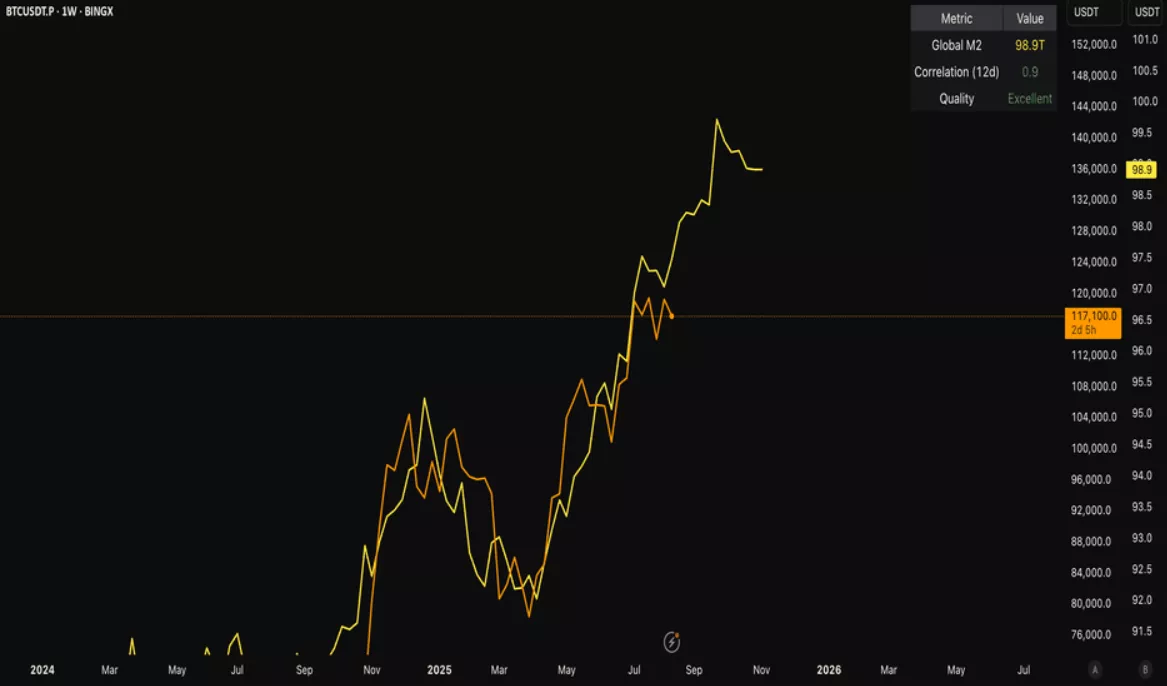
During major liquidity expansions, the rolling correlation between log changes in Bitcoin’s price and global M2 trends upward, often hovering between $0.80\text{ and }0.95$.
However, this long-term alignment does not move in a straight line. The market structure of early 2026 highlights a distinct divergence: global M2 pushed past $\$120$ trillion, expanding at an annualized clip above $10\%$, while digital assets consolidated within a broad range.
This break in correlation has split macro analysts into two camps:
- The Monetary Easing Bull Case: Institutions like Fidelity Digital Assets maintain that this divergence is temporary. They point to the conclusion of the Federal Reserve’s quantitative tightening (QT) program and a synchronized global rate-cutting cycle as forces that will inevitably pull crypto valuations higher to match the expanded money supply.
- The Structural Regime Shift Shift: Other asset managers argue that the correlation is changing because structural forces—such as massive Treasury bill issuance and changing corporate balance sheet strategies—have altered how liquidity flows through the system.
The Institutional Playbook: Tracking the Fed Net Liquidity Index
While global M2 offers a valuable broad view, systematic crypto trading desks rely on a more precise metric: the Fed Net Liquidity Index. This index isolates the capital actually moving through the U.S. financial system by adjusting the raw size of the Federal Reserve balance sheet for fiscal operations that lock up capital.
The index is calculated using the following formula:
$$\text{Fed Net Liquidity} = \text{Fed Total Assets} – \text{Treasury General Account (TGA)} – \text{Reverse Repurchase Agreements (RRP)}$$
- The Treasury General Account (TGA): This is the U.S. government’s operating account at the Fed. When the Treasury hoards cash (increasing the TGA), it pulls liquidity out of commercial banking reserves. Conversely, when the government spends this cash, the TGA falls, flushing capital directly back into the market.
- Reverse Repurchase Agreements (RRP): The RRP facility allows money market funds to park excess cash overnight at the Fed. Capital stuck in the RRP is effectively sterilized, meaning it cannot flow into financial assets. When RRP balances decline, that cash returns to bank reserves, serving as a stealth liquidity injection.
       [ Fed Total Balance Sheet Assets ]
                       │
        ─── Deduct Fiscal Drags ───
                       │
                       ├──► [ Treasury General Account (TGA) ]
                       │
                       └──► [ Reverse Repo Balances (RRP) ]
                       │
                       ▼
          [ Fed Net Liquidity Index ]
                       │
                       ▼ Direct Injection
         [ Commercial Banking Reserves ]
                       │
                       ▼ High-Beta Absorption
       [ Crypto Asset Market Valuations ]
Since 2021, shifts in these fiscal channels have outpaced pure balance sheet fluctuations. For example, even during periods when the Fed pursued quantitative tightening, net market liquidity often stayed flat or rose because the Treasury drew down the TGA or cash drained from the RRP facility.
Institutional desks track day-to-day changes in these components to spot turning points ahead of broad market realizations.
DXY Inverse Velocity and the Fiat Debasement Signal
A key indicator of global macro liquidity cycles is the relationship between digital assets and the U.S. Dollar Index ($DXY$). The $DXY$ measures the value of the greenback against a basket of major foreign currencies. Because Bitcoin is priced in dollars globally, it naturally shares an inverse relationship with the dollar.
$$\text{Crypto Valuation Momentum} \propto \frac{1}{\Delta \text{DXY Velocity}}$$
When the $DXY$ falls, it typically signals that international dollars are becoming more abundant and cheaper, which encourages capital to move into risk assets. To accurately track liquidity, macro analysts evaluate the DXY inverse velocity. This metric looks past simple price moves to measure how quickly capital is exiting the dollar system and moving into global risk assets.
               [ DXY Weakness / Declining Velocity ]
                                │
          ┌─────────────────────┴─────────────────────┐
          ▼                                           ▼
[Global Dollar Abundance]                  [Emerging Market Credit Expansion]
          │                                           │
          └─────────────────────┬─────────────────────┘
                                ▼
               [ Cross-Border Liquidity Surges ]
                                │
                                ▼
               [ Outperformance of Scarce Assets ]
When the velocity of the inverse $DXY$ accelerates, it indicates that global institutions are actively putting cash to work rather than hoarding safe-haven dollars. This shift is particularly influential for altcoins, which generally require a weak dollar and strong global credit conditions to outperform.
Systemic Risks, Structural Limits, and the Evolving Landscape
The thesis that global liquidity inevitably lifts all digital assets faces several structural limitations. As the crypto market grows and matures, its relationship with macroeconomic cycles changes.
The dynamic between crypto and liquidity carries specific structural trade-offs:
- Pros:
- Asymmetric Upside: Crypto remains highly sensitive to global liquidity shocks, offering structural outperformance during central bank expansion cycles compared to traditional equities.
- Predictable Transmission Leads: The $60\text{ to }90\text{-day}$ transmission delay allows systematic traders to adjust their risk exposure using leading macro data.
- Clear Valuation Floors: Net liquidity calculations offer reliable support levels for major digital assets during market drawdowns.
- Cons:
- Severe Downside Exposure: High sensitivity to liquidity cuts both ways. When central banks drain liquidity or the Treasury builds up its cash reserves, digital assets often experience sharp deleveraging events.
- Changing Structural Sensitivity: The launch of spot ETFs and the arrival of institutional capital have altered how crypto responds to macro shifts. Price-insensitive inflows have dampened its historical volatility, reducing its overall responsiveness to liquidity expansions.
- Idiosyncratic Regulatory Risks: Macro liquidity provides fuel, but local regulatory crackdowns, exchange failures, or technological risks can cut off transmission channels entirely.
For example, the market structure of 2026 has been reshaped by the refinancing demands of the U.S. Treasury, which faces massive debt rollover obligations. This dynamic prompts substantial short-term T-bill issuance, pulling capital away from traditional banking reserves and altering how liquidity flows into risk assets.
Furthermore, any sudden unwinding of global currency carry trades, or unexpected shifts in international capital controls, can distort historical correlation models. This makes relying on a single macro indicator highly risky for portfolio management.
FAQ SECTION
– How does the global M2 money supply directly impact the price of Bitcoin?
- The global M2 money supply impacts Bitcoin by altering the purchasing power of fiat currency. When global M2 expands, central banks inject liquidity into the financial system, lowering the cost of capital. This excess cash flows down the risk spectrum. Because Bitcoin has a fixed supply cap, it acts as a liquidity sponge, capturing a proportional share of this expanding fiat capital and driving valuations higher.
– What is the typical transmission lag between liquidity injections and crypto market moves?
- Historical cross-correlation analysis indicates a transmission lag of 60 to 90 days (approximately 13 weeks) between initial central bank balance sheet expansion or fiscal injections and visible trends in crypto asset valuations. This delay represents the time it takes for capital to move through commercial banking rails and primary dealers into risk-tolerant allocation funds.
– Why should crypto investors track the Fed Net Liquidity Index instead of just the total Fed balance sheet?
- Investors should track the Fed Net Liquidity Index because the total balance sheet fails to account for fiscal actions that lock up or free up cash. By subtracting the Treasury General Account (TGA) and Reverse Repurchase Agreements (RRP) from the Fed’s total assets, the Net Liquidity Index measures the actual capital available in commercial bank reserves to fund risk assets.
– Does a falling U.S. Dollar Index (DXY) guarantee a crypto market rally?
- A falling $DXY$ does not guarantee a crypto market rally, but it establishes a strong tailwind. A declining $DXY$ signifies global dollar abundance and expanding cross-border credit. When this weakness is paired with an accelerating DXY inverse velocity, it demonstrates that capital is leaving safe-haven fiat positions and actively entering speculative, scarce digital assets.
– How have spot ETFs altered Bitcoin’s historical sensitivity to macro liquidity cycles?
- Spot ETFs have reduced Bitcoin’s sensitivity to macro liquidity cycles by introducing structurally steady, price-insensitive institutional capital. This institutional presence acts as a stabilizing force, muting historical volatility and reducing the asset’s beta relative to sudden changes in central bank balance sheets.
FINANCIAL DISCLAIMER
Regulatory and Market Risk Disclosure: The analysis provided in this publication is intended strictly for informational and educational purposes. It does not constitute investment, financial, or trading advice. Digital assets, including Bitcoin and alternative cryptocurrencies, are subject to extreme market volatility, regulatory uncertainty, and structural technological risks. Performance patterns observed in past macro liquidity cycles do not guarantee future results.
Consult a registered financial advisor or conduct thorough due diligence before making capital allocations. The author and the publication maintain no liability for direct or consequential financial losses resulting from the use of this data.