Landmark “Digital Commodity” Classification: The New Institutional Standard for XRP
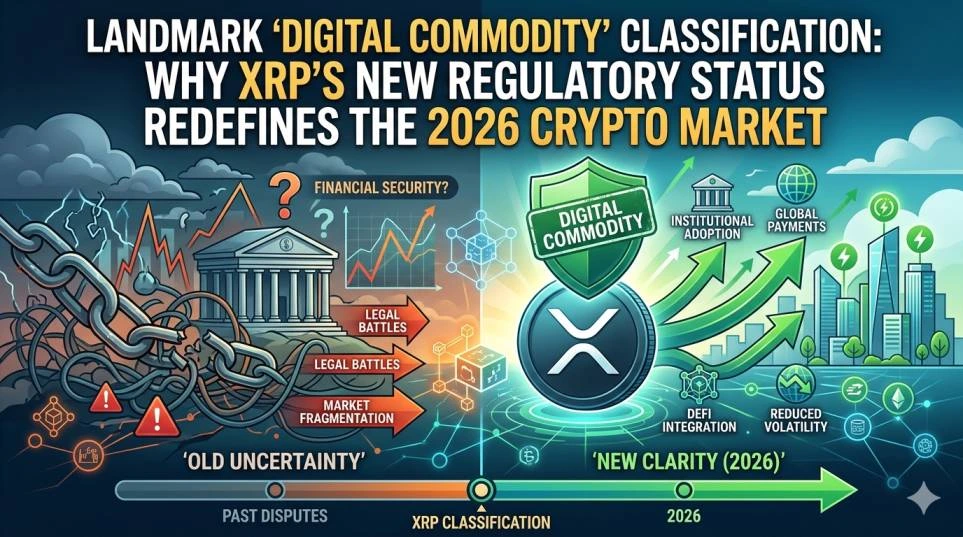
In late March 2026, the landscape of the American digital asset market underwent its most significant transformation since the inception of Bitcoin. Following a joint release by the SEC and CFTC, XRP was formally recognized as a “digital commodity.” This Landmark “Digital Commodity” Classification effectively ended a decade of “regulation by enforcement,” placing XRP on the same regulatory footing as Bitcoin and Ether.
The move was part of a broader 68-page crypto taxonomy framework that categorized 16 digital assets—including Solana, Cardano, and Chainlink—as commodities. For XRP, however, the implications are uniquely structural, given its primary use case as a global bridge for institutional liquidity.
The Regulatory Pivot: SEC and CFTC Unified Stance
For years, the “Howey Test” was applied to XRP with varying degrees of success and controversy. The 2026 joint ruling finalized the debate by defining a Digital Commodity as an asset whose value is derived from the operation of its network and supply-demand dynamics, rather than expectations of profit from a central management team.
Key Takeaways from the Joint Release:
- Legal Finality: XRP is no longer classified as an investment contract in secondary market transactions.
- Jurisdictional Clarity: Oversight shifts primarily to the CFTC for spot market conduct, while the SEC retains authority over “Digital Securities” (ICOs/initial raises).
- ETF Pathway: The classification removes the “security risk” hurdle, streamlining the approval for leveraged and inverse XRP exchange-traded products.
Institutional Impact: The “Goldman Effect”
The immediate result of the Landmark “Digital Commodity” Classification was a surge in institutional confidence. By April 2026, 13F filings revealed that Goldman Sachs had disclosed a $153.8 million position in spot XRP ETFs. This level of exposure was previously unthinkable for a Tier-1 bank while the “security” label loomed.
| Metric | Q4 2025 (Pre-Classification) | April 2026 (Post-Classification) |
| XRP ETF Monthly Inflows | $31.1M (Outflow) | $81.6M (Inflow) |
| Daily XRPL Transactions | 1.1 Million | 3.0 Million |
| Institutional Holders (Top 30) | $45 Million | $211 Million |
Pro Tip: Watch the $1.50 “Cup and Handle” neckline. Technical analysis suggests that with the commodity status confirmed, XRP is no longer trading purely on legal news but is re-correlating with macro liquidity cycles.
The Utility Shift: XRP as the Liquidity Bridge
While the classification provided the legal “green light,” the fundamental value of XRP in 2026 is being driven by the XRP Ledger’s (XRPL) role in the “multi-moneyverse.”
- RLUSD Integration: Ripple’s USD-pegged stablecoin (RLUSD) now acts as the “fiat leg,” while XRP functions as the bridge asset to move that value across borders instantly.
- Tokenized Real-World Assets (RWAs): Over $474 million in RWAs are now tokenized on the XRPL. The Landmark “Digital Commodity” Classification allows these assets to be traded against a regulated commodity (XRP) rather than an uncertain security.
Risks and Technical Limitations
Despite the bullish regulatory news, XRP faces significant headwinds:
- The Escrow Overhang: Ripple continues to unlock 1 billion XRP monthly. In May 2026, the post-release escrow still holds over 33 billion tokens, creating constant sell-side pressure.
- SMA Resistance: As of May 5, 2026, XRP is trading around $1.40—well above its SMA-50 ($1.45) but significantly below its SMA-200 ($2.13). A sustained move above $1.60 is required to confirm a long-term trend reversal.
FAQ SECTION
– What does the Landmark “Digital Commodity” Classification mean for retail investors ?
- It provides “safe harbor” status. Retail investors can trade XRP on U.S. exchanges without fear of delisting due to regulatory shifts, ensuring deeper liquidity and tighter spreads.
– How does this classification affect the XRP ETF ?
- It simplifies the “S-1” filing process. Since the SEC has already established a precedent with Bitcoin and Ether (both commodities), XRP ETFs are now judged on market maturity and anti-manipulation standards rather than the nature of the asset itself.
– Does this mean Ripple’s legal battles are over ?
- The commodity classification makes the SEC’s previous appeals largely moot. While minor procedural points may remain, the core question—whether XRP is a security—has been settled in favor of a commodity status.
– Will this lead to an XRP price of $10 or more ?
- While regulatory clarity is a catalyst, price is still bound by market cap and supply. For XRP to reach $10, it would require a market cap exceeding $500 billion, necessitating massive adoption by central banks for settlement.
FINANCIAL DISCLAIMER
This article is for informational purposes only and does not constitute financial, legal, or investment advice. Crypto assets are highly volatile. The 2026 regulatory environment is subject to change based on new legislative acts or judicial reviews.