Volatility Squeeze and On-Chain Warnings: Decoding the XRP Price Standoff
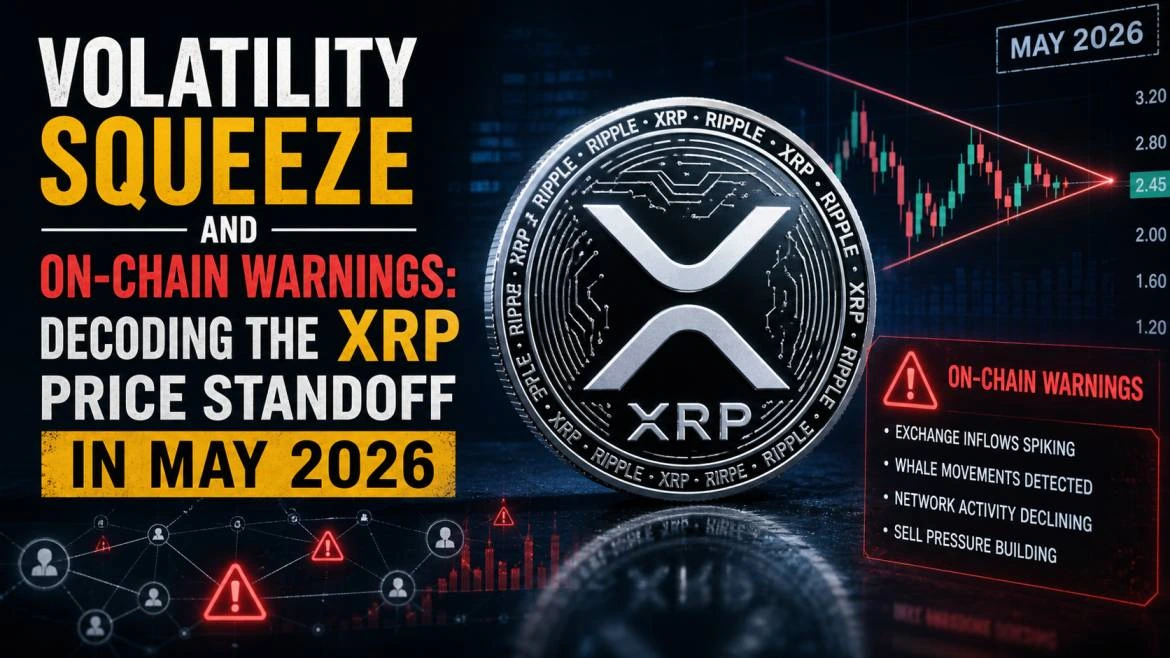
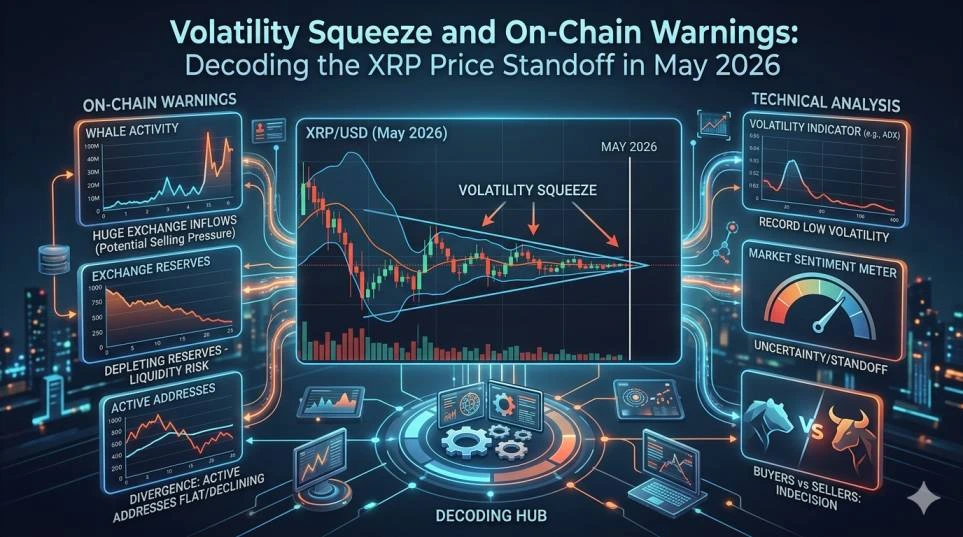
Volatility Squeeze and On-Chain Warnings characterized the majority of XRP’s market action throughout April 2026. While the broader market looked toward the “Digital Commodity” classification as a catalyst for immediate verticality, price action remained uncharacteristically suppressed. Technically, XRP spent most of April in a “volatility squeeze,” trading primarily between $1.30 and $1.50. This compression suggests a massive buildup of energy, typically preceding a move of 20% or more.
However, the nature of that move remains contested. While institutional buying via spot ETFs reached new highs, on-chain metrics flashed a warning on April 26 when exchange inflows spiked by 55 million XRP in a mere 48 hours. This 12-fold increase over the month’s baseline signaled significant sell-side pressure from whales, creating a complex tug-of-war between legacy holders and new institutional entrants.
Analyzing the Volatility Squeeze and On-Chain Warnings of April 2026
The $1.30–$1.50 range has become a psychological and technical battleground. In technical terms, the Bollinger Bands on the daily timeframe reached their tightest levels since late 2025. A volatility squeeze occurs when market participants are in disagreement over the next directional move, resulting in low-volume consolidation.
The Institutional Floor
Throughout this squeeze, institutional demand provided a relentless bid. With over $81.6 million in net inflows for the month, the “ETF Absorption Floor” prevented a breakdown below the $1.30 support level. For every million XRP sent to exchanges by whales, institutional desks like Bitwise and Franklin Templeton appeared to be on the other side of the trade, neutralizing the potential for a catastrophic slide.
Interpreting On-Chain Warnings: The April 26 Inflow Spike
The most significant data point of the second quarter occurred in late April. The 55 million XRP inflow to centralized exchanges was the largest single-day spike in nearly 18 months. When Volatility Squeeze and On-Chain Warnings appear simultaneously, it usually indicates that “Smart Money” is repositioning.
Why Did Whales Move?
Three primary theories explain this 12-fold increase in sell-side pressure:
- De-risking Before the CLARITY Act Vote: Large holders may be locking in profits ahead of the Senate’s final decision on the Digital Asset Market CLARITY Act, preferring the certainty of fiat over the “62% odds” of a legislative win.
- Tax-Quarter Rebalancing: Institutional whales and family offices often rebalance their crypto exposure at the end of April to cover capital gains liabilities.
- Liquidity Provision for ETFs: Some “market-maker whales” move XRP to exchanges specifically to facilitate the creation of ETF units for the likes of BlackRock and Bitwise.
Institutional Accumulation vs. Whale Distribution
The divergence between on-chain warnings and fundamental news is striking. While 55 million XRP moved to exchanges, the “Address Count” for wallets holding 1 million to 10 million XRP actually increased by 2.4% in the same period. This suggests that the “Whale Inflow” was concentrated among a few ultra-large holders (the “Humpbacks”), while mid-tier institutional “Whales” continued to accumulate.
Technical Outlook: Breaking the Squeeze
To resolve the Volatility Squeeze and On-Chain Warnings, XRP must break the $1.55 resistance level on high volume. A daily close above this mark would likely trigger a “Short Squeeze,” as the low-volatility environment has led to a buildup of leveraged positions near the $1.50 ceiling.
- Support Level 1: $1.30 (Multi-month floor)
- Support Level 2: $1.15 (The 200-day SMA)
- Resistance Level 1: $1.55 (The Squeeze ceiling)
- Resistance Level 2: $1.88 (Target for May 2026)
Risk Analysis: Pros, Cons, and the “Liquidity Vacuum”
The Bull Case (Pros):
- Squeeze Resolution: Historically, the longer the squeeze, the more violent the breakout.
- Absorption: The fact that 55 million XRP did not dump the price below $1.30 proves the strength of institutional demand.
- Regulatory Tailwinds: The CLARITY Act remains the most potent upside catalyst in the market.
The Bear Case (Cons):
- Whale Fatigue: If exchange inflows continue at 12-fold levels, the “ETF Floor” may eventually crack.
- Macro Headwinds: Federal Reserve hawkishness regarding the 2026 inflation target could dry up the liquidity required to resolve the squeeze upward.
Key Insight: Retail traders should watch the “Exchange Net Flow” metric. If we see a reversal—where XRP begins leaving exchanges in 10M+ daily clips—it will signal that the whale distribution phase has ended, clearing the path for the next leg up.
FAQ SECTION
– What is a “Volatility Squeeze” in the context of XRP ?
- A volatility squeeze occurs when XRP’s price trades within a very narrow range (currently $1.30–$1.50), causing technical indicators like Bollinger Bands to contract. This usually precedes a major directional price movement.
– Should the 55 million XRP inflow spike on April 26 worry investors ?
- It is an on-chain warning that large holders (whales) are moving assets to exchanges to sell or rebalance. While it creates sell-side pressure, the high level of institutional ETF buying has so far absorbed this volume without a major price crash.
– How do institutional ETFs affect these on-chain warnings ?
- In 2026, spot ETFs act as a “Liquidity Vacuum.” When whales send XRP to exchanges, the ETFs often buy that supply to satisfy investor demand, which stabilizes the price even during high-volume sell-offs.
– What are the critical price levels to watch in May 2026 ?
- The key support is $1.30. If XRP breaks below this on high volume, it could signal a deeper correction. The key resistance is $1.55; breaking above this would signal a bullish resolution to the volatility squeeze.
– Why is the “Whale Inflow” 12 times higher than usual ?
- This increase is likely due to a combination of institutional de-risking ahead of legislative votes (CLARITY Act) and large-scale rebalancing by early adopters who are diversifying into the now-regulated XRP ETFs.
FINANCIAL DISCLAIMER
This analysis is for informational purposes only. The technical patterns and on-chain data discussed—including the Volatility Squeeze and On-Chain Warnings—do not guarantee future price performance. Crypto assets involve high risk, and whales often move funds to exchanges for reasons other than selling (such as staking or collateral). Consult a financial professional before trading.