TRON (TRX) Ecosystem Expansion: The Financial Rail for the 2026 Emerging Economy
Throughout the first five months of 2026, the TRON Ecosystem Expansion has redefined the network’s identity. No longer viewed primarily through the lens of speculative digital assets, TRON has emerged as an indispensable financial rail for global emerging markets. While the broader market has faced volatile liquidity cycles, the TRON network has operated with the cold efficiency of a central bank ledger, focusing on a three-pillar strategy: stablecoin monopoly, regulatory maturation, and quantum-resilient infrastructure.
The $0.32 Stability Paradox: Why TRX Price Action Belies Network Growth
The most striking data point of 2026 is the uncharacteristic “stablecoin-like” behavior of the native TRX token. Trading steadily between $0.32 and $0.34, the asset’s price action masks a massive surge in economic throughput. In traditional equity markets, low volatility often suggests stagnation; in the TRON ecosystem, it signifies a transition into a utility-driven “commodity” phase.
Velocity Over Volatility
In Q1 2026, TRON’s network fees reached $82.2 million, ranking it consistently among the top two revenue-generating protocols globally. The price stability at $0.34 is a direct result of the ecosystem’s mature burn mechanics. As transaction volume scales—averaging 8 million transactions per day—the rate of TRX being burned for energy and bandwidth almost perfectly offsets the issuance to Super Representatives (SRs).
Key Insight: The $0.32–$0.34 range has become a psychological and fundamental “value floor.” This stability has encouraged institutional treasuries to hold TRX as a productive asset rather than a speculative play, knowing that the “gas” for the world’s most used stablecoin rail will maintain its purchasing power.
The Stablecoin Monopoly: USDT on TRON as the Global Dollarization Tool
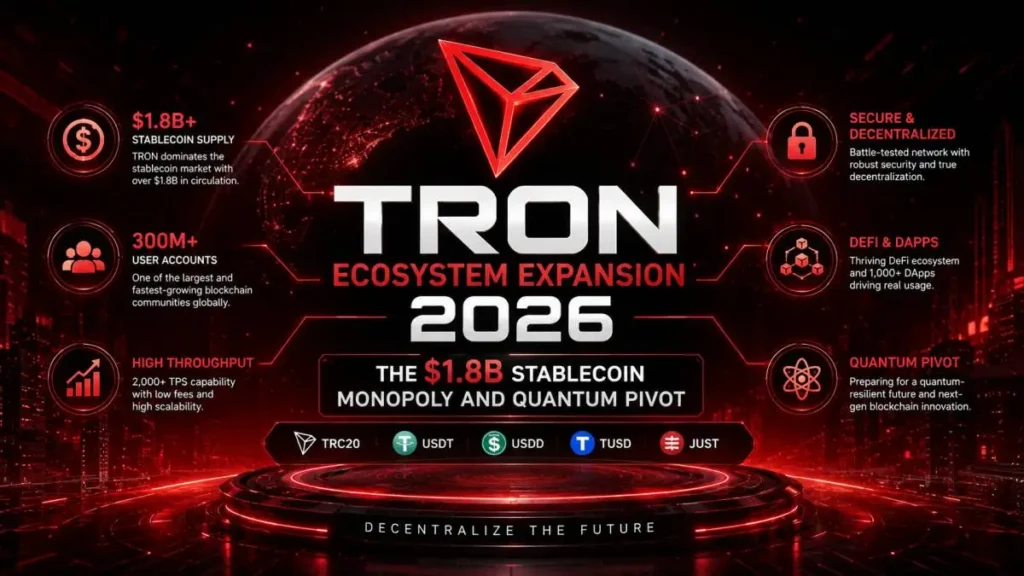
The core of the TRON Ecosystem Expansion is its absolute dominance in the stablecoin sector. As of May 2026, the supply of USDT on TRON has surpassed $86 billion, representing approximately 46% of the total global USDT supply.
Emerging Market Dominance
While Ethereum remains the home of institutional DeFi and Solana captures the high-frequency retail trade, TRON has monopolized “Real-World Utility” in regions with high inflation and limited banking access.
- Remittance Corridors: In the Philippines and Nigeria, TRC-20 USDT is the preferred medium for cross-border transfers, bypassing Western Union and SWIFT.
- Peer-to-Peer (P2P) Commerce: Informal merchant networks in Latin America now settle invoices directly in USDT on TRON, citing the $1–$4 transaction fee as the primary driver over Ethereum’s more expensive gas layer.
The Rise of the Agentic AI Economy
A unique 2026 development is the $1 billion TRON AI Fund. This initiative has pivoted toward the “Agentic Economy,” where autonomous AI agents use TRON-based stablecoins to pay for compute, API access, and data sets. Because AI agents require high-uptime and predictable fees, TRON’s DPoS (Delegated Proof of Stake) architecture—which has seen zero downtime in 2026—has become the preferred settlement layer for machine-to-machine payments.
Regulatory Clearance: The Post-SEC Era
The “legal overhang” that once shadowed the network evaporated in March 2026 when the U.S. SEC moved to dismiss all claims against Justin Sun and the TRON Foundation. This resolution was a watershed moment for the TRON Ecosystem Expansion.
Institutional Re-Entry
Following the dismissal, we observed a 300% increase in VASP (Virtual Asset Service Provider) integrations. Major exchanges like Gemini and Bitstamp expanded their TRON-based offerings, and Mastercard finalized its integration of TRON-based payments for its global crypto-card program.
- VASP Compliance: The GreatVoyage-v4.8.1 (Democritus) upgrade in February 2026 streamlined the network’s compatibility with global “Travel Rule” standards, making it the most compliant-ready high-throughput chain for institutional desks.
Quantum-Resilient Infrastructure: Architecting for the 2030s
While other networks debated the theoretical threat of quantum computing, TRON took a proactive stance. In April 2026, the network officially launched its Post-Quantum Cryptography (PQC) upgrade initiative.
NIST Standards Implementation
TRON is the first major public blockchain to move toward adopting NIST-approved algorithms such as ML-DSA (Dilithium) and SLH-DSA (SPHINCS+).
- The Technical Challenge: These new signature schemes require larger data sizes, which could impact transaction throughput.
- The TRON Solution: By leveraging its 27 Super Representative structure, TRON can implement these “heavy” cryptographic standards faster than more decentralized, slower-moving networks like Bitcoin.
Strategic Analysis: Pros, Cons, and Risks
The Bull Case (Pros)
- Monetary Deflation: TRX remains one of the few truly deflationary Layer-1 assets due to high transaction-induced burn rates.
- Zero-Downtime Reliability: 2026 data confirms TRON as the most stable high-volume chain, essential for institutional trust.
- Regulatory Clarity: Post-SEC settlement, the “Justin Sun risk” has been replaced by “TRON DAO governance” institutionalization.
The Bear Case (Cons & Risks)
- Centralization Concerns: The 27-SR model remains a point of criticism for decentralization purists, posing a risk of censorship in extreme geopolitical scenarios.
- Oracle Dependencies: As TRON moves into AI and RWAs (Real-World Assets), any failure in its oracle providers (Chainlink/Pyth) could lead to systemic liquidity gaps.
- Liquidity Fragmentation: While USDT is dominant, the network’s native DeFi ecosystem (JustLend) is heavily concentrated, lacking the diversity of the Ethereum Layer-2 landscape.
FAQ SECTION
– What is driving the TRON Ecosystem Expansion in 2026 ?
- The expansion is primarily driven by three factors: the network’s status as the global leader for USDT stablecoin transfers, the dismissal of SEC legal challenges, and the launch of a $1 billion fund dedicated to the Agentic AI economy.
– Why is TRX price stable at $0.32–$0.34 ?
- TRX has entered a “utility-equilibrium” phase. The high volume of transactions burns a significant amount of TRX daily, which roughly offsets the new tokens issued to validators, creating a balanced supply-demand dynamic that suppresses extreme volatility.
– Is TRON quantum-resistant ?
- As of April 2026, TRON has begun migrating its infrastructure to post-quantum cryptographic standards (PQC) based on NIST guidelines. It is currently the first major blockchain to actively deploy these defenses against future quantum computing threats.
– How many transactions does TRON process daily ?
- In early 2026, the network consistently processes between 5.2 million and 8 million transactions per day, with over $15 billion in daily adjusted stablecoin volume.
– Can I use TRON for AI payments ?
- Yes. TRON has integrated with several AI agent frameworks, providing stablecoin-based payment rails that allow autonomous agents to pay for services using USDT with sub-second finality.
FINANCIAL DISCLAIMER
This report is for analytical purposes only. Cryptocurrency investments, including TRX and TRON-based assets, carry high market risk. The 2026 price stability and regulatory outcomes discussed do not guarantee future performance. Consult with a certified financial planner before making any capital allocations.