
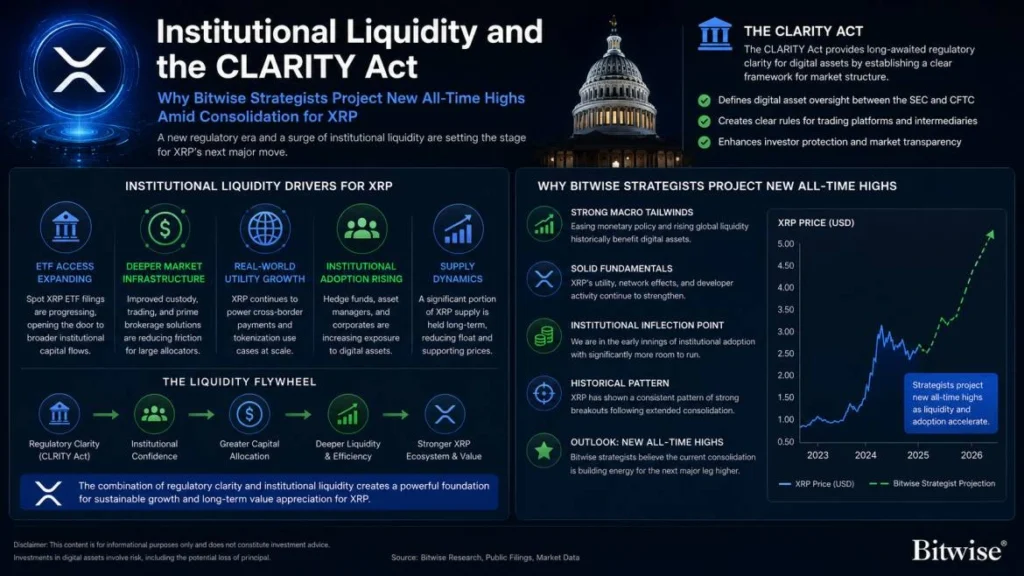
Institutional Liquidity and the CLARITY Act: Why Bitwise Strategists Project New All-Time Highs Amid Consolidation
Bitwise Strategists Project New All-Time Highs Amid Consolidation for XRP as institutional market structures mature in mid-2026. Despite trading roughly 60% below its July 2025 peak, institutional analysts expressed a highly bullish outlook during mid-May market recaps. Bitwise strategists noted that with regulatory headwinds fading due to the CLARITY Act and Ripple’s expanding stablecoin (RLUSD) partnerships in Singapore, Japan, and Africa, XRP could test new all-time highs within the next 12 to 18 months, assuming spot ETF inflows remain steady.
This assessment occurs at a structural inflection point for digital asset infrastructure. The transition from speculative retail momentum to highly structured, compliance-driven institutional allocation is reshaping token valuations. Understanding this projected macro shift requires evaluating legal frameworks, settlement mechanisms, and capital flow dynamics.
Macro Foundations: The Path to All-Time Highs and the 2025 Correction
The digital asset markets experienced significant volatility over the past year. After achieving historic peaks in July 2025, driven by initial filings for diverse altcoin spot ETFs and a favorable summary judgment phase, a broader macroeconomic contraction triggered a deep correction. High-for-longer interest rate policies from the Federal Reserve, combined with structural liquidations across major derivatives platforms, resulted in a sharp revaluation. XRP retrenched to trade roughly 60% below its prior cycle high, entering a prolonged accumulation block.
However, experienced digital asset managers distinguish between short-term price drawdowns and long-term network fundamentals. While retail sentiment remained depressed during early 2026, indicators monitored by platforms like Glassnode and CryptoQuant revealed a steady accumulation pattern among large-scale investors. The market structure shifted from public exchanges toward institutional over-the-counter (OTC) desks.
This consolidation phase mimics historical crypto asset market cycles, where extended periods of horizontal price movement precede major breakouts. The primary difference in 2026 is the presence of robust institutional vehicles—such as regulated spot ETFs—which establish a permanent demand floor that did not exist during prior structural macro expansions.
The Legislative Turning Point: How the CLARITY Act Erases Jurisdictional Risk
The primary barrier to institutional capital allocation in digital assets has consistently been regulatory ambiguity. For nearly a decade, enforcement-led actions by the SEC created a fragmented market environment. This era of legal uncertainty is ending due to legislative progress in Washington.
The Digital Asset Market Clarity Act—formally known as the CLARITY Act—cleared a major legislative hurdle on May 14, 2026, when the U.S. Senate Banking Committee advanced the bill with bipartisan support. The legislation establishes a transparent statutory framework by dividing digital asset oversight between two principal regulators:
- The Commodity Futures Trading Commission (CFTC): Receives exclusive regulatory jurisdiction over spot and cash markets for digital commodities. A digital commodity is defined as an asset intrinsically linked to an operational blockchain whose underlying value derives from network utility.
- The Securities and Exchange Commission (SEC): Retains authority over digital assets that function strictly as investment contracts or traditional corporate equities, requiring standard disclosure regimes.
For XRP, this legislative clarity provides explicit legal validation. By codifying asset classifications, the CLARITY Act allows institutional compliance departments to clear capital allocations without risking enforcement actions. The bill also establishes a 180-day provisional registration window, enabling platforms to operate under structured compliance guidelines while permanent rulemakings are finalized.
The Strategic Synthesis of RLUSD and XRP: Synergy or Substitution?
A frequent point of debate among market observers is whether the launch of Ripple USD (RLUSD) undermines the core utility of XRP. Traditional market analysts initially hypothesized that a fiat-pegged stablecoin would replace the native token within cross-border payment networks. However, institutional analysis indicates that the two assets operate symmetrically rather than competitively.
Expanding Cross-Border Corridors: Singapore, Japan, and Africa
Enterprise adoption of Ripple’s liquidity solutions has accelerated across key global corridors. In Singapore and Japan, where clear local stablecoin frameworks were established by the Monetary Authority of Singapore (MAS) and the Financial Services Agency (FSA), corporate treasury offices use RLUSD as a predictable, dollar-denominated settlement asset.
Simultaneously, commercial partnerships in Africa—specifically through integrations with Chipper Cash, VALR, and Yellow Card—demonstrate the real-world demand for stable digital fiat infrastructure. These regional financial institutions leverage RLUSD to manage treasury liquidity and execute cross-border business payments without routing funds through slower traditional correspondent banking networks.
Dissecting the Tokenomics: Bridge Asset Liquidity vs. Fiat-Pegged Settlement
The operational synergy between the two assets centers on capital efficiency and order book depth:
- RLUSD Utility: Serves as a low-volatility vehicle for local fiat on-ramps and off-ramps. It mitigates intra-day settlement risk for corporate treasuries that require fixed dollar values for ledger balancing.
- XRP Utility: Functions as the underlying, non-fiat bridge asset for cross-currency netting. When a transaction requires conversion between non-dollar pairs (e.g., Japanese Yen to South African Rand), routing directly through XRP pools on the XRP Ledger Automated Market Maker (AMM) reduces frictional costs.
Pro Tip: Stablecoins like RLUSD capture market share on the outer layers of transaction networks, while XRP handles the core liquidity layer. Deep stablecoin adoption expands total network volume, driving systemic demand for the underlying settlement engine.
Institutional Flows: Spot ETF Mechanics and Structural Demand
The introduction of regulated spot ETFs has redefined market liquidity. Unlike derivative products, spot ETFs require institutional sponsors to purchase and hold the underlying asset in secure, regulated custody accounts (such as those managed by Coinbase Custody or Anchorage Digital).
| Metric | Detail / Estimated Range | Source |
| Escrow Distribution Model | 1 Billion XRP released monthly; unused portions returned to escrow | Ripple Ledger Data |
| Average Institutional Bid-Ask Spread | 1.5 to 3.5 basis points on major regulated venues | CoinGecko Institutional |
| Spot ETF Inflow Velocity | Steady baseline inflows required to offset structural sell pressure | TradingView / Bitwise Analysis |
| On-Chain Settlement Time | 3 to 5 seconds per final block confirmation | XRPL Analytics |
Steady spot ETF inflows serve as a key structural mechanism for price discovery. Every month, a specific volume of tokens is unlocked from programmatic escrow accounts to maintain network distribution. Historically, this supply expansion created predictable resistance.
However, sustained inflows into spot vehicles neutralize this structural sell pressure by systematically removing circulating tokens from public order books. This alters the underlying supply-and-demand mechanics, making the asset increasingly sensitive to positive demand shocks.
Risk Assessment and Market Realities
An institutional investment thesis requires an objective examination of systemic challenges, operational risks, and technological friction points.
Pros and Cons of the Current Institutional Framework
Pros:
- Statutory Legality: Bipartisan progress on the CLARITY Act removes tail-risk enforcement events from the SEC.
- Capital Infrastructure: Regulated spot ETFs allow wirehouses and registered investment advisors (RIAs) to allocate capital directly through standard brokerage accounts.
- Enterprise Validation: Production-grade partnerships with pan-African and APAC fintech firms provide verifiable transaction volume data.
Cons:
- Escrow Overhang: Ripple’s significant internal token holdings continue to present a perceived centralization risk for traditional portfolio managers.
- Execution Friction: Achieving global scale requires continuous alignment with evolving anti-money laundering (AML) and travel rule standards across multiple jurisdictions.
- Platform Competition: The institutional stablecoin layer is highly competitive, with deep incumbent liquidities present in alternatives like Circle’s USDC and Tether’s USDT.
Technical Limitations and Downside Vectors
From an architectural standpoint, the XRP Ledger must continually optimize its throughput to compete with emerging Layer-1 networks and highly customized modular rollups. While the native AMM structure handles automated liquidity provisioning efficiently, extreme market volatility can result in temporary pool imbalances.
Furthermore, if the macroeconomic outlook deteriorates—such as an unexpected escalation in geopolitical tensions or a systemic liquidity crunch in traditional banking sectors—institutional allocators will likely revert to cash equivalents. This scenario would stall projected capital inflows into digital commodities, extending the consolidation phase beyond the 12-to-18-month timeline projected by Bitwise strategists.
Conclusion: The 12-to-18-Month Outlook
The confluence of structural market factors supports the bullish outlook articulated by Bitwise strategists. With the asset consolidating roughly 60% below its July 2025 peak, the current market structure offers an accumulation window for long-term capital allocators.
As the CLARITY Act moves toward final implementation and global enterprise corridors scale their use of the RLUSD-XRP architecture, the structural foundation for sustained capital growth becomes clear. If institutional inflows into spot ETFs remain consistent, the market is positioned to clear current consolidation levels and test new all-time highs over the coming months.
FAQ SECTION
– What is the primary catalyst behind the new all-time high projections for XRP?
- Bitwise strategists base their projections on two main structural factors: the removal of regulatory uncertainty via the CLARITY Act and expanding enterprise adoption of Ripple’s dual-token system (XRP and RLUSD) across APAC and African financial corridors.
– How does the CLARITY Act change crypto regulations for institutional investors?
- The CLARITY Act establishes explicit statutory distinctions between digital securities and digital commodities. By placing digital commodities under the exclusive jurisdiction of the CFTC, the legislation provides institutions with a clear, predictable legal framework for capital allocation.
– Will the Ripple USD (RLUSD) stablecoin replace the utility of XRP?
- No. RLUSD and XRP serve complementary functions within the payment ecosystem. RLUSD acts as a stable, dollar-denominated vehicle for ledger on/off ramps, while XRP serves as the high-speed, non-fiat bridge asset to execute cost-efficient cross-currency conversions.
– What role do spot ETFs play during market consolidation periods?
- Regulated spot ETFs generate steady, baseline structural demand. By accumulating and locking the underlying asset in institutional custody, spot ETFs absorb liquid supply from public exchanges, neutralizing sell pressure and strengthening market foundations.
– What are the main risks to the 12-to-18-month bullish outlook?
- The primary risks include macroeconomic shifts such as broader monetary tightening by the Federal Reserve, prolonged execution timelines for final legislative implementation, and intense competition from alternative institutional stablecoins and payment networks.
FINANCIAL DISCLAIMER
Disclaimer: The information provided in this article is for informational and analytical purposes only and does not constitute financial, investment, legal, or tax advice. Digital assets are subject to high market volatility and structural regulatory risks. Readers should conduct independent research and consult with a licensed financial advisor before making any investment decisions.