
Senate Banking Committee Advances Digital CLARITY Act: XRP Reclassification Sparks $1.48 Institutional Breakout
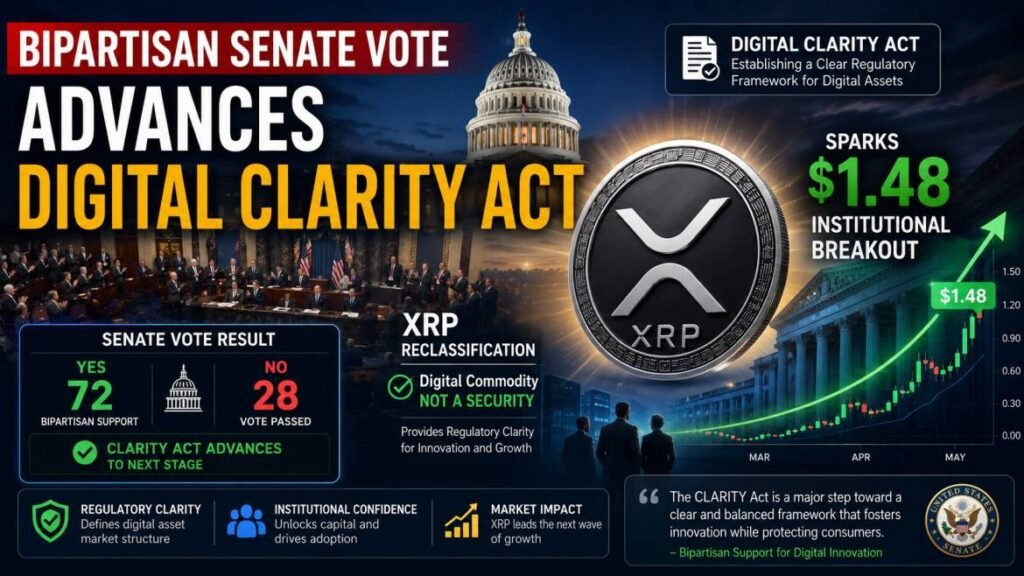
On May 14, 2026, the legislative architecture of the U.S. digital asset market underwent a historic structural shift as the Senate Banking Committee advanced the Digital CLARITY Act (H.R. 3633) in a decisive bipartisan 15-to-9 vote. Led by Chairman Tim Scott (R-S.C.), the committee’s approval marks the most significant regulatory milestone for digital assets in modern financial history. By explicitly proposing to recognize XRP and similar network tokens as digital commodities under the jurisdiction of the Commodity Futures Trading Commission (CFTC), the bill establishes a permanent statutory boundary between securities and commodities.
The immediate market response underscored the significance of this institutional legal certainty. XRP rapidly cleared its long-standing $1.45 overhead technical resistance, rallying to trade at $1.48 within hours of the vote’s conclusion. This price breakout reflects a profound structural repricing of regulatory risk across institutional capital allocations.
Institutional Mechanics of the Digital CLARITY Act
The core objective of the Digital CLARITY Act is to resolve the destructive jurisdictional friction between the Securities and Exchange Commission (SEC) and the CFTC. For nearly a decade, the digital asset industry operated under a framework of “regulation by enforcement.” This statutory update replaces subjective judicial interpretations with explicit federal rule-making.
Resolving the SEC vs. CFTC Jurisdictional Tug-of-War
Under the newly approved market structure framework, the legislation draws an unambiguous line based on operational functionality rather than historical fundraising formats:
- Investment Contracts: The SEC retains complete authority over initial token capital raises, investment contracts, and entities operating as traditional securities issuance intermediaries.
- Digital Commodities: The CFTC assumes primary spot and derivatives market oversight over fully functional, open-source network tokens that meet decentralized infrastructure criteria.
This clean division effectively curtails the SEC’s broad assertion that secondary market transactions of native digital assets retain an permanent “security” status.
The Statutory Classification of XRP as a Digital Commodity
The bill contains specific provisions concerning “network tokens” with established utility and history. It directly addresses the legal ambiguity that has constrained XRP since the SEC initiated litigation in 2020.
By defining digital commodities through clear legislative metrics, the bill codifies the landmark programmatic sales ruling from the Southern District of New York. The legislation states that secondary market trading on digital asset exchanges does not constitute an investment contract transaction. This long-sought institutional legal certainty clears the path for domestic banking institutions to integrate XRP ledger infrastructure for cross-border settlement without structural regulatory exposure.
Macro Liquidity Cycles and Market Reaction
The advancement of the Digital CLARITY Act by the Senate Banking Committee triggered an immediate capital reallocation across major crypto assets. While Bitcoin pushed past the $81,000 threshold and Ethereum registered solid gains, XRP stood out as the session’s dominant macro mover.
The $1.45 Resistance Breakout and Volume Profiles
For months, the $1.45 level served as a firm psychological and technical ceiling for XRP, heavily defended by algorithmic derivatives desks and macro short positions. The 15-to-9 committee vote forced an aggressive short-squeeze. Order book depth on major domestic platforms revealed a massive influx of institutional limit orders, absorbing the available ask-side liquidity and driving the spot price to $1.48.
Institutional Insight: This breakout differs fundamentally from retail-driven speculative spikes. The volume profile exhibits high-density block trades and sustained capital commitment, typical of asset managers re-weighting portfolios following an asymmetric risk-mitigation event.
Decoupling from Macro Headwinds
The crypto market’s sharp advance occurred despite a broader pullback in traditional risk-sensitive assets. Equities and standard commodities faced pressure due to restrictive Federal Reserve policy parameters and lingering macroeconomic uncertainty. Digital assets effectively decoupled from these broader macro headwinds, treating this legislative milestone as an independent, dominant positive catalyst capable of unlocking trillions in sidelined institutional capital.
The Legislative Compromise: Bank Protections and AML Frameworks
The passage of H.R. 3633 required months of intensive, good-faith bipartisan negotiations. To secure the critical votes of committee Democrats—including Arizona Senator Ruben Gallego and Maryland Senator Angela Alsobrooks—the bill’s sponsors integrated rigorous consumer safety and banking system guardrails.
Stablecoin Yield Constraints to Mitigate Deposit Flight
A major battleground in the legislative drafting process focused on stablecoin provisions, a sector also influenced by the companion GENIUS Act. Traditional banking institutions expressed intense opposition to initial proposals that would allow stablecoin issuers to pass interest yields directly to retail holders.
- The Risk: Yield-bearing stablecoins could trigger massive deposit flight from traditional regional bank savings accounts into digital alternatives.
- The Compromise: The approved text of the Digital CLARITY Act restricts issuers from paying direct yield rewards on idle stablecoin balances. Users may only be incentivized through transactional utility rewards, such as payment settlement rebates.
Bank Secrecy Act Codification for Exchanges and Networks
To satisfy national security requirements, the bill subjects digital asset exchanges, custodians, and broker-dealers to the exact same anti-money laundering (AML) and know-your-customer (KYC) regimes as traditional Tier-1 banks under the Bank Secrecy Act.
Furthermore, the bill introduces a strict, objective technical test to determine whether a network is genuinely decentralized:
| Decentralization Criteria | Compliant (Digital Commodity) | Non-Compliant (Financial Institution) |
| Transaction Control | Automated, immutable protocol execution. | Ability to unilaterally block specific users/addresses. |
| Governance Structure | Distributed node consensus; open source. | Retained administrative privileges or master keys. |
| Reporting Duty | Standardized network data disclosures. | Mandatory Bank Secrecy Act suspicious activity reporting. |
Comprehensive Risk Analysis: Limits of the Current Framework
While the committee approval is a monumental milestone, sophisticated market participants must analyze the structural limitations and ongoing operational risks before executing long-term capital deployments.
Remaining Legislative Hurdles
The Digital CLARITY Act has cleared a key committee hurdle, but it is not yet federal law. The bill must now transition to a full floor vote in the Senate.
Following a full Senate vote, any structural variations between this bill and the version passed by the House of Representatives in July 2025 (which cleared with a 294-134 vote) must be reconciled via a joint conference committee before hitting the president’s desk for signature.
Operational and Political Risks
- Executive Branch Opposition: Pockets of intense anti-crypto sentiment remain within specific federal agencies. Implementation delays or administrative friction during the transition of regulatory authority to the CFTC could slow down the roll-out of compliant products.
- Infrastructure Costs: The stringent AML/KYC requirements mean that mid-sized crypto firms will face substantial compliance expenditures, potentially consolidating market share toward capitalized institutional incumbents.
- Ethics and Political Volatility: Ongoing debates regarding government officials holding digital assets could introduce headline risk during the final Senate floor debate.
Strategic Implications for Global Capital Markets
The institutional legal certainty introduced by the Digital CLARITY Act will reverberate far beyond domestic borders. By establishing clear statutory classifications, the United States is positioning itself to capture institutional capital that previously migrated to more permissive jurisdictions like Switzerland, Dubai, or Singapore.
For XRP, the transition to an explicit digital commodity framework lays the foundation for rapid institutional product expansion. Asset managers can now finalize structures for spot XRP exchange-traded funds (ETFs) with clear statutory backing, eliminating the risk of sudden SEC listing challenges. Furthermore, global financial market utilities can confidently integrate the XRP Ledger into commercial cross-border settlement architectures, driving long-term utility-based network demand.
To stay ahead of the rapidly shifting regulatory landscapes and access exclusive institutional macro asset analyses, subscribe to our premium financial newsletter or download our comprehensive Q2 Market Structure Report below.
FAQ
– What is the Digital CLARITY Act and why does it matter for crypto?
- The Digital CLARITY Act (H.R. 3633) is a comprehensive market structure bill designed to establish clear regulatory guidelines for the U.S. digital asset industry. It explicitly divides oversight between the SEC and the CFTC, replacing years of ambiguous enforcement actions with static statutory rules that protect consumers while fostering domestic financial innovation.
– How did the Senate Banking Committee vote on the bill?
- The Senate Banking Committee advanced the legislation with a historic bipartisan 15-to-9 vote. The bill received unanimous support from committee Republicans, alongside critical crossover votes from key committee Democrats, signaling strong momentum for its upcoming full Senate floor debate.
– Why does the Digital CLARITY Act recognize XRP as a digital commodity?
- The legislation establishes objective statutory criteria to differentiate between securities and commodities based on operational decentralization and protocol utility. Under these definitions, XRP qualifies as a digital commodity, codifying prior judicial precedents and separating secondary market exchange trading from initial security fundraising frameworks.
– What caused XRP’s price to break out to $1.48?
- XRP’s price surged past its immediate $1.45 technical resistance level to trade around $1.48 because the committee’s vote delivered long-sought institutional legal certainty. This structural risk mitigation triggered significant capital inflows from institutional asset managers and forced short positions to cover, accelerating the upward breakout.
– What are the main rules for stablecoins under this legislation?
- The bill subjects stablecoin issuers to strict capital, disclosure, and licensing mandates while preventing the Federal Reserve from introducing a competing central bank digital currency (CBDC). To protect the traditional banking sector from deposit flight, the bill prohibits stablecoin platforms from offering direct interest yields on idle stablecoin balances.
– How does the bill define whether a crypto platform is decentralized?
- A crypto platform or network is deemed decentralized under the bill if it operates via distributed, immutable consensus mechanisms where no single entity possesses administrative privileges to unilaterally block transactions, alter data, or grant special user permissions. Platforms failing this test are classified as financial institutions subject to strict Bank Secrecy Act reporting mandates.
– What are the remaining steps before the bill becomes federal law?
- Now that the bill has cleared the Senate Banking Committee, it must be debated and passed by the full Senate floor. Following a successful vote, any differences between the Senate bill and the version passed by the House of Representatives in July 2025 must be reconciled in a conference committee before being sent to the President to be signed into law.
FINANCIAL DISCLAIMER
Disclaimer: The information provided in this article is for informational and analytical purposes only and does not constitute investment, financial, legal, or tax advice. Digital assets are subject to high market volatility and regulatory shifts. Consult with a licensed financial advisor or legal professional before making any capital allocation decisions.