

Solayer Pay Visa Card Launches Global USDC Real-World Settlement Rail
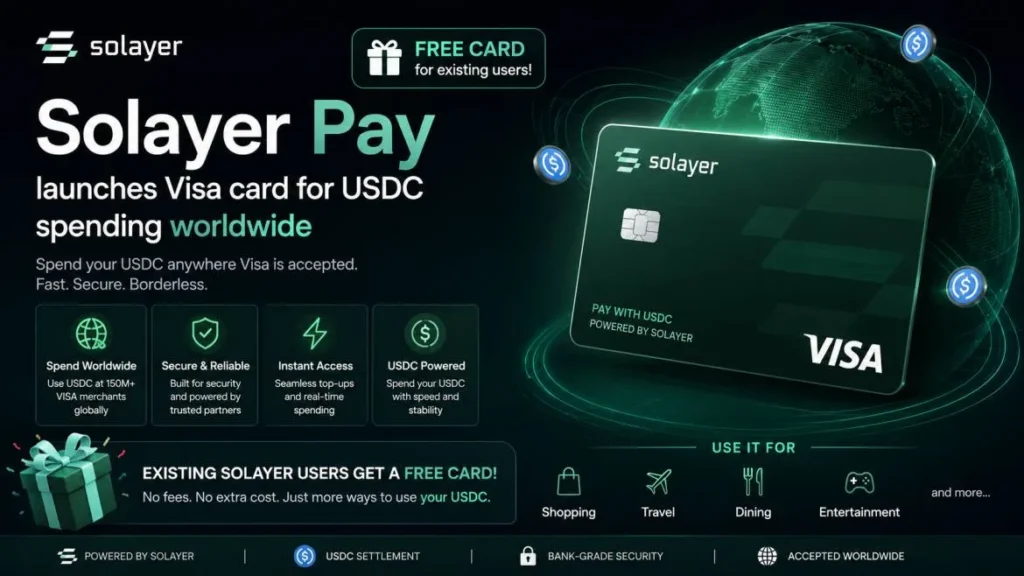
The integration of digital assets into the legacy macroeconomic settlement layer has advanced. On May 14, 2026, Solayer Pay announced the launch of its physical Visa-compatible payment card. This advancement shifts the application profile of stablecoins from speculative decentralized finance (DeFi) liquidity pools to global retail points-of-sale.
The introduction of the Solayer Pay Visa card enables users to spend USDC balances directly at millions of merchants and automated teller machines (ATMs) across the globe. This release builds directly upon the groundwork laid by the platform’s initial iteration, the Emerald Card. It represents a programmatic effort to eliminate the multi-step off-ramping workflows that have traditionally isolated crypto-native capital from real-world merchant settlement systems.
[User USDC Balance] ---> [infiniSVM Settlement Layer] ---> [Visa Network Clearing] ---> [Global Merchant]Microeconomics of the Solayer Pay Visa Card
Analyzing the fee structure, access conditions, and loyalty mechanics reveals how Solayer aims to scale its market share within an increasingly competitive payment ecosystem.
Fee Infrastructure and Distribution Framework
The distribution model for the Solayer Pay Visa card introduces a clear distinction between the protocol’s bootstrapping user base and new retail acquisitions:
- Existing Account Holders: Users migrating from the legacy virtual architecture receive the physical card at a $0 issuance cost.
- New Platform Registrants: New users incur a flat $20 annual activation fee collected during the initial provisioning sequence.
From a cost standpoint, this fee matches or undercuts legacy cross-border neo-banking platforms. The elimination of manual transfer workflows saves users substantial gas costs and exchange-rate slippage fees typically associated with centralized exchange off-ramping.
The Integration of the Solayer Pay Visa Card with the Emerald Ecosystem
This physical release extends Solayer Pay’s underlying Emerald Card network infrastructure. Launched in April 2025 as a digital-only virtual asset framework integrated with Apple Pay and Google Pay, the Emerald platform secured over 40,000 active users distributed across 100 countries.
The physical card upgrades this digital footprint by providing physical cash liquidity options via ATM access networks globally. Furthermore, the spending architecture integrates directly with Solayer’s native reward infrastructure. Transactions generate proportional rewards indexed as Emerald Points, structured into specific volume tiers:
| Transaction Value Band | Points Multiplier |
| Under $100 | $1\times$ Base Yield |
| $100 \text{ to } $499 | $2\times$ Base Yield |
| $500 \text{ to } $2,499 | $3\times$ Base Yield |
| $2,500 \text{ and above} | $5\times$ Base Yield |
These programmatic incentives drive higher transaction velocity, converting the asset from a passive store of value into an active daily currency.
System Architecture: infiniSVM and Real-Time Settlement Engineering
A core point of friction for crypto-linked debit infrastructure has been transaction processing latency. Traditional point-of-sale systems require authorization windows under two seconds. Standard base-layer blockchain gas competitions and block confirmation times cannot consistently meet this standard.
The transactional clearing pipeline of the Solayer Pay Visa card operates via infiniSVM, a highly specialized, hardware-accelerated Solana Virtual Machine layer-1 framework designed explicitly for high-throughput financial throughput.
Key Architectural Metrics of infiniSVM:
- Maximum Throughput Capacity: $330,000+$ transactions per second (TPS).
- Block Finality Window: $\sim 400\text{ms}$ deterministic execution.
- Gas Asset Dependency: Native $SOL$ utilization for all transaction computation fees.
By processing the balance confirmations on infiniSVM, Solayer Pay isolates payment processing queues from the main Solana mainnet state adjustments. If a major NFT mint or high-volume memecoin event clogs the public Solana mainnet, the isolated settlement engine of infiniSVM ensures retail card swipes at merchant terminals avoid delays.
The infrastructure continuously verifies non-custodial capital availability, authorizes the transaction on the Visa network, and executes on-the-fly stablecoin conversions without introducing terminal latency.
Macro Dynamics: The Stablecoin Expansion Matrix in 2026
The commercial viability of the Solayer Pay Visa card aligns with an unprecedented macro expansion in the aggregate supply of tokenized dollars. Data compiled from onchain analytics platforms highlights a historic capital reallocation into productive stablecoin assets over the past twelve months.
- May 2025 Aggregate Stablecoin Supply: $243 Billion
- May 2026 Aggregate Stablecoin Supply: $322 Billion
As of May 2026, the aggregate stablecoin market capitalization reached an all-time high of $322 billion. Within this expansion framework, Circle’s USD Coin (USDC) commands a dominant liquidity profile, supporting approximately $78 billion in circulating supply.
This growth is reinforced by massive structural developments from traditional institutions:
- Visa & Stripe Integration: In March 2026, Visa collaborated with Stripe’s Bridge division to scale stablecoin-native settlement systems across 18 core sovereign jurisdictions, with a strategic roadmap targeting over 100 nations by the end of the fiscal year.
- Institutional Clearing Volumes: Visa’s core stablecoin settlement pilot has scaled to handle over $7 billion in transaction volume across nine distinct cryptographic protocols.
This secular shift indicates that financial networks no longer view blockchain assets as test sandboxes. Instead, they treat decentralized ledgers as prime-time transaction settlement options.
Concurrently, macroeconomic variables—specifically Federal Reserve monetary adjustments—have altered user behavior. With sustained high interest rates, users demand capital efficiency. Solayer addresses this by allowing cardholders to convert idle USDC into sUSD, a secure treasury-backed stablecoin instrument that delivers a $4\%\text{ to }5\%$ passive yield without capital lockups. This shifts the debit card from a pure cost center into an onchain interest-bearing checking account.
Structural Trade-offs: Risk Analysis and Technical Boundaries
Despite structural efficiencies, users and institutional allocators must evaluate the systemic risk parameters inherent to the Solayer financial architecture.
Smart Contract Risks and the Counterparty Landscape
While standard traditional credit lines shield the consumer from backend settlement failures, using the Solayer Pay Visa card connects the user to smart contract risk layers:
- Bridge and Execution Layer Vulnerabilities: The flow of funds through infiniSVM requires continuous state synchronization with the primary Solana layer. Any compiler logic errors or unexpected software bugs within the SVM iteration could lead to frozen assets or transactional halts.
- Yield-Bearing Counterparty Risk: The accumulation of $4\%\text{ to }5\%$ returns on underlying
sUSDassets depends entirely on tokenized short-term United States Treasury obligations managed by third-party real-world asset (RWA) protocols. Any operational insolvency or liquidity gap among these asset managers could impair the stablecoin’s $1:1$ dollar parity peg.
Regulatory Risks and KYC Alignment
To maintain direct communication with the global Visa clearing network, Solayer Pay enforces rigid Know Your Customer (KYC) compliance frameworks and anti-money laundering (AML) controls. This creates a clear operational boundary:
- Custodial Disconnect: While the application preserves cryptographic ledger transparency, it operates as a hybrid non-custodial framework. This setup requires identity verification to link real-world actors to specific onchain wallet addresses.
- Geographic Service Restrictions: Due to shifting national regulatory positions regarding stablecoins, capital availability remains restricted across specific jurisdictions. Users in non-compliant zones face geo-blocking boundaries regardless of their underlying onchain wallet balance.
Comparative Evaluation: Pros and Cons
To assist capital allocators and retail participants, the matrix below details the advantages and operational constraints of the payment network.
Systematic Strengths and Shortcomings
Pros
- Direct Asset Liquidation: Eliminates the intermediate step of converting crypto to fiat via centralized brokers before spending.
- Capital Efficiency Via sUSD: Allows users to capture a $4\%\text{ to }5\%$ treasury-backed passive yield on unspent capital up until the second of execution.
- Isolated Processing Architecture: Utilizes infiniSVM’s isolated $330,000+$ TPS throughput to insulate point-of-sale checkouts from wider network congestion.
- Zero-Cost Bootstrapping: Existing virtual Emerald Card system participants face zero physical issuance fees.
Cons
- New User Activation Tariffs: New retail signups face an ongoing $20 annual friction hurdle.
- Identity Verification Dependencies: Demands complete KYC submission, removing structural financial pseudonymity.
- Yield System Vulnerabilities: Exposes asset pools to asset-backed real-world counterparties and smart contract security threats.
- Regional Jurisdictional Gaps: Compliance boundaries limit deployment options in specific regulatory environments.
FAQ SECTION
-How do I get a physical Solayer Pay Visa card?
- Existing users can order the physical card directly through the Solayer Pay application dashboard at no cost. New applicants must download the app, submit identity verification details under KYC guidelines, and pay a $20 annual activation fee to initiate manufacturing and distribution.
-What are the main fees associated with the Solayer Pay Visa card?
- Existing Emerald Card platform holders pay zero issuance fees. New users pay an annual activation fee of $20. Point-of-sale spending converts digital assets into local fiat currencies on the fly, backed by competitive currency conversion rates handled through the network.
-How does the infiniSVM network speed up transactions?
- The infiniSVM network is a high-performance Layer 1 framework compatible with the Solana Virtual Machine. It runs separate from the main Solana network, allowing it to process up to 330,000 transactions per second with a roughly 400-millisecond confirmation time. This ensures retail payments are approved almost instantly, even when the main Solana network is congested.
-Can I earn yield on my funds while holding the Solayer Pay Visa card?
- Yes. Users can convert standard USDC balances into Solayer’s treasury-backed stablecoin asset,
sUSD. This instrument generates a continuous 4% to 5% passive yield by investing in short-term US Treasury bills. The capital remains completely unlocked and ready for real-world card payments at any time.
-Is the Solayer Pay Visa card available globally?
- The physical card works anywhere Visa is accepted, supporting merchant transactions and ATM cash withdrawals in over 100 countries. However, due to regional cryptocurrency regulations, certain geographic locations may be restricted from account setup and activation.
FINANCIAL DISCLAIMER
Disclaimer: The information provided in this article is for educational and analytical purposes only and does not constitute financial, investment, or legal advice. Digital assets, stablecoins, and associated debit products carry inherent risks, including smart contract vulnerabilities, counterparty risks, and regulatory changes. Conduct independent due diligence and consult a qualified financial professional before deploying capital into any cryptographic infrastructure.