
Why XRP Institutional Inflows Just Bucked the Macro Trend: Inside the Senate’s Bipartisan Regulatory Breakthrough
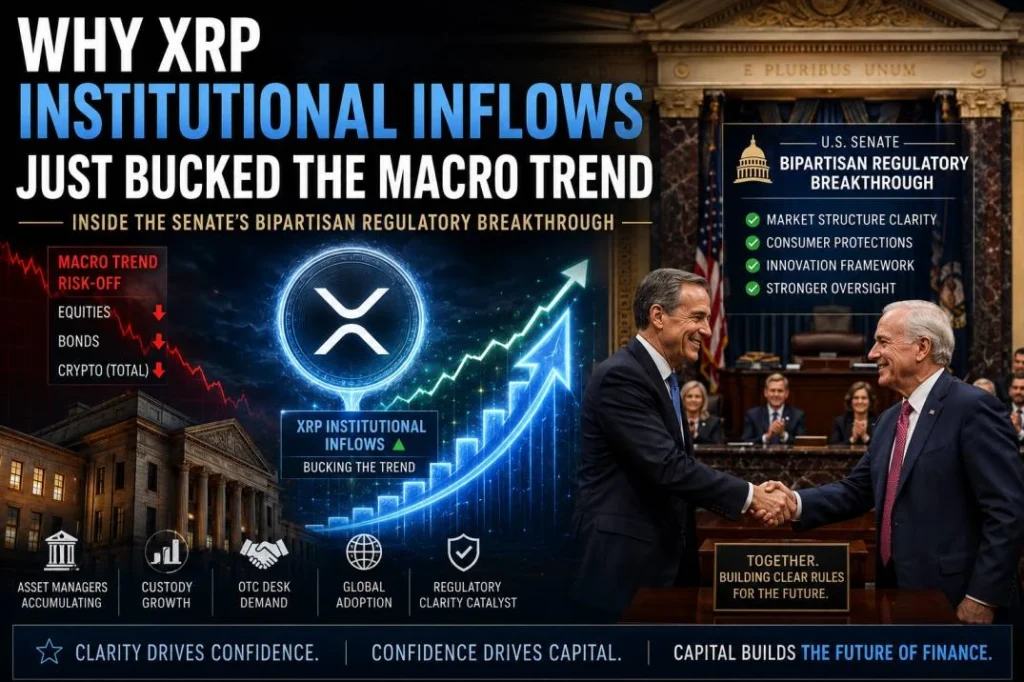
The broader cryptocurrency market faces severe macro headwinds. A hawkish federal liquidity posture, rising bond yields, and aggressive capital rotation have triggered sharp liquidations across risk assets, driving Bitcoin back down to the $70,000 baseline and flushing out weaker positions. Yet, beneath this retail-driven volatility layer, XRP institutional inflows have completely bucked the dominant trend, signaling a fundamental regime shift in how institutional allocators value compliant digital assets.
While Bitcoin spot vehicles hemorrhaged over $3.4 billion and Ethereum investment funds shed upwards of $400 million during a brutal late-May stretch, institutional product vehicles tied to XRP recorded a massive $118 million in fresh net inflows for the month. This distinct trend divergence highlights a major decoupling event. Capital is actively moving away from purely speculative momentum plays and positioning into assets backed by clear legislative progress.
May 2026 Digital Asset ETF Capital Flows (Net)
======================================================
[Bitcoin ETFs]   █████████████████████████-$3.45B (Outflow)
[Ethereum ETFs]  █████ -$400M (Outflow)
[XRP ETFs]       █ +$118M (Inflow)
======================================================
The Catalyst: The Digital Asset Market Clarity Act Clears the Senate
The fundamental driver anchoring this unique institutional accumulation is a monumental regulatory pivot out of Washington. On May 14, 2026, the U.S. Senate Banking Committee advanced H.R. 3633, the Digital Asset Market Clarity Act, in a historic 15-9 bipartisan vote. Led by Chairman Tim Scott, the progression of this landmark bill onto the formal Senate Legislative Calendar has effectively altered how institutional compliance officers evaluate the long-term risk profile of digital assets—specifically those built for banking enterprise utility.
The Digital Asset Market Clarity Act introduces structural changes designed to end the years-long era of regulatory enforcement-led oversight:
- The Dual-Regulator Boundary: The bill explicitly separates oversight between the Securities and Exchange Commission (SEC) and the Commodity Futures Trading Commission (CFTC). The CFTC gains full, formal jurisdiction over digital commodity spot markets.
- The “Mature Blockchain” Exemption: Tokens intrinsically tied to an operating blockchain network—where value scales with functional utility rather than managerial promotion—are classified as digital commodities. This directly plays into XRP’s historical legal defense and operational reality.
- The Regulation Crypto Safe Harbor: The bill creates a structured disclosure pathway. Asset originators can raise capital and issue network tokens under clear exemptions, avoiding overly restrictive public equity requirements while offering transparent, standard investor protection.
Institutional Insight: By creating a formal statutory process to transition digital assets from SEC security status to CFTC commodity status via the “mature blockchain test,” the bill builds a clear bridge for institutional capital. It provides capital allocators with a reliable playbook rather than leaving them to navigate unpredictable judicial outcomes.
Deconstructing the Inflow Metrics: Sticky vs. Speculative Capital
The $118 million allocation to XRP products throughout May pushed total aggregate assets under management (AUM) across the seven dominant U.S. spot XRP ETFs to approximately $1.2 billion. Cumulative inflows since their market introduction have climbed steadily to $1.4 billion.
+------------------------------------+-----------------------+
| Metric                             | Value (As of May 2026)|
+------------------------------------+-----------------------+
| May Net Inflows (XRP Products)     | $118 Million          |
| Total Spot XRP ETF AUM             | $1.2 Billion          |
| Cumulative Inflows Since Launch    | $1.4 Billion          |
| Combined ETF Custody Reserves      | ~775 Million XRP      |
+------------------------------------+-----------------------+
This institutional demand curve remained highly resilient even as the month closed out. Between May 20 and May 29, institutional allocators deployed an additional $35 million into XRP-focused investment vehicles. This occurred during the exact same window when broader crypto investment vehicles faced staggering multi-billion-dollar liquidations.
This data demonstrates a clear structural divergence. Retail positions on derivatives exchanges remain highly sensitive to macro volatility, interest rate updates, and liquidations. However, the institutional capital flowing into spot XRP products is structural and long-term. These allocators are establishing foundational long positions based on fundamental legislative changes and real-world utility frameworks.
Enterprise Utility: Real-World Asset Tokenization and Ecosystem Expansion
Beyond legislative momentum, institutional capital is closely tracking the underlying utility of the XRP Ledger (XRPL). The platform’s core focus on low-cost, high-speed, cross-border settlement is expanding into broader financial structures.
The Rise of RLUSD and Regulated Stablecoins
The rollout and expansion of Ripple’s USD-pegged stablecoin, RLUSD, has introduced a highly predictable liquidity layer directly onto the XRPL. Under the newly advanced Digital Asset Market Clarity Act frameworks, payment stablecoins face strict oversight from federal banking regulators. The law bans passive, deposit-like yield payment structures on unutilized digital balances—an amendment originally brought forward by the GENIUS Act—while paving the way for fully integrated, highly transparent payment instruments.
Real-World Asset (RWA) Tokenization
Traditional financial firms are increasingly moving beyond simple speculation. They are leveraging the XRPL to tokenize physical and financial assets, including sovereign debt instruments, commercial paper, and real estate vehicles. The network’s native support for decentralized asset issuance makes it a primary choice for institutional back-end infrastructure integration.
Institutional Investment Risk Analysis
While the structural capital trend remains highly encouraging, institutional participants must balance their accumulation strategies against real operational and market structure constraints.
Pros
- Regulatory De-risking: The explicit legislative push by the Senate Banking Committee provides a clear legal runway, drastically lowering compliance and regulatory penalties.
- Counter-Trend Capital Resiliency: Strong institutional inflows create a structural floor under the asset, softening broader macro sell-offs and reducing downside volatility compared to peer altcoins.
- Institutional Settlement Infrastructure: Deep institutional integration with legacy banking rails makes XRP uniquely positioned to capture capital flowing into regulated cross-border payment networks.
Cons & Technical Limitations
- Unresolved Congressional Friction: While H.R. 3633 has successfully cleared the Senate Banking Committee, it must still pass a full Senate floor vote and undergo reconciliation with the Senate Agriculture Committee’s companion bill, the Digital Commodity Intermediaries Act.
- Legislative Restrictions on Retirement Accounts: Ongoing political pressure from senior lawmakers continues to target alternative asset access within standard tax-advantaged 401(k) frameworks, which could limit broader retail wealth inflows.
- Escrow Supply Releases: The programmatic monthly unlock of 1 billion XRP from escrow can create occasional short-term supply pressure, requiring consistent institutional absorption to sustain long-term upward price action.
FAQ SECTION
– What are the main drivers behind XRP institutional inflows in May 2026?
- The primary driver is the structural progress of the Digital Asset Market Clarity Act through the U.S. Senate Banking Committee. This bipartisan legislative framework introduces clear regulatory definitions, classifying decentralized network tokens as digital commodities under CFTC oversight. This has significantly reduced long-term regulatory compliance risks for institutional allocators.
– How does the Digital Asset Market Clarity Act impact XRP’s legal status?
- The bill establishes a formal “mature blockchain test.” This framework allows digital assets to transition out of SEC security oversight and into a CFTC digital commodity framework once a network exhibits sufficient decentralization and functional utility, providing a clear legal blueprint for asset operations.
– Why did XRP decouple from Bitcoin and Ethereum ETF trends in late Q2 2026?
- While Bitcoin and Ethereum experienced substantial capital outflows due to broader macro de-risking and interest rate hawkishness, XRP attracted $118 million in net inflows. This trend separation highlights that institutional allocators are intentionally building targeted long positions in assets with emerging, clear regulatory advantages.
– What is the current asset volume held by spot XRP ETFs?
- As of late May 2026, U.S. spot XRP ETFs collectively manage roughly $1.2 billion in total assets under management (AUM), controlling an estimated aggregate supply pool of 775 million native tokens.
– Does the new Senate bill allow interest payments on stablecoins?
- No. The Digital Asset Market Clarity Act extends strict provisions that prohibit digital asset platforms and stablecoin issuers from offering passive, deposit-like yield or interest on unutilized customer stablecoin balances. It does, however, permit standard activity-based rewards and transactional cash-back programs.
FINANCIAL DISCLAIMER
Disclaimer: This publication is for informational and educational purposes only. The information contained herein does not constitute financial, investment, legal, or tax advice. Digital assets and cryptocurrency products are subject to extreme market volatility, technical limitations, and evolving regulatory changes. Institutional and individual investors must conduct independent due diligence or consult with a certified financial professional prior to executing any capital allocations or digital asset investment strategies. The publisher and author assume no liability for any direct or consequential financial losses resulting from the use of this content.