Technical Analysis for Buy or Sell Decisions in Cryptocurrency (Bitcoin)
The application of legacy financial charting methods to digital assets requires a structural shift in perspective. Because cryptocurrency markets operate continuously, feature fragmented exchange liquidity, and are heavily influenced by derivative leverage, unrefined retail indicators frequently yield false signals.
To achieve consistent execution, traders must transition from single-indicator strategies to strict, multi-layered validation systems. This guide details a objective framework for utilizing technical analysis for buy or sell decisions in cryptocurrency (Bitcoin). By testing the combined performance of the 200-day moving average (MA), structural candlestick patterns, and volume confirmation, market participants can isolate high-probability breakout points while insulating capital from market maker manipulation (Yumna et al., 2024).
The Core Triad: Moving Averages, Candlesticks, and Volume Confirmation
Relying on an isolated chart pattern or a single momentum oscillator exposes capital to high-leverage whipsaws. Institutional-grade technical analysis for buy or sell decisions in cryptocurrency (Bitcoin) relies on a three-tiered filtering sequence. Each layer filters out noise from the preceding one, ensuring capital is deployed only when structural, behavioral, and transactional metrics align.
1. The 200-Day Moving Average: The Macro Trend Baseline
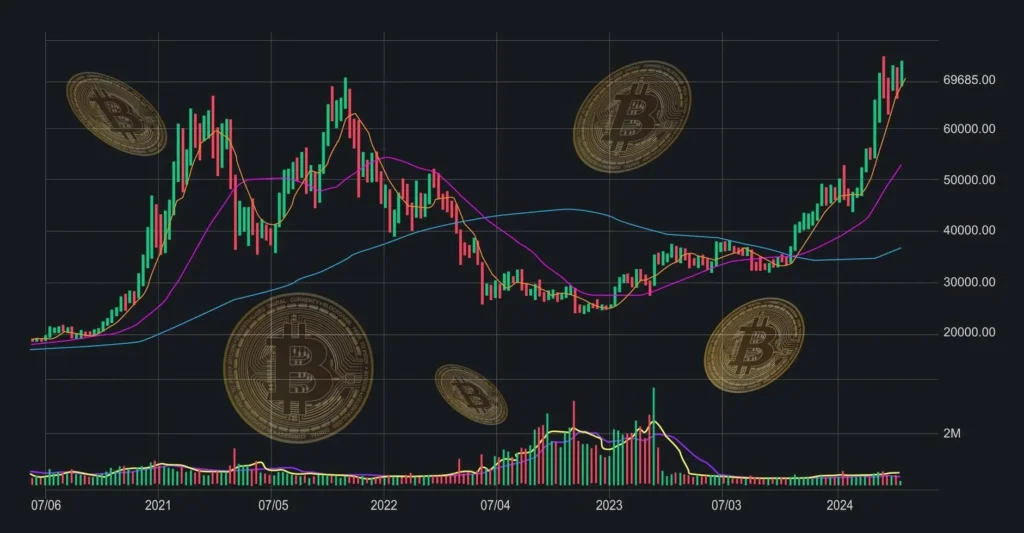
The 200-day simple moving average serves as the definitive boundary between structural bull and bear regimes. It aggregates roughly six months of trading data, smoothing out short-term volatility induced by liquidations.
- The Baseline Rule: When Bitcoin trades above its 200-day MA, the macro trend is structurally bullish, and the trading strategy prioritizes long entries at key support levels. When price resides below the 200-day MA, the regime is structurally bearish, shifting focus toward short execution or capital preservation.
2. Candlestick Patterns: Spotting Behavioral Shifts
Once the macro baseline establishes the market’s direction, Japanese candlestick patterns serve as the immediate behavioral trigger. Rather than treating these patterns as rigid geometric shapes, analysts interpret them as real-time maps of buyer and seller exhaustion.
- In a bullish regime, patterns such as the Bullish Engulfing or the Hammer signal that sellers have run out of momentum at key structural zones, allowing buyers to reclaim control of the auction block.
3. Volume Confirmation: The Institutional Signature
Volume represents the true fuel behind any price movement. Without strong transactional volume, a breakout above a moving average or a bullish candlestick pattern is simply a low-conviction retail fluctuation, highly vulnerable to reversal.
- Volume confirmation requires that a structural breakout be accompanied by a clear, above-average surge in trading volume. This spike confirms that institutional market makers and algorithmic desks are actively committing capital to the directional move.
Step-by-Step Framework for High-Probability Breakouts
Isolating high-probability breakout points requires a sequential execution checklist. If any single component of this triad fails to validate, the setup is discarded.
Step 1: Establish the Macro Regime (The 200-Day MA Filter)
Plot the 200-day simple moving average on a daily (1D) or 4-hour (4H) chart. Wait for the price of Bitcoin to clean out a local consolidation range and cross this boundary.
- For a Buy Decision, the price must close conclusively above the 200-day MA line, transforming a legacy resistance level into structural support.
- For a Sell Decision, the price must breach and close below the 200-day MA line, signaling that the macro trend is shifting downward.
Step 2: Identify the Behavioral Confirmation (The Candlestick Trigger)
Once price interacts with the 200-day MA, observe the immediate candlestick closes.
- If the price is attempting an upward breakout, look for a Bullish Engulfing pattern where the body of the current green candle completely swallows the body of the preceding red candle.
- Alternatively, a Pin Bar / Hammer pattern with a long lower wick extending below the 200-day MA indicates that downside sell stops were swept and rapidly absorbed by institutional buyers.
Step 3: Verify the Capital Commit (The Volume Overlay)
Look down at the volume oscillator or volume bars.
- The breakout candle must exhibit a volume profile that is at least 1.5x to 2x higher than the 20-period moving average of volume.
- To further protect against false breakouts, cross-reference this move with spot exchange data via platforms like CoinGecko or on-chain transaction data from tools like Glassnode. A authentic breakout features expanding spot volume alongside rising futures open interest, proving that new capital is actively entering the market rather than short positions simply getting squeezed.
Deep Dive: Applying the Framework to Buy vs. Sell Decisions
To understand how this system operates under real market conditions, let’s analyze the precise mechanics of both buy and sell trade setups.
| Metric / Layer | Bullish Buy Setup (Long Entry) | Bearish Sell Setup (Short Entry) |
| Macro Regime (200-Day MA) | Price breaks and closes above the MA | Price breaks and closes below the MA |
| Primary Candlestick Pattern | Bullish Engulfing, Hammer, or Morning Star | Bearish Engulfing, Shooting Star, or Evening Star |
| Volume Confirmation Requirement | Volume $> 1.5\times$ of the 20-day volume average | Volume $> 1.5\times$ of the 20-day volume average |
| On-Chain / Derivative Pulse | Rising open interest + Spot market delta buying | Rising open interest + Net exchange inflows |
| Stop-Loss Placement | Just below the breakout candle’s swing low | Just above the breakout candle’s swing high |
The Buy Setup: Executing Long Breakouts
When utilizing technical analysis for buy or sell decisions in cryptocurrency (Bitcoin), a long entry requires patience during extended periods of sideways consolidation.
Institutional Breakdown Rule: Imagine Bitcoin has been consolidating in a tight $3,000 range directly underneath its 200-day MA. A daily candle closes above the 200-day MA. Simultaneously, a Bullish Engulfing pattern materializes, wiping out three days of slow, grinding sell-offs.
The final confirmation comes from a dramatic volume surge that clears out local resistance blocks. This sequence proves that the breakout is not a retail-driven anomaly, but an institutional re-accumulation phase shifting into an expansion phase.
The Sell Setup: Executing Short or Capital Preservation Closures
Conversely, identifying the exact moment to exit long positions or initiate speculative short entries is vital for protecting capital during market transitions.
When the price of Bitcoin breaks downward through the 200-day MA via a high-volume Bearish Engulfing or Shooting Star pattern, it indicates that institutional support has collapsed. A dramatic volume spike on a downward breach confirms that large entities are aggressively offloading spot allocations or building heavy short positions, turning previous support structures into overhead resistance.
Risk Management, Limitations, and Market Realities
No charting framework guarantees a 100% win rate. Cryptocurrencies are highly sensitive to global liquidity flows, central bank policies, and abrupt shifts in leverage. Managing risk requires a clear understanding of the limitations inherent to this asset class.
The Limits of Traditional Technical Analysis in Crypto
Traditional technical analysis models assume that asset markets are continuous and orderly. However, the crypto ecosystem frequently experiences extreme, leverage-driven liquidations.
When a massive cluster of over-leveraged long positions is forced closed, it triggers a cascade of selling that can temporarily push prices far below structural support lines—independent of macro trends or moving averages. These events create “wicking” behavior that can trigger stop-losses before the price abruptly snaps back.
The Threat of “Fakeouts” and Stop-Hunting
Because crypto order books are often thin across fragmented exchanges, large trading entities can deliberately drive prices past highly visible technical lines, such as the 200-day MA, to trigger retail stop-loss orders. This process, known as liquidity hunting, creates a temporary surge in volume that can easily mimic a genuine breakout.
Strategic Risk Mitigation Framework
To protect capital against these inherent market risks, implement the following guardrails:
- Buffer Stops: Avoid placing stop-loss orders exactly at the 200-day MA or at the absolute low of a candlestick wick. Instead, set stop-losses slightly beyond local liquidity zones, or utilize an Average True Range (ATR) multiplier (e.g., $1.5 \times \text{ATR}$) to give the trade room to breathe.
- Time-Based Filters: Instead of entering a trade the moment a price breaks a level on a lower-timeframe chart, wait for a definitive daily (1D) or weekly (1W) candle close to confirm the validity of the structural shift.
- Dynamic Position Sizing: Limit total capital risk on any individual breakout trade to a fixed percentage of equity—typically 1% to 2%—ensuring that a series of consecutive false breakouts will not deeply impair trading capital.
FAQ SECTION
– How reliable is the 200-day moving average for Bitcoin compared to traditional stocks?
- The 200-day moving average is highly effective for Bitcoin because large institutions and quantitative funds use it as a core trend indicator. However, due to Bitcoin’s higher volatility, price wicks tend to penetrate the moving average further than seen in traditional equity indexes like the S&P 500. This requires traders to use wider stop-losses or wait for daily candle closes to confirm trends.
– What candle timeframe is best when analyzing crypto buy or sell decisions?
- For macro trend structural analysis, the 4-hour (4H), Daily (1D), and Weekly (1W) timeframes are most reliable. Lower timeframes, such as the 15-minute or 1-hour charts, contain significant noise and are highly vulnerable to localized leverage flushes and market maker manipulation.
– Why does volume confirmation matter if the price has already broken out?
- Price movement without volume expansion indicates a low-liquidity environment, where very little capital was required to move the market. These low-volume breakouts are often “bull traps” or “bear traps” orchestrated by algorithmic market makers to harvest retail liquidity. True trend reversals require expanding volume to prove institutional participation.
– Can I use exponential moving averages (EMA) instead of simple moving averages (SMA)?
Yes, many crypto traders prefer the 200-day Exponential Moving Average (EMA) because it places greater weight on recent price action, making it react faster to rapid market shifts. However, the Simple Moving Average (SMA) remains highly valuable because it is the baseline metric viewed by major institutional desks globally.
– How do crypto liquidations impact standard candlestick patterns?
- Liquidations can create massive, elongated wicks on candlestick patterns that do not necessarily reflect organic supply or demand shifts. For example, a sudden drop and instant recovery might simply be a futures liquidation cascade sweeping long positions, rather than a fundamental shift toward a bearish regime.
FINANCIAL DISCLAIMER
Regulatory and Financial Risk Disclaimer: This article is provided purely for informational, educational, and analytical purposes. It does not constitute formal financial, investment, legal, or tax advice. Cryptocurrency trading involves substantial risk of loss and is not suitable for every investor. The digital asset markets are highly speculative, volatile, and sensitive to systemic, regulatory, and technical risks.
Past performance of technical charting models, including the combinations of moving averages, candlestick formations, and volume metrics outlined herein, is not indicative of future market results. Readers must conduct their own independent due diligence, evaluate their personal risk tolerance, and consult with a licensed professional financial advisor before executing any market transactions. The author and publication assume no liability for any financial losses incurred through the use of the frameworks described in this content.