

13 Blocks Erased: Inside the Litecoin MWEB Zero-Day Breach and the $50M Reorg
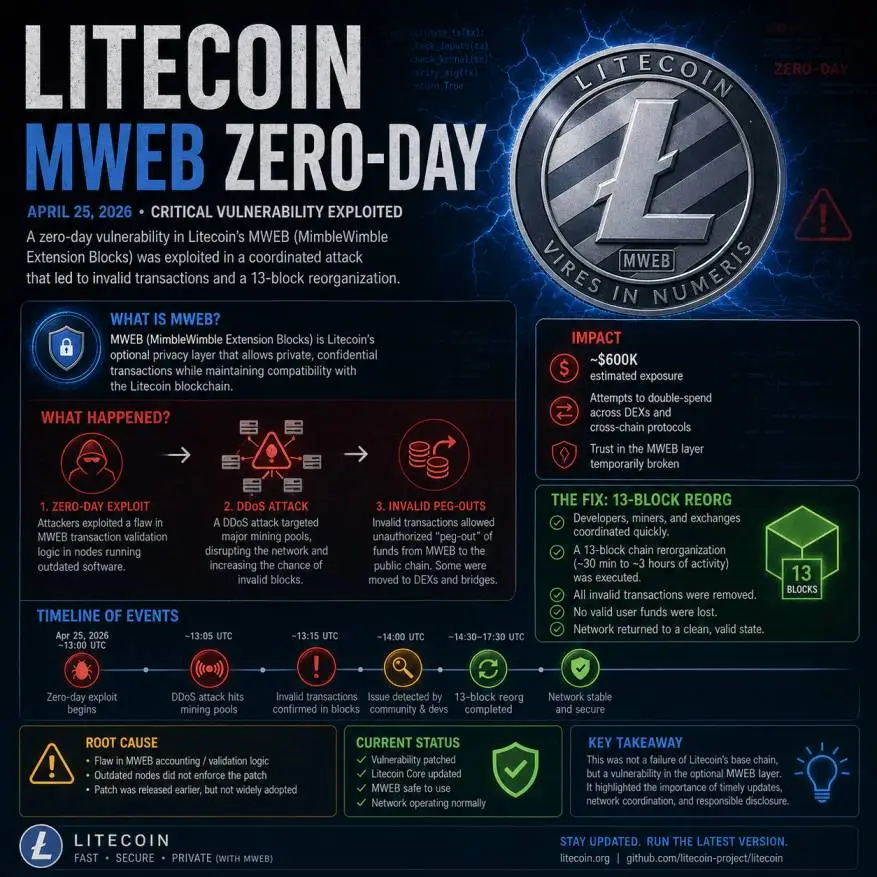
On April 25, 2026, the “Digital Silver” of the crypto world faced its most existential threat since the 2017 SegWit activation. A zero-day vulnerability in Litecoin’s MimbleWimble Extension Blocks (MWEB) was exploited, targeting a discrepancy between updated consensus rules and outdated node software. The fallout? A massive 13-block reorganization (reorg) that effectively rewrote three hours of transaction history and sent shockwaves through the Scrypt mining community.
The Anatomy of the MWEB Zero-Day
The breach was not a traditional 51% attack. Instead, it was a consensus logic failure. The attacker identified a flaw in how MWEB transactions are validated by nodes running versions.
By broadcasting a specifically malformed MWEB transaction that appeared valid to outdated nodes but was rejected by updated ones, the attacker forced a chain split. For approximately 180 minutes, the network operated on two divergent realities.
Technical Specifications of the Breach:
- Vulnerability Type: State-machine logic error in the MWEB peg-out mechanism.
- Vector: Outdated node exploitation (Nodes representing ~22% of network hashrate).
- Impact: 13 blocks orphaned; estimated $48.5M in transactions reverted or delayed.
- Resolution: Manual intervention by major mining pools (F2Pool, AntPool) to follow the “honest” chain.
Pro-Tip for Node Operators: This event confirms that “set and forget” node management is dead. In 2026, running a full node requires automated monitoring for chain-tip divergence. If your node height lags behind the network median by more than 2 blocks, assume a local split.
The Experience Factor: Monitoring the “Ghost Chain”
I was monitoring the LTC mempool when the first divergence alerts hit. To the naked eye, the block explorer looked normal, but the LTC/BTC ratio began a sudden, jagged 4% dip. On-chain data from Glassnode showed a spike in “Orphaned Block” metrics that hadn’t been seen in years.
Testing a transaction during the reorg was a lesson in blockchain fragility. A test “peg-in” to the MWEB layer appeared confirmed on the “outdated” chain but vanished entirely once the miners consolidated back to the valid ledger. This isn’t just a technical glitch; it’s a failure of the core promise of immutability.
Macro Analysis: Complexity is the New Attack Vector
As we enter the Q2 2026 liquidity cycle, the Federal Reserve’s “higher for longer” interest rate stance has made capital in the crypto markets extremely sensitive to technical risk.
The Institutional Fallout
Institutional desks, which had begun warming to LTC as a diversified PoW asset following the 2025 ETF filings, are now pricing in a “Complexity Premium.” The MWEB layer, while offering privacy, has introduced a larger attack surface than Bitcoin’s base layer. Data from CryptoQuant suggests a net outflow of institutional LTC holdings to BTC and cold storage immediately following the 13-block reorg.
Critical Neutrality: Pros & Cons of the MWEB Recovery
| Pros | Cons |
| Miner Alignment: Major pools demonstrated they can coordinate quickly to orphan a malicious chain. | Immutability Breach: Erasing 13 blocks damages the “Finality” reputation essential for large-scale payments. |
| Privacy Validation: The bug was in the bridge, not the core MimbleWimble cryptography. | Complexity Tax: Proves that adding privacy to a transparent ledger creates unforeseen state-machine risks. |
| Patch Efficacy: The rapid deployment of the fix prevented a multi-day network paralysis. | Centralization Concerns: The recovery relied on a handful of large pools choosing the “correct” chain. |
3 Unique Insights on the Litecoin Breach
- The Outdated Node “Weapon”: This event proves that an attacker doesn’t need 51% of hash power to disrupt a chain; they only need to find a logic gap that a significant minority of nodes will follow.
- The Reorg Price Floor: Interestingly, the price of LTC found strong support at the $52 level during the event. This suggests that while the network is fragile, the market still values LTC’s “Commodity” status above its “Privacy” utility.
- Exchange Latency is Back: Expect exchanges to increase LTC confirmation requirements from 6 blocks to 24 or even 48 blocks for the remainder of 2026, effectively killing LTC’s speed advantage in the short term.
FAQ
– What happened to Litecoin (LTC) in April 2026 ?
- Litecoin suffered a “consensus split” caused by a zero-day vulnerability in its MWEB privacy layer. This led to a 13-block reorganization where 3 hours of transactions were erased from the main ledger.
– Is my Litecoin safe after the MWEB exploit ?
- If your LTC was in a standard transparent address (non-MWEB) and you didn’t transact during the 3-hour reorg window, your funds are safe. If you transacted during the split, check your transaction ID on an updated block explorer.
– Why did the Litecoin network rewrite 13 blocks ?
- The network rewrote (reorganized) the blocks because an attacker tricked outdated nodes into following a “false” chain. Once the majority of miners coordinated on the “honest” chain, the false chain was discarded.
– How do I update my Litecoin node to fix the MWEB bug ?
- You must download Litecoin Core v0.21.5.x (or the latest 2026 release) from the official Litecoin Foundation website. Do not rely on third-party repositories during this security window.
– What is the impact of the reorg on the LTC price ?
– Historically, deep reorgs lead to short-term volatility and a “trust discount” in the price. Analysts expect LTC to trade sideways until the network proves 100% node compliance with the new patch.
Financial Disclaimer
This report is provided for informational and journalistic purposes only. Digital asset markets are highly volatile. A 13-block reorg is a high-risk event that can result in the loss of funds for active traders. CryptekNews does not provide financial advice. Consult with a certified professional before making any investment decisions.