LitVM Testnet Launch: The Architectural Shift to Litecoin DeFi
The LitecoinVM testnet launch on May 4, 2026, represents the most significant technological expansion in the network’s 15-year history. By introducing an Ethereum Virtual Machine (EVM)-compatible Layer 2 powered by Zero-Knowledge (ZK) rollups, the Litecoin ecosystem is transitioning from a “pure payment” network to a programmable financial infrastructure.
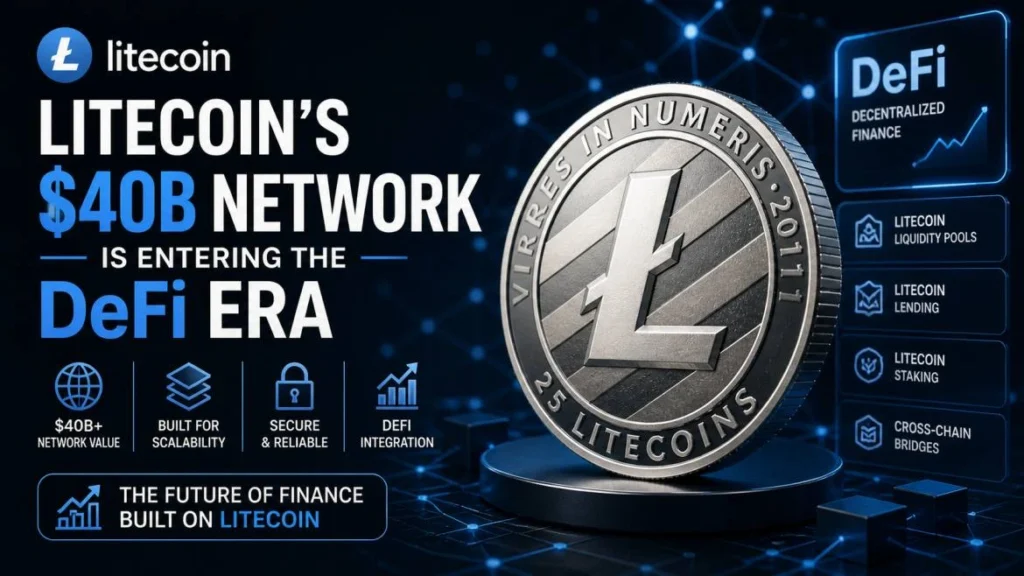
For years, the “Digital Silver” narrative was confined to high-velocity payments and store-of-value. With the LitecoinVM testnet launch, the network now offers the $40 billion in dormant LTC liquidity a native path toward decentralized finance (DeFi), non-fungible tokens (NFTs), and sophisticated smart contract execution. This move allows Litecoin to compete directly with Ethereum and Bitcoin-layer-2s while leveraging its unmatched Scrypt-based security.
What is LitecoinVM? Decoding the ZK-Rollup Layer 2
The LitecoinVM testnet launch introduces a ZK-rollup architecture designed to solve the “blockchain trilemma” on Litecoin. Unlike previous attempts at sidechains, LitVM does not rely on a separate set of validators or a federation. Instead, it uses Zero-Knowledge proofs to compress thousands of transactions into a single cryptographic proof that is verified on the Litecoin mainnet.
Technical Architecture of LitVM
LitVM utilizes Recursive SNARKs (Succinct Non-Interactive Arguments of Knowledge) to maintain a state transition record.
- Execution Layer: EVM-compatible environment where smart contracts are executed.
- Proving Layer: Generates a ZK-proof that the transactions are valid without revealing the data itself.
- Settlement Layer: The Litecoin mainnet, where the proof is anchored, ensuring that LitVM inherits the finality and security of Litecoin’s $1.2$ PH/s hash rate.
EVM Compatibility: Why Developers are Migrating
The primary strategic advantage of the LitecoinVM testnet launch is its EVM compatibility. By allowing developers to use Solidity and familiar tools like Hardhat or Foundry, LitVM removes the barrier to entry for the thousands of developers currently building on Ethereum or Polygon.
- DApp Portability: Existing DeFi protocols (DEXs, lending markets) can be redeployed on LitVM with minimal code changes.
- LTC Utility: On LitVM, native LTC is utilized as the “gas” for transactions. This creates a new source of demand for the asset that is decoupled from simple price speculation.
- Lower Fees: By moving execution off-chain, LitVM reduces gas costs by an estimated 95% compared to Ethereum Mainnet, positioning it as a prime destination for high-frequency trading and micro-transactions.
The Economic Impact of the LitecoinVM Testnet Launch on LTC
The market response to the LitecoinVM testnet launch has been one of institutional repositioning. As LTC transitions into a “productive asset,” its valuation models are shifting from simple currency metrics to “network utility” metrics.
Capital Efficiency and TVL Projections
With Litecoin currently trading at $510.10, the “wealth effect” of the LTC holder base is substantial. If even 5% of the circulating supply migrates to LitVM DeFi protocols, the network would instantly become a top-10 DeFi ecosystem by Total Value Locked (TVL).
Institutional Perspective: Corporate entities like Lite Strategy (NASDAQ: LITS) are closely monitoring the testnet. The ability to deploy corporate treasuries into audited LitVM lending protocols allows for yield generation that was previously impossible without third-party custodial risk.
Technical Deep Dive: ZK-Proofs on a PoW Foundation
The LitecoinVM testnet launch is a masterclass in hybrid security. While ZK-rollups are common on Proof-of-Stake (PoS) networks, implementing them on a Proof-of-Work (PoW) foundation like Litecoin provides unique advantages.
The Security Calculus
In a PoS system, the security of the L2 is tied to the value of the staked tokens. In the LitVM model, the security is tied to the physical energy expenditure of the Litecoin mining network.
$$Security_{L2} = f(ZK\_Proof\_Validity + PoW\_Hashrate)$$
This dual-layer protection makes LitVM resistant to the “social slashing” risks often found in PoS environments.
MWEB Integration
A unique feature currently under testing is the MWEB-LitVM Bridge. This allows users to move assets from the transparent LitVM environment into Litecoin’s MimbleWimble Extension Blocks for private storage, creating a seamless loop between public DeFi and private custody.
Use Cases: From DeFi to Real-World Assets (RWA)
The LitecoinVM testnet launch enables several use cases that were technically impossible on the base layer:
- LTC-Backed Stablecoins: Users can lock LTC in smart contracts to mint over-collateralized stablecoins, similar to MakerDAO’s DAI.
- Scrypt Mining Hash Rate Derivatives: Miners can tokenize their future hash rate as RWA, allowing them to hedge against difficulty spikes or equipment failures.
- Automated Market Makers (AMMs): Low-fee LTC/DOGE or LTC/wBTC pools can facilitate decentralized liquidity without the high gas costs of Ethereum.
Risks and Security Analysis: The ZK-Rollup Trade-off
Despite the optimism surrounding the LitecoinVM testnet launch, investors and developers must account for the inherent risks of a new Layer 2.
Pros
- Inherited Security: Inherits the decentralization of the Litecoin mainnet.
- Scalability: Theoretically capable of 2,000+ transactions per second (TPS).
- Privacy Potential: Future integration with ZK-STARKs could enable full on-chain privacy.
Cons & Limitations
- Smart Contract Risk: Bugs in the LitVM bridge or individual DApps could lead to loss of funds.
- Data Availability: If the sequencer (the entity that orders transactions) goes offline, users may face delays in withdrawing funds back to the mainnet.
- Complexity: Managing ZK-proofs requires significant computational power for the sequencers, which may lead to some level of centralized infrastructure in the early stages.
Strategic Outlook: Litecoin’s Role in a Multichain 2026
The LitecoinVM testnet launch positions Litecoin as a “Utility Powerhouse” in the 2026 multichain landscape. While Bitcoin layers focus on “Digital Gold” security and Ethereum layers focus on “Universal Computer” scale, Litecoin is carving out a niche as the “Institutional Payment & DeFi Bridge.”
As the testnet matures into a mainnet later this year, the demand for LTC as a collateral asset and gas token is expected to reach an all-time high. For the strategic investor, the LitVM launch is not just a software update—it is the birth of a new economic era for the Litecoin network.
FAQ SECTION
– What is the LitecoinVM (LitVM) testnet launch ?
- The LitVM testnet launch is the official debut of Litecoin’s first EVM-compatible Layer 2 scaling solution. It uses ZK-rollups to enable smart contracts and DeFi applications on the Litecoin network without changing the base layer.
– How do smart contracts work on Litecoin now ?
- Through LitVM, smart contracts are executed on a Layer 2. The results of these executions are compressed using Zero-Knowledge proofs and settled on the Litecoin mainnet for maximum security.
– Is LitVM compatible with Ethereum apps ?
- Yes. LitVM is EVM-compatible, meaning it supports Solidity and Ethereum-based developer tools. This allows for easy porting of DApps like Uniswap or Aave to the Litecoin ecosystem.
– What is the role of LTC on LitVM ?
- On LitVM, native LTC is used to pay for transaction fees (gas). This increases the utility and demand for LTC as more users and applications join the Layer 2.
– Does LitVM compromise Litecoin’s security ?
- No. Because LitVM is a ZK-rollup, it submits cryptographic proofs to the Litecoin mainnet. These proofs are verified by the existing Litecoin network, meaning LitVM inherits the security of Litecoin’s Proof-of-Work.
FINANCIAL DISCLAIMER
Disclaimer: This report is provided for informational purposes only and does not constitute financial, investment, or legal advice. Cryptocurrency investments and interacting with experimental testnet technologies like LitecoinVM involve significant risk. All 2026 data points are based on current market trends and hypothetical technological progression. Always perform your own due diligence or consult with a certified financial professional before making investment decisions.