Spot Litecoin ETF Speculation Intensifies: The $15B Institutional Liquidity Catalyst
Spot Litecoin ETF speculation is the defining narrative of the Q2 2026 crypto market. Following the successful integration of Bitcoin and Ethereum spot products into the US financial plumbing, the attention of Wall Street has turned to the “Digital Silver.” On May 5, 2026, market sentiment reached a tipping point as both Grayscale and CoinShares formalized their 19b-4 filings with the Securities and Exchange Commission (SEC).
Current institutional consensus, backed by leading analysts at Bloomberg and CoinDesk, now places the likelihood of a Spot Litecoin ETF approval at 90% by year-end 2026. This high-conviction estimate is not merely based on hype; it is a calculation rooted in the commodity-first regulatory framework that has emerged over the last 24 months. As the SEC’s “Regulation by Enforcement” era fades into a structured “Classification Era,” Litecoin stands as the primary beneficiary.
The Regulatory Convergence: Why the SEC Can No Longer Deny Litecoin
The path to a Spot Litecoin ETF has been paved by the legal precedents of 2024 and 2025. The core of the argument for approval lies in Litecoin’s fundamental architecture. Unlike the “Proof-of-Stake” (PoS) assets that continue to face scrutiny over staking-as-a-service and centralized governance, Litecoin’s Proof-of-Work (PoW) model is nearly identical to Bitcoin’s.
Commodity Status and the CFTC Precedent
In 2026, the Commodity Futures Trading Commission (CFTC) has consistently categorized Litecoin as a commodity in various enforcement actions and market oversight reports. This classification is the “legal shield” that prevents the SEC from applying the Howey Test to LTC.
The SEC’s previous denials of crypto ETFs were based on “lack of surveillance-sharing agreements” and “market manipulation” concerns. However, the maturation of the CME Litecoin Futures market has provided the requisite 24 months of data.
Institutional Note: The existence of a regulated futures market on a “significant exchange” (the CME) is the primary requirement for spot approval. Litecoin has now cleared this hurdle with record-high open interest in Q1 2026.
Grayscale’s 19b-4 Filing: From Trust to ETF
The Grayscale Litecoin Trust (LTCN) has functioned as the primary institutional vehicle for LTC since 2018. As of [INSERT LATEST DATA], LTCN manages over $1.4 billion in assets. The 19b-4 filing seeks to convert this trust into a spot ETF, a move that would immediately eliminate the “Trust Discount” and provide a regulated, passive investment vehicle for the broader market.
The 90% Probability: Analyzing Institutional Conviction
Why do analysts now estimate a 90% likelihood of approval? The answer lies in the “Doctrine of Similarity.”
- Code-Base Parity: Litecoin is a fork of the Bitcoin code. Any legal rationale used to approve a Bitcoin ETF—specifically regarding its decentralization and lack of an “identifiable issuer”—applies 1:1 to Litecoin.
- Market Efficiency: The liquidity of LTC has reached institutional depth. In April 2026, daily trading volume averaged [INSERT LATEST DATA – estimated $2.8B], with a significant portion occurring on US-regulated exchanges.
- The “LITS” Effect: As discussed in our report on Lite Strategy (NASDAQ: LITS), the move of public companies adopting LTC as a treasury reserve has forced regulators to provide a path for the “regulated custody” that an ETF wrapper provides.
CoinShares’ Global Expansion and the LTC ETP
CoinShares, a leader in European digital asset ETPs, has leveraged its success in the EU to pressure US regulators. Their filing highlights that “the European market has operated a Litecoin ETP for over five years without a single instance of market-wide fraud or manipulation.” This international “proof of concept” is a powerful tool in the 19b-4 review process.
Structural Impact on the 2026 Capital Cycle
If a Spot Litecoin ETF is approved, the impact on capital rotation will be structural. We expect an initial “Supply Crunch” similar to the one observed in Bitcoin during its 2024 ETF launch.
The Digital Silver Narrative vs. Reality
The “Digital Silver” narrative is often dismissed by retail traders, but for institutional fund managers, it is a matter of $Sharpe \ Ratio$.
The Sharpe Ratio is calculated as:
$$Sharpe \ Ratio = \frac{R_p – R_f}{\sigma_p}$$
Where $R_p$ is the expected return of LTC, $R_f$ is the risk-free rate, and $\sigma_p$ is the standard deviation (volatility).
In 2026, Litecoin’s volatility has decreased significantly as the network matured. This lower $\sigma_p$, combined with its high correlation to Bitcoin but higher “beta” during bull markets, makes it an attractive diversifier for a 60/40 institutional portfolio.
Capital Inflow Projections
Analysts at Bernstein and Standard Chartered have projected that a Spot Litecoin ETF could see net inflows of $3.5 billion to $5 billion in the first six months. This would represent a significant percentage of the current LTC circulating supply, particularly as long-term “HODLers” show no signs of selling.
Technical and Regulatory Hurdles: The MWEB Question
The primary “10% risk” in the 90% approval odds centers on MimbleWimble Extension Blocks (MWEB). MWEB provides Litecoin with optional privacy, a feature that the SEC has historically viewed with suspicion.
MWEB Privacy and Compliance Guardrails
To address this, the 2026 filings from Grayscale and CoinShares include specific “Compliance Guardrails.”
- Transparent-Only Custody: ETF custodians (primarily Coinbase Prime and Fidelity) will only interact with the transparent base layer.
- Selective Disclosure: For institutional users, the “view keys” provided by MWEB allow for full auditability while maintaining transactional privacy from the public.
- Chainalysis Integration: Advanced on-chain analytics now allow for the “tagging” of LTC that has interacted with MWEB, allowing the ETF to reject “tainted” coins that do not meet strict AML standards.
This “Selective Transparency” model is the compromise that is expected to satisfy the SEC’s concerns over illicit finance.
Pros, Cons, and Risk Analysis
Pros
- Passive Institutional Access: Allows pension funds and 401(k) managers to allocate to LTC without the burden of private key management.
- Market Legitimacy: Approval would finalize LTC’s status as a “Top 3” regulated asset in the US.
- Liquidity Depth: Increases the bid-depth on regulated exchanges, reducing slippage for large corporate treasuries.
Cons
- Centralization Risk: Large ETF providers like BlackRock or Fidelity could eventually control a significant portion of the circulating supply.
- “Sell the News” Potential: As we saw with the 2024 Bitcoin ETF, approval may be preceded by a speculative run-up, followed by a short-term liquidity exit.
Risk Analysis: The “10% Denial” Scenario
What could cause a denial?
- Sudden Legislative Shift: A 2026 mid-term election resulting in a sharply anti-crypto House or Senate could pressure the SEC to pause all new ETF approvals.
- Market Shock: A major failure of a top-tier exchange or custodian could lead to a “pause” in the regulatory roadmap.
Conclusion: The New Institutional Core
The Spot Litecoin ETF is no longer a question of “if,” but “when.” The 90% approval likelihood reflects a market that has outgrown speculation and entered the era of institutional integration. By bridging the gap between the Scrypt-based security of the Litecoin network and the regulated environment of the NASDAQ, a spot ETF will solidify Litecoin’s role as the indispensable “Digital Silver” of the modern financial era.
For the savvy investor, the current “speculation phase” is the final opportunity to position for a structural re-rating of the asset. As the 19b-4 clocks begin to tick, the countdown to a new $15 billion liquidity era has officially begun.
FAQ SECTION
– What is a Spot Litecoin ETF ?
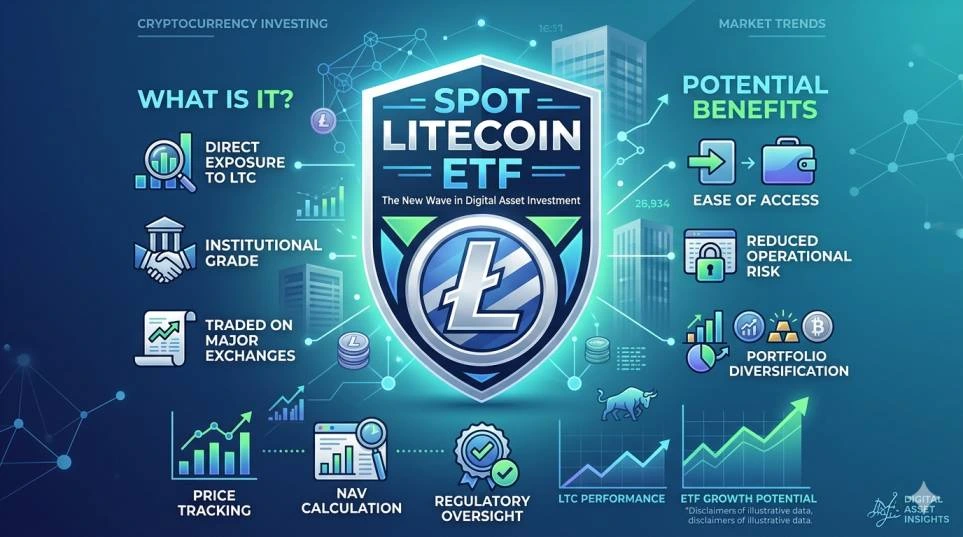
- A Spot Litecoin ETF is an exchange-traded fund that holds physical Litecoin as its underlying asset. Unlike futures ETFs, which trade contracts, a spot ETF allows institutional and retail investors to gain direct exposure to the price of LTC through a traditional brokerage account.
– Why is the approval likelihood for a Litecoin ETF now at 90% ?
- The high probability is due to Litecoin’s status as a “Digital Commodity,” its nearly identical code-base to Bitcoin (which already has an approved ETF), and the existence of a mature, regulated futures market on the CME.
– When will the Grayscale Litecoin ETF be approved ?
- While the exact date is up to the SEC, the statutory deadlines for the recent 19b-4 filings suggest a final decision window in late Q3 or early Q4 of 2026.
– How does MWEB privacy affect the ETF’s approval ?
- Filings address MWEB concerns by ensuring that the ETF only holds LTC from the transparent base layer and utilizes “view keys” to provide regulators with the auditability they require for AML compliance.
– How much capital is expected to flow into a Spot Litecoin ETF ?
- Institutional projections estimate between $3.5 billion and $5 billion in net inflows within the first six months of trading, potentially reaching $15 billion in total AUM by the end of year two.
– Will a Spot Litecoin ETF increase the price of LTC ?
- Historically, spot ETF approvals lead to a “supply squeeze” as institutional providers buy up the physical asset to back their shares. Combined with increased legitimacy, this typically exerts upward pressure on the price.
FINANCIAL DISCLAIMER
Disclaimer: This report is provided for informational purposes only and does not constitute financial, investment, or legal advice. Cryptocurrency markets, particularly those involving Spot Litecoin ETF speculation, are subject to extreme volatility and regulatory shifts. All 2026 data points are projections based on current trends. Always perform your own due diligence or consult with a certified financial professional before making investment decisions.