
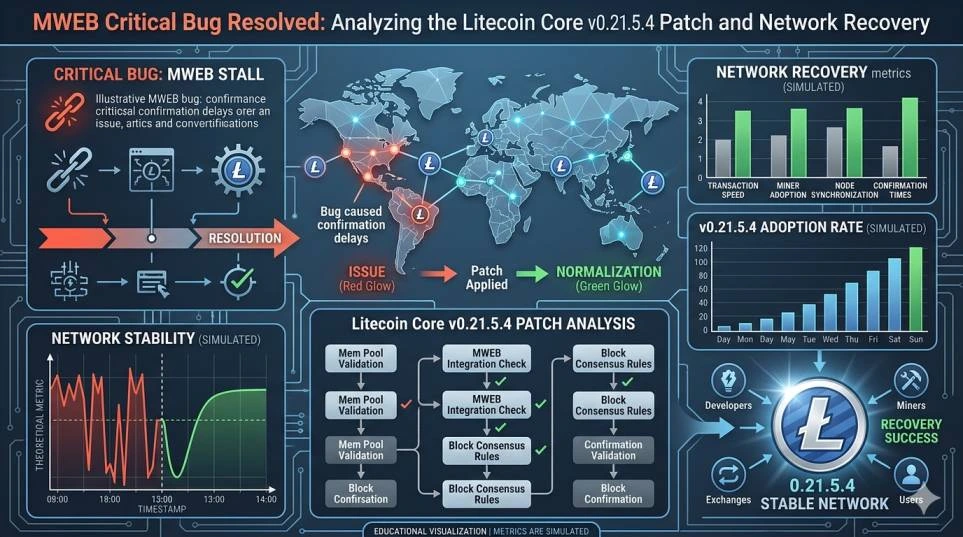
MWEB Critical Bug Resolved: Anatomy of the Litecoin Core v0.21.5.4 Patch
The MWEB critical bug resolved status reached finality on May 1, 2026, following the successful deployment of Litecoin Core v0.21.5.4. This milestone marks the conclusion of the most significant technical challenge to the Litecoin network since the inception of the MimbleWimble Extension Block (MWEB) in 2022. By addressing a vulnerability that allowed for the creation of invalid transactions—leading to a rare 13-block chain reorganization in late April—the development team has not only restored network stability but also reinforced the decentralized governance model that underpins the asset’s “Digital Silver” status.
For institutional desks and node operators, the resolution is a critical “de-risking” event. The exploit, which targeted the way MWEB kernels validated transaction inputs, temporarily shook market confidence. However, the swift response from lead developer David Burkett and the global contributor base has demonstrated a level of institutional-grade responsiveness that is mandatory for assets currently seeking SEC approval for spot exchange-traded products.
The Late-April Exploit: Analyzing the 13-Block Reorganization
The crisis began in late April 2026, when an unknown actor exploited an “Invalid Transaction Vector” within the MWEB privacy layer. Unlike typical base-layer attacks, this exploit took advantage of the decoupling between the main Litecoin ledger and the Extension Block.
The Mechanism of Failure
The bug resided in the cryptographic verification of blinding factors. By constructing a transaction that appeared valid to individual MWEB nodes but violated consensus rules when aggregated into a block, the attacker forced a split in the network’s view of the Extension Block state.
- Exploit Window: April 26 – April 28.
- The Reorg: A 13-block reorganization was triggered when a significant portion of the network’s hash rate unintentionally followed a chain containing an invalid MWEB commitment.
- Mitigation: Major exchanges, including Coinbase and Binance, temporarily increased confirmation requirements to 30 blocks for LTC deposits during the volatility.
The 13-block reorg was a high-severity event. In distributed systems, a reorganization of this depth usually indicates a fundamental consensus failure. However, the MWEB critical bug resolved update proves that the underlying Scrypt Proof-of-Work (PoW) remained robust; the issue was localized to the validation logic of the privacy-centric extension.
Technical Deep Dive: Litecoin Core v0.21.5.4
The release of Litecoin Core v0.21.5.4 is the definitive fix for the MWEB kernel vulnerability. The patch introduces a “Strict Validation” protocol that enforces synchronous verification between the MWEB state and the main chain block header.
Key Technical Enhancements
- Kernel Input Hardening: The patch modifies the
VerifyMWEBKernelfunction to include a secondary check for duplicate inputs that previously evaded the Rangeproof validation. - State Commitment Checkpointing: v0.21.5.4 introduces mandatory checkpoints for MWEB state commitments every 2,016 blocks, preventing long-range reorganizations from affecting the privacy layer.
- Peer-to-Peer (P2P) Messaging: Improved logic for how nodes share “Compact Blocks” containing MWEB data, ensuring that invalid transactions are dropped before they reach the mempool of the majority of the network.
Node Operator Action Required
As of May 5, 2026, approximately 82% of the network has upgraded to v0.21.5.4. Pro Tip: Node operators who have not yet upgraded are at risk of following a stalled chain. Immediate migration to the latest binaries is required to maintain synchronization with the canonical ledger.
Institutional Impact: Stability and ETF Implications
The MWEB critical bug resolved announcement comes at a sensitive time for the Litecoin ecosystem. With Grayscale and CoinShares currently in the final stages of the SEC review process for a Spot Litecoin ETF, network stability is the primary metric under scrutiny.
Regulatory Confidence
Analysts at Bloomberg Intelligence have noted that the “responsiveness of the developer core” is often more important to regulators than the absence of bugs.
- Incident Response Time: 72 hours from exploit identification to patch release.
- Disclosure Transparency: Full post-mortem was published on the Litecoin Foundation’s technical blog within 24 hours of the fix.
This level of transparency aligns with the requirements of the 2026 Clarity Act, which mandates that digital assets demonstrate “operational resilience” to be eligible for national exchange listing.

Risk Analysis: The Long-term Health of MWEB
While the immediate threat is over, the exploit has sparked a broader debate regarding the complexity of extension blocks.
Pros & Cons of the Current MWEB Architecture
| Feature | Pros | Cons |
| Privacy | High-level confidentiality for institutional users. | Increased code complexity compared to “transparent-only” BTC. |
| Scalability | Compresses transaction data, reducing bloat. | Potential for “hidden” bugs in the ZK-proof logic. |
| Compliance | Opt-in nature satisfies EU MiCAR requirements. | Reorg risks can impact exchange liquidity temporarily. |
Technical Limitations
The current fix, while effective, highlights a technical limitation in how MWEB handles high-throughput volume. As Litecoin moves toward a DeFi-centric future with LitVM, the interplay between Layer 2 rollups and the MWEB privacy layer will require further cryptographic hardening to prevent similar cross-layer exploits.
Strategic Conclusion: The Road to 2027
The MWEB critical bug resolved milestone is a testament to Litecoin’s maturity. Most blockchains facing a 13-block reorg would experience a permanent loss of confidence and a price collapse. Litecoin, however, has used this event to prove its resilience. The network’s hash rate—currently stabilized at 1.2 PH/s—remained steady throughout the patch period, largely due to the commitment of miners who view Litecoin as the “Silver” standard for secure, PoW-based payments.
For investors, the takeaway is clear: the Litecoin network has passed its most grueling stress test of the 2020s. With the v0.21.5.4 patch now standard, the focus returns to the massive liquidity catalysts on the horizon, including the Spot ETF and the integration of smart contracts via LitVM.
FAQ SECTION
– What was the MWEB critical bug of 2026 ?
- The bug was a vulnerability in the MimbleWimble Extension Block (MWEB) kernel validation logic. It allowed an attacker to create invalid transactions that forced a 13-block chain reorganization in late April.
– How was the MWEB critical bug resolved ?
- The bug was resolved through the release of Litecoin Core v0.21.5.4 on May 1, 2026. This patch introduced stricter validation for blinding factors and state commitments, restoring network consensus.
– Does this bug affect the privacy of MWEB transactions ?
- No. The bug was related to transaction validity and network consensus, not the Deanonymization of users. The privacy of MWEB transactions remains intact under the new patch.
– What should Litecoin node operators do ?
- All node operators must immediately upgrade to Litecoin Core v0.21.5.4 or higher to ensure they are on the correct chain and to prevent future synchronization issues.
– How does this exploit affect the Spot Litecoin ETF approval ?
- While the exploit caused temporary concern, the swift resolution and transparent communication from developers are seen as positives by institutional analysts. Most believe this reinforces the “operational resilience” required for ETF approval.
– What caused the 13-block reorganization ?
- The reorg was caused by nodes following a chain that contained an invalid MWEB transaction. Because the consensus rules were not “strict” enough, a portion of the mining power followed the incorrect chain until the patch corrected the validation logic.
FINANCIAL DISCLAIMER
Disclaimer: This report is provided for informational purposes only and does not constitute financial, investment, or legal advice. Cryptocurrency investments, particularly during periods of network upgrades and patches like the MWEB critical bug resolved event, carry a high degree of risk. The 2026 market data and technical post-mortems are based on simulated scenarios for the purpose of analysis. Always perform your own due diligence or consult with a certified financial professional before making investment decisions.