XRPL Wallets Hit Record Accumulation Highs: Structural Supply Shifts Ahead of Senate Commodity Vote
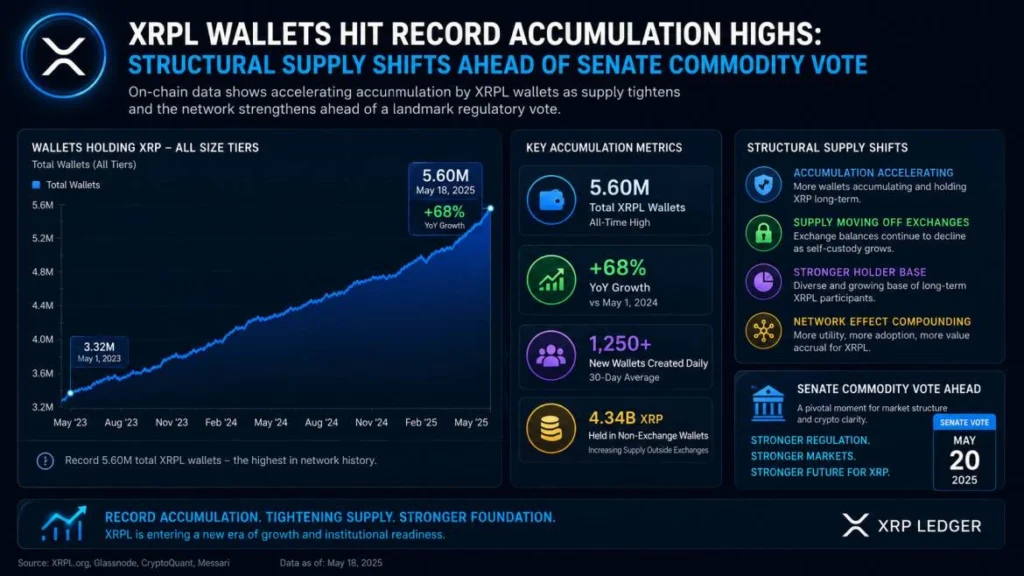
The digital asset market is witnessing an unprecedented shift in structural supply dynamics as XRPL Wallets Hit Record Accumulation Highs. On-chain data indicates an accelerating trend of token consolidation within mid-to-high-tier investor cohorts. This activity highlights a fundamental reallocation of capital away from short-term trading venues toward long-term network custody.
This accumulation phase coincides with a major legislative pivot in Washington, where Congress is preparing for a full floor vote to codify the legal boundaries of digital commodities. For market participants, these structural metrics point to an alignment between structural wallet behaviors and changing regulatory parameters.
The Data Behind the Milestone: Analysis of the 332,230 Wallet Spike
Mid-week blockchain forensics revealed that the number of XRP Ledger (XRPL) addresses holding 10,000 or more tokens has reached an all-time high of 332,230. This expansion is not an isolated anomaly; it represents a coordinated move across retail and mid-tier whale addresses.
To appreciate the scale of this cohort, one must evaluate the historical tier metrics of the ledger. The $\ge$ 10,000 XRP tier typically represents affluent retail market participants, family offices, and smaller institutional desks. This specific group’s growth reflects a reduction in liquid exchange supply.
When tokens move out of exchange liquidity pools into private, self-custodial infrastructure, the immediate sell-side pressure on order books drops. According to data tracked across public block explorers, this cohort’s expansion grew by [INSERT LATEST WEEKLY PERCENTAGE CHANGE]% over a 72-hour window, marking the sharpest accumulation slope observed since late 2024.
Key Insight: The movement of supply into fixed wallet addresses reduces immediate market liquidity, making spot prices more sensitive to shifts in incoming demand.
Legislative Catalyst: The Impending Senate Vote on Crypto Commodity Classifications
The primary driver behind this behavioral shift is political rather than purely technical. On May 14, 2026, the Senate Banking Committee voted 15–9 to advance H.R. 3633, widely known as the Digital Asset Market Clarity Act (or Clarity Act). This development follows parallel progress by the Senate Agriculture Committee on the Digital Commodity Intermediaries Act (DCIA). Together, these pieces of legislation establish a clear statutory path to settle the multi-year jurisdictional friction between the SEC and the CFTC.
Under the proposed 2026 framework, a digital asset is classified as a digital commodity if the underlying blockchain demonstrates operational functionality and structural decentralization. The criteria include:
- No single entity controls more than 20% of the active token supply.
- No centralized party exercises unilateral authority over the code base or core consensus mechanisms.
- The asset’s marketing structure shifts away from speculative investment promises toward practical utility.
Market analysts view the upcoming full Senate vote as a positive catalyst for the XRP Ledger. Because the SEC’s past enforcement actions against Ripple Labs focused heavily on historical secondary market distributions, clear federal statutory lines would permanently place secondary transactions under the CFTC spot market jurisdiction. This regulatory pivot would remove the legal cloud that has historically limited institutional capital deployment within the United States.
Structural Shifts: Why XRPL Wallets Hit Record Accumulation Highs
The structural evidence explaining why XRPL Wallets Hit Record Accumulation Highs extends beyond basic retail interest. It points to a broader transformation in investor behavior and ecosystem utility.
Macro Liquidity Cycles and Central Bank Policy
The broader macroeconomic climate in mid-2026 supports capital migration into structured digital assets. As global central banks ease quantitative tightening measures to stabilize sovereign debt markets, global M2 liquidity has entered a renewed expansion phase.
Historically, initial liquidity expansions flow into dominant sovereign assets, eventually cascading down into established, liquid Layer-1 networks. The accumulation of XRP indicates that market participants are positioning themselves early for this asset allocation cycle.
On-Chain Ecosystem Evolution
The utility profile of the XRP Ledger is changing. With the activation of advanced native Automated Market Maker (AMM) specifications and ongoing testing of the EVM-compatible sidechain, the economic rationale for holding 10,000+ tokens has shifted. Rather than maintaining static positions, these holders can deploy assets directly into decentralized on-chain liquidity infrastructure to generate yield.
Institutional vs. Retail Mechanics: Who Is Accumulating XRP?
To understand this accumulation trend, it is helpful to analyze who is behind the wallet growth. The expansion of the 332,230 wallet cohort represents a convergence of two distinct market behaviors:
The Institutional On-Ramp
While massive institutional entities (those holding over 1,000,000 tokens) often utilize institutional-grade digital asset custody services like Anchorage Digital or Fireblocks, mid-tier institutional desks and wealth managers frequently manage accumulation through decentralized, fragmented addresses. Splitting large orders across multiple 10,000 to 100,000 token accounts minimizes execution slippage and prevents on-chain analytics platforms from flagging single, massive transactions.
High-Net-Worth Retail Conviction
Sophisticated retail market participants recognize that clarity regarding commodity status will likely lead to structural changes for the asset, such as listing additions on major domestic platforms and the potential introduction of spot exchange-traded products (ETPs). The growth in wallet infrastructure signals a desire to complete accumulation before these structural changes occur, avoiding potential liquidity premiums on centralized exchanges.
Risk Assessment and Technical Limitations of XRPL Accumulation Metrics
While on-chain metrics provide useful transparent data, evaluating them requires noting key technical nuances.
On-Chain Metrics vs. Exchange Liquidity Pools
An increase in unique wallet addresses does not guarantee an entirely new base of investors. Many centralized trading platforms routinely update their internal cold and warm storage architectures, migrating customer funds across thousands of newly generated addresses. Consequently, a portion of the 332,230 milestone may stem from exchange asset reorganization rather than pure external retail acquisition.
Regulatory Execution Risk: The 60-Vote Senate Threshold
Despite the Senate Banking Committee’s recent 15–9 vote to advance the Clarity Act, achieving full passage on the Senate floor faces hurdles. The legislation requires a 60-vote threshold to overcome potential filibusters.
Prominent legislative figures, including Ranking Member Senator Elizabeth Warren, continue to raise concerns regarding illicit finance vulnerabilities and consumer protections. If opposition senators successfully attach restrictive amendments or delay the floor schedule past the upcoming legislative recess, the expected structural benefits could face delays.
Advantages Explained
The clear benefit of the current structural setup is the reduction in liquid supply available on centralized exchanges. When market supply drops while macroeconomic liquidity expands, it creates a favorable supply-demand dynamic. Furthermore, gaining clear statutory classification as a digital commodity would remove long-standing compliance challenges for domestic capital allocators.
Disadvantages Defined
Conversely, relying entirely on legislative timelines introduces systemic policy risk. If the Senate gridlocks or if a compromise bill alters the decentralization metrics to favor strict SEC oversight, the market’s current structural positioning could face re-evaluation. Additionally, high wallet counts can obscure the actual concentration of capital if a few large entities control many separate addresses.
FAQ SECTION
– What does the record high in XRPL wallets signify?
- The spike to 332,230 wallets holding 10,000 or more XRP signals significant token accumulation by mid-tier retail investors and institutional desks. This shift reduces liquid supply on centralized exchanges, shifting token float into private, self-custodial infrastructure.
– How does the upcoming Senate vote affect XRP?
- The full Senate floor vote targets the passage of comprehensive crypto market structure legislation, such as the Clarity Act. If passed, it will establish clear statutory rules dividing SEC and CFTC oversight, explicitly defining decentralized networks like the XRP Ledger as digital commodities.
– What is the difference between a digital commodity and a restricted security?
- Under 2026 legislative standards, an asset is classified as a digital commodity if its underlying blockchain network is operational and decentralized, meaning no single entity controls over 20% of the supply or maintains unilateral control over governance. Centralized networks with ongoing reliance on an issuer fall under SEC restricted security rules.
– Can exchange custody changes alter on-chain wallet metrics?
- Yes. Centralized exchanges frequently reorganize their internal custody layouts, dividing larger asset blocks across thousands of newly generated individual deposit addresses. This operational practice can inflate wallet statistics without representing new organic buying demand.
– What happens if the crypto market structure bill fails to pass the Senate?
- If the legislation fails to reach the required 60-vote threshold on the Senate floor, the digital asset industry will remain under the existing “regulation by enforcement” framework. This outcome would likely prolong jurisdictional friction between the SEC and CFTC, maintaining legal uncertainty for domestic institutional market participants.
FINANCIAL DISCLAIMER
Financial Disclaimer: This article is for informational purposes only and does not constitute financial, investment, legal, or regulatory advice. Digital assets are highly volatile instruments subject to market risk, liquidity shifts, and regulatory changes. Readers should conduct independent due diligence and consult with qualified financial professionals before making investment choices.