

Spot XRP ETFs See Highest Inflows Since January Following $153.8 Million Goldman Sachs Disclosure
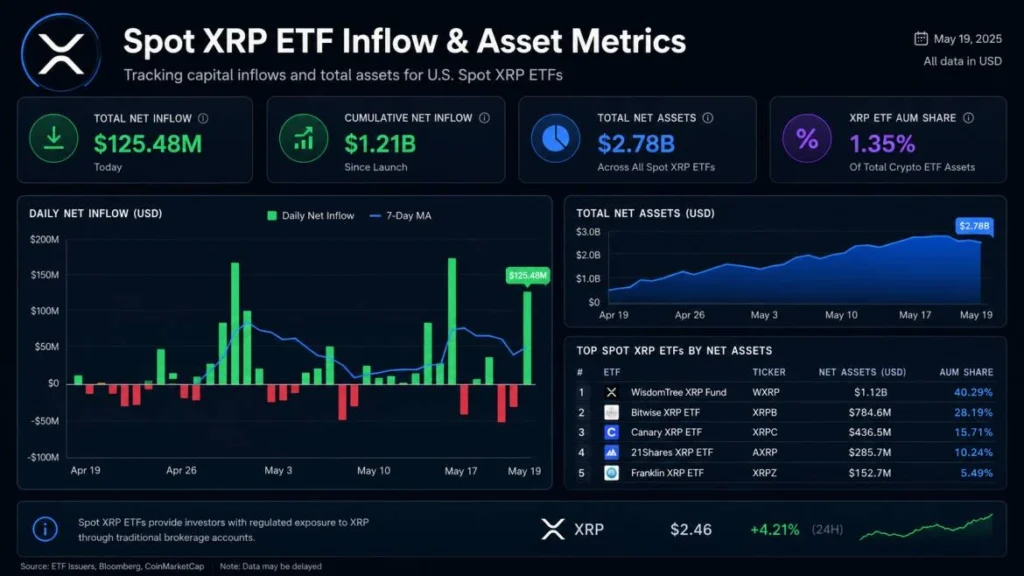
Institutional capital allocation within the digital asset market underwent a structural shift on May 12, 2026. The five U.S.-listed spot XRP ETFs recorded their highest single-day institutional influx since January 5. This capital acceleration pushes the cumulative net inflows since their late-2025 launch past the $1.35 billion threshold, cementing the vehicle’s status as a core alternative asset class for institutional portfolios.
This liquidity concentration coincided with a major regulatory filing. A 13F disclosure revealed that Goldman Sachs holds a massive $153.8 million position in these newly established spot XRP ETFs. The convergence of clear capital flows and tier-1 banking validation marks a distinct phase of maturity for the underlying asset, shifting the narrative from legacy regulatory disputes to institutional market integration.
Analyzing the May 12 Capital Influx into Spot XRP ETFs
The acceleration of single-day flows on May 12 reflects a programmatic and systematic allocation cycle rather than retail momentum. According to aggregated market-maker sheets, the influx was distributed across the five primary domestic fund offerings, led by issuers that established deep institutional clearing networks early in the listing cycle.
The five approved U.S. issuers—comprising offerings from Bitwise, Canary Capital, Grayscale, Franklin Templeton, and 21Shares—experienced a simultaneous compression of tracking errors as institutional size hit the order books. The single-day volume peak confirms that capital allocators are treating the current price levels as a structurally sound entry zone. This collective action indicates that institutional desks are utilizing these products to establish structural positions rather than short-term tactical trades.
Reaching $1.35 billion in cumulative net inflows over an approximate six-month window establishes these investment vehicles as viable institutional choices. The acceleration curve highlights a successful transition through the seasoning period. This path was reinforced by the establishment of the CME CF XRP-Dollar Reference Rate, which provided the necessary pricing integrity required by institutional compliance officers before committing large blocks of capital. The sustained capital velocity demonstrates that the product infrastructure has successfully addressed the legal and administrative hurdles that historically restricted alternative digital asset allocations.
The Goldman Sachs Catalyst: Strategic 13F Disclosures Explained
When an institutional participant of Goldman Sachs’ scale discloses a $153.8 million concentration in spot XRP ETFs, the underlying implications extend far beyond basic asset accumulation. In traditional market architecture, such a balance sheet position points to several operational realities within investment banking operations.
Large investment firms rarely assume outright directional risk on emerging alternative products using proprietary capital. Instead, a position of this magnitude generally points to two structural functions: client-facing wealth management and prime brokerage market-making. Wealth management divisions service direct demand from ultra-high-net-worth individuals and single-family offices that require regulated exposure without the operational complexities of native token custody. Meanwhile, prime brokerage desks maintain adequate inventory to facilitate institutional block trades, options clearing, and structured lending products for hedge funds utilizing relative-value arbitrage strategies.
Tier-1 institutions also serve as Authorized Participants to exploit minor discrepancies between the ETF’s share price and its net asset value. When institutional buying causes the ETF shares to trade at a premium relative to the underlying spot market, Authorized Participants purchase spot XRP, deliver it to the fund custodian, and create new ETF shares to capture the risk-free arbitrage margin. This mechanism ensures deep liquidity and low tracking errors for the product suite.
Macroeconomic and Legislative Tailwinds: The Digital CLARITY Act of 2026
The institutional accumulation of spot XRP ETFs is happening within a shifting macroeconomic and legislative environment. Financial institutions are adjusting their digital asset playbooks in response to updated regulatory structures and shifting global liquidity conditions.
As the Federal Reserve manages its balance sheet and interest rate framework in 2026, institutional asset allocators face compressed yield profiles across legacy fixed-income instruments. This structural reality forces multi-strategy funds to diversify a percentage of capital into liquid alternatives that exhibit low correlation with traditional equity markets. Due to its utility in international bank settlement frameworks, XRP presents a distinct alternative asset risk profile for portfolio construction.
The major catalyst for the capital influx on May 12 was the legislative progress of the Digital CLARITY Act in the U.S. Senate Banking Committee. The committee’s 15-to-9 bipartisan vote to advance the bill provides an explicit federal statutory framework, recognizing XRP as a digital commodity. This legislative milestone effectively eliminates lingering institutional legal concerns, providing a clear path for corporate treasuries and institutional asset managers to deploy capital into these funds.
Technical Market Structure: Order Books, Liquidity, and Token Distribution
The performance of spot XRP ETFs is structurally dependent on the health and depth of the underlying spot market. Market microstructure data indicates that the institutional bid is matching a heavy phase of wallet consolidation.
On-chain analytics from Santiment reveal a strong correlation between exchange-traded product flows and native ledger behavior. Addresses holding a minimum of 10,000 XRP have reached an all-time high of 332,230 wallets. This cohort’s growth indicates that sophisticated market participants were building spot positions throughout the early 2026 accumulation phase, setting a firm floor between $1.40 and $1.45. This on-chain floor minimized downward price risk for the institutional desks deploying capital through the ETF complex on May 12.
The efficiency of an ETF depends on the order book depth of its underlying asset across regulated spot exchanges. As institutional trading volume expands, market makers have tightened bid-ask spreads to historical lows. This deep liquidity reduces execution slippage during the daily calculation of the fund’s net asset value, ensuring that large institutional creation baskets do not distort the spot market structure during the closing auction window.
Institutional Pros, Cons, and Risk Analysis of Spot XRP ETFs
Portfolio managers must balance the operational efficiencies of institutional wrapper products against the unique structural constraints of exchange-traded crypto vehicles.
On the positive side, these vehicles offer regulated custody integration, standardized tax compliance, and clear clearing routes. Capital avoids native cryptographic platform vulnerabilities by relying on institutional custodians like Coinbase Custody and Anchorage Digital. Fund performance generates standard tax documentation, fitting easily into institutional reporting software. Furthermore, orders clear through standard institutional broker-dealers and central clearing corporations, eliminating counterparty risks associated with unregulated venues.
Conversely, operational challenges remain. Expense ratios compound over multi-year horizons, potentially reducing net returns compared to direct spot exposure. Traditional market hour limitations mean that the ETF vehicles trade only during standard U.S. exchange hours, exposing institutional holders to gap risk during weekend or overnight international market moves. There is also the risk of premium or discount volatility relative to the net asset value during periods of extreme market stress or infrastructure disruptions.
Competitive Landscape: The Digital Asset Allocator Vector
As spot XRP ETFs capture a larger share of institutional capital, they alter the competitive landscape for digital asset assets under management, which has been dominated by Bitcoin and Ethereum vehicles.
While Bitcoin is primarily held as a digital store of value and Ethereum represents an application layer index, XRP’s value thesis centers on its role as an institutional settlement asset for cross-border liquidity. This distinct operational focus allows asset managers to use these funds as a diversifier rather than a direct substitute for other digital assets. Multi-asset portfolios are increasingly using these three instruments to construct balanced digital asset allocations, using each asset’s unique market profile to optimize risk-adjusted returns.
The rotation of capital into alternative digital asset structures suggests that sophisticated allocators are moving toward a multi-asset framework for digital assets, moving away from simple single-asset strategies. As the market moves through the remainder of 2026, the adoption curve of these funds will likely depend on the final passage of the Digital CLARITY Act on the Senate floor. If legislative momentum holds, the current $1.35 billion inflow milestone could serve as the foundation for broader institutional participation across Wall Street asset management platforms.
Frequently Asked Questions
– What caused the record inflows into spot XRP ETFs on May 12 ?
- The record influx was driven by institutional asset accumulation following a key 13F regulatory filing. This disclosure revealed that Goldman Sachs holds a $153.8 million position in spot XRP ETFs, validating the product architecture and triggering programmatic buy orders across multiple institutional desks.
– What is the total cumulative inflow for spot XRP ETFs in 2026 ?
- Cumulative net inflows have surpassed the $1.35 billion mark since the product suite’s late-2025 launch, reflecting steady, structural accumulation by institutional asset managers rather than short-term retail speculation.
– How does the Digital CLARITY Act impact spot XRP ETFs ?
- The Digital CLARITY Act significantly de-risks these investment vehicles. The Senate Banking Committee’s 15-to-9 bipartisan vote to advance the bill provides clear statutory recognition of XRP as a digital commodity, removing regulatory ambiguity for institutional compliance departments.
– Why do institutional allocators prefer spot XRP ETFs over direct token ownership ?
- Institutional allocators utilize spot XRP ETFs because they fit directly into existing prime brokerage, clearing, and custody architectures. This framework removes the operational burdens, security requirements, and regulatory complexities associated with managing native cryptographic keys.
– Which issuers currently offer approved spot XRP ETFs in the United States ?
- There are currently five active U.S. issuers offering these funds: Bitwise, Canary Capital, Grayscale, Franklin Templeton, and 21Shares. All five rely on regulated benchmark index pricing, such as the CME CF XRP-Dollar Reference Rate, to minimize tracking error.
Financial Disclaimer
Disclaimer: The information provided in this analysis is for informational and educational purposes only and does not constitute financial, legal, or investment advice. Digital asset products, including spot exchange-traded funds (ETFs), are highly volatile instruments subject to significant market, operational, and regulatory risks. Past performance is not indicative of future market results. Disclosed institutional positions via 13F filings reflect historical quarterly balances and do not represent active investment endorsements or directional recommendations for retail portfolios. Investors should conduct thorough due diligence and consult with a certified financial advisor before making any allocation decisions.