

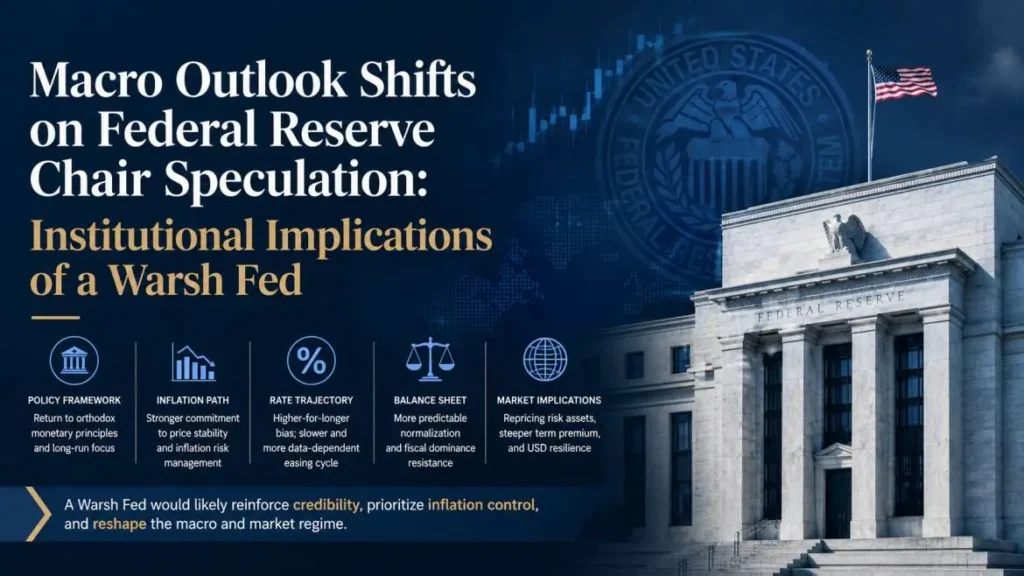
Macro Outlook Shifts on Federal Reserve Chair Speculation: Institutional Implications of a Warsh Fed
Macro outlook shifts on federal reserve chair speculation have reached a critical tipping point as institutional trading desks re-examine the core structural foundations of U.S. monetary policy. The confirmation of Kevin Warsh to take over the chairmanship of the Federal Reserve has introduced a new variable into global macro models. Allocators are actively balancing Warsh’s historical criticism of legacy central banking frameworks against a complex economic backdrop defined by sticky 3.50% to 3.75% interest rates and persistent inflation pressures.
While broader markets remain cautious due to restrictive cost-of-capital constraints, the digital asset derivatives sector has shown signs of heightened sensitivity. Earlier in the week, Bitcoin perpetual funding rates spiked to an annualized recent high of 6%. This sharp move reveals a buildup of leveraged bullish positions, which was subsequently cooled by a standard weekend pullback. This leverage dynamic highlights a growing institutional view that looks past short-term interest rate friction to focus on a broader long-term adjustment in central bank policy.
The Warsh Doctrine: “New Gold” and Institutional Re-pricing
The nomination and confirmation of Kevin Warsh represents a clear shift from the monetary approach maintained under Jerome Powell. Warsh, a former Morgan Stanley investment banker and the youngest governor in Federal Reserve history during the 2008 financial crisis, brings a distinct market-oriented perspective to the central bank’s leadership.
Decoding the “New Gold” Thesis
Of particular interest to digital asset strategists is Warsh’s public view regarding alternative reserve assets. He has noted that Bitcoin functions as a modern form of gold, serving as a structural store of value and an inflation hedge for younger demographics.
This interpretation marks a significant departure from traditional central bank rhetoric, which routinely dismisses non-fiat assets as speculative instruments. By framing digital assets as a legitimate generational store of value, Warsh’s presence at the head of the Fed could accelerate the integration of crypto-assets into institutional treasury strategies. If the leader of the world’s primary central bank recognizes the structural validity of digital alternatives, it alters the regulatory risk premium used by compliance officers at major wirehouses and sovereign wealth funds.
The Influence of Private Sector Experience
Warsh’s recent work alongside billionaire investor Stanley Druckenmiller has further shaped his views on capital market dynamics. Druckenmiller has long warned of fiscal dominance—where central bank policy becomes secondary to funding government debt.
Reflecting these concerns, Warsh has argued that current monetary strategies rely too heavily on backward-looking data models. He advocates for forward-looking indicators derived directly from live market pricing. This approach suggests the Fed may reduce its reliance on delayed econometric prints and focus more on real-world asset indicators, corporate credit spreads, and market-implied inflation expectations.
Sticky Interest Rates vs. Crypto Liquidity Cycles
Despite the optimistic sentiment surrounding long-term policy adjustments, the immediate macroeconomic environment presents real structural headwinds for risk-on capital allocations.
The Reality of the 3.50%–3.75% Terminal Rate Floor
Recent economic data confirms that inflation remains stubborn, with core consumer prices rising well above the target baseline. Consequently, data from the CME FedWatch tool indicates that the Federal Open Market Committee (FOMC) is highly likely to keep the benchmark federal funds rate pinned within the 3.50% to 3.75% range for the remainder of 2026.
This prolonged high-rate environment keeps the baseline cost of capital elevated, creating an environment where risk assets must compete directly with safe-haven yielding instruments:
- Yield Competition: Short-duration U.S. Treasury bills yielding near 4% drain passive liquidity from risk-on ecosystems.
- Margin Compression: High borrowing costs increase the hurdle rate for speculative investments, limiting institutional credit expansion.
- Equity Risk Premium Friction: The compressed spread between equity yields and risk-free returns encourages asset managers to maintain conservative portfolio balances.
Structural Capital Inflows and Network Decoupling
Despite these high interest rates, digital asset networks are demonstrating structural resilience, driven by shifting macro perspectives on inflation and changing allocation trends.
The steady growth of institutional spot inflows, combined with clear fair-value accounting rules, has helped decouple digital asset performance from traditional technology equities. As investors realize that a 3.50% policy rate may not fully suppress supply-side inflation pressures, alternative reserve assets with fixed programmatic issuance schedules are increasingly viewed as necessary components of long-term portfolios rather than mere speculative options.
Derivatives Deep Dive: The 6% Perpetual Funding Rate Spike
The tension between long-term policy optimism and short-term interest rate constraints recently played out in crypto derivatives markets, resulting in a classic leverage squeeze.
Mechanics of the Funding Rate Anomaly
Earlier in the week, the perpetual swap market experienced an unusual surge in demand. The funding rate for Bitcoin perpetual contracts briefly climbed to an annualized peak of 6%. To understand the structural implications of this anomaly, it is helpful to look at the underlying mechanics of perpetual swap pricing.
Because perpetual contracts do not have a fixed expiry date, they utilize an 8-hour funding mechanism to keep the contract price aligned with the underlying spot index:
- Positive Funding Rates: When the perpetual contract trades at a premium to the spot price, long traders must pay a fee to short traders.
- The 6% Annualized Spike: This level indicates an extreme imbalance in market leverage, showing that long buyers were willing to pay high funding premiums just to maintain their leveraged exposure.
- Liquidity Absorption: This high cost of leverage drains capital from trading accounts over time, making long positions highly vulnerable to sudden downswings if spot momentum stalls.
Leveraged Liquidation Profiles and the Weekend Pullback
This extreme leverage created a fragile market structure. As spot buying volume slowed ahead of the weekend, market makers began reducing their active bids to manage risk over the low-liquidity weekend session.
When spot prices slipped by even a small margin, it triggered automated stop-loss orders on highly leveraged long positions. This selling pressure quickly snowballed into a minor liquidation cascade, cleaning out the speculative froth and bringing funding rates back down to baseline levels. This flushing of leverage highlights the ongoing disconnect between optimistic long-term macro speculation and the realities of short-term liquidity constraints.
Structural Risks: Fed Independence and Regime Change Scenarios
A core element of the macro outlook shifts on federal reserve chair speculation centers on Warsh’s public calls for a fundamental “regime change” in the organizational structure of the Federal Reserve.
Balance Sheet Reduction vs. Rate-Cut Pressures
Warsh has frequently argued that the Federal Reserve’s balance sheet is bloated, and that holding trillions of dollars in government debt distorts traditional credit pricing. He advocates for an accelerated reduction of the Fed’s asset holdings through Quantitative Tightening (QT), suggesting that a smaller balance sheet would allow the economy to function cleanly with a lower baseline policy rate.
[Warsh Balance Sheet Strategy: Accelerated Asset Liquidation (QT) -> Structural Banking System Drain]
vs.
[Political Administration Goals: Aggressive Nominal Rate Reductions -> Systemic Credit Expansion]
This strategy introduces a unique structural paradox for financial markets:
- Short-Term Liquidation Risks: Accelerating the reduction of the Fed’s balance sheet removes bank reserves and tightens base-layer liquidity, which can create a deflationary headwind for high-beta risk assets.
- Long-Term Policy Reconfiguration: If successful, this approach could lower structural interest rates over time, but the initial transition phase risks creating unexpected volatility in banking reserves and dollar swap markets.
The Threat to Central Bank Independence
Furthermore, Warsh’s confirmation has drawn criticism from analysts who worry about the erosion of the Federal Reserve’s political independence. Critics point out that Warsh’s policy shifts have occasionally aligned with political calls for lower interest rates, raising concerns that the central bank could face pressure to prioritize short-term growth over long-term price stability.
If international investors begin to perceive that the Fed is prioritizing political goals over sound monetary policy, it could weaken confidence in the U.S. dollar’s role as the global anchor currency, accelerating the shift toward decentralized asset alternatives.
Institutional Strategy Matrix: Asset Allocation Under a Warsh Fed
As financial institutions adjust to this new leadership era, asset managers are adapting their trading frameworks to handle the unique policy mix of a Warsh Fed.
Implementation of the Basis Trade
Given the frequent spikes in perpetual funding rates, institutional desks are increasingly deploying market-neutral basis trades to capture predictable yield spreads.
[Inflow of Institutional Capital] -> [Long Spot Asset Purchase (CME/ETF)]
                                  -> [Short Perpetual Contract Sale (Binance/Bybit)]
                                  -> [Capture 6% Non-Directional Yield Spread]
By purchasing spot Bitcoin through regulated exchange-traded products (ETPs) and simultaneously selling an equivalent short position in high-funding perpetual contracts, fund managers can lock in a low-risk yield that regularly outperforms traditional fixed-income instruments, all without taking on directional market risk.
Balanced Allocation Frameworks
For directional investment portfolios, managers are implementing structured frameworks designed to navigate short-term volatility while capturing long-term gains:
- Spot Accumulation Focus: Using short-term leverage washouts and weekend pullbacks to build core spot holdings, avoiding the risks of high perpetual funding costs.
- Options-Based Tail Protection: Utilizing downside put options to protect spot holdings against sudden liquidation drops, ensuring portfolios can withstand short-term margin squeezes.
- Macro Correlation Modeling: Monitoring changes in the Fed’s balance sheet and bank reserve levels rather than focusing solely on nominal interest rate announcements, tracking the true drivers of market liquidity.
Comparison: Fed Policy Environments and Digital Asset Performance
To better understand how this new leadership direction differs from previous eras, we can map the core characteristics of the Federal Reserve’s policy environments across recent cycles.
| Federal Reserve Leadership Era | Dominant Policy Focus | Average Balance Sheet Trend | Digital Asset Market Impact |
| Late Powell Era (2024–2025) | Data-dependent, cautious fine-tuning | Slow, predictable reduction | Driven by spot ETF approvals and traditional inflows |
| Early Warsh Era (2026) | Market-driven, structural revamp | Accelerated Reduction (Aggressive QT) | High volatility with long-term re-pricing as a reserve asset |
| Political Pressure Scenario | Growth-oriented, nominal rate focus | Expansionary or flat lining | Accelerated debasement hedge buying and structural capital shifts |
This structural breakdown shows that while the early stages of a Warsh chairmanship may introduce liquidity friction due to aggressive balance sheet adjustments, the long-term changes to how alternative reserve assets are viewed could create a constructive backdrop for digital asset networks.
Operational Realities: Navigating 2026 Compliance Realities
Finally, institutional participants must evaluate these shifting macro realities alongside changing regulatory standards.
The implementation of new tax guidelines, such as the IRS Form 1099-DA broker reporting requirements, means that capital moves must be supported by transparent compliance tracking. Institutional trading desks must ensure that their automated basis trading and liquidity provisions are fully integrated with robust back-end accounting systems to avoid operational compliance risks.
FAQ SECTION
– How does speculation about the Federal Reserve chair affect crypto markets?
- Speculation regarding Fed leadership changes shifts expectations for future interest rates, balance sheet strategies, and regulatory approaches. When a nominee with a market-oriented background or an open stance toward digital assets emerges, it can alter institutional risk premiums, shifting capital flows between traditional Treasuries and alternative reserve assets.
– What does Kevin Warsh’s “new gold” thesis mean for Bitcoin?
- Kevin Warsh’s “new gold” thesis suggests that Bitcoin serves as a legitimate programmatic store of value and an inflation hedge, particularly for younger generational cohorts. If a sitting Federal Reserve chair holds this view, it lends institutional credibility to digital assets, potentially accelerating their adoption as alternative corporate reserve assets.
– Why did Bitcoin perpetual funding rates spike to 6% earlier in the week?
- The spike to an annualized 6% was driven by an over-allocation of leveraged long positions in the derivatives market. This premium indicated that buyers were willing to pay high funding fees to maintain their bullish exposures, creating a top-heavy market structure vulnerable to sudden liquidations when spot momentum slowed.
– How do sticky 3.50%–3.75% interest rates impact digital asset liquidity?
- Sticky interest rates keep the baseline cost of capital high, ensuring that low-risk options like U.S. Treasury bills continue to offer strong competition for capital. This environment requires digital assets to demonstrate clear structural advantages or secular growth to attract institutional capital inflows.
– What risks does an accelerated reduction of the Fed balance sheet pose?
- An accelerated reduction of the Federal Reserve’s balance sheet through Quantitative Tightening (QT) drains reserves from the banking system and reduces overall liquidity. This tightening can create short-term challenges for high-beta risk assets, even if accompanied by lower nominal interest rates.
FINANCIAL DISCLAIMER
Disclaimer: The analysis provided above is for informational and educational purposes only and does not constitute formal financial, investment, legal, or tax advice. Macroeconomic forecasts, central bank policy shifts, and digital asset derivatives trading carry high levels of risk, including potential loss of principal. Derivatives structures such as perpetual swaps involve leverage risks and funding fee expenses that can impact investment performance. Past performance is not indicative of future market results. Consult a certified financial planner and an institutional risk officer before making asset allocation decisions.