
The Anatomy of a Chain Reorg: Inside the Mid-May Debates Over the Litecoin MWEB Exploit Window
The mid-May post-mortem debates within the cryptocurrency engineering community regarding the Litecoin MWEB exploit have shifted from short-term emergency mitigation to long-term architectural risk management. Following a late-April exploit on Litecoin’s MimbleWimble Extension Block (MWEB) privacy layer—which forced an anomalous 13-block chain reorganization—institutional actors, security collectives like SEAL911, and core developers are grappling with the structural realities of protocol upgrades. Though the Litecoin Foundation has verified that the core vulnerability is completely neutralized via recent emergency software deployments, the incident has exposed critical friction points in decentralized consensus management, cross-chain bridge validation, and the security implications of the “patch window gap.”
Chronology of the Litecoin MWEB Exploit: From March Inception to the 13-Block April Rollback
To evaluate the structural risks introduced by the Litecoin MWEB exploit, the timeline must be divided into two distinct execution phases: the initial silent inflation event in March 2026 and the disruptive node divergence that occurred in late April.
The Initial 85,034 LTC Inflation Anomaly (March 2026)
The core systemic risk began in March 2026 at block height 3,073,882. A sophisticated actor detected a flaw within the validation framework of the MWEB consensus layer. By manipulating input metadata during a peg-out transaction (the mechanism used to move assets from the private MWEB extension block back to the transparent base ledger), the attacker successfully obfuscated the true underlying value of the transaction.
An input size of just 1 to 2 LTC was altered in memory to read as a valid balance for an output of 85,034 LTC. Because the network’s final consensus-level verification failed to check the integrity of this input metadata against the historical Unspent Transaction Output (UTXO) state, the transaction was committed. This allowed the attacker to initiate an unauthorized inflation event.
Key Metric: The total abnormal peg-out reached 85,034 LTC. Coordinated efforts by major mining operations, including F2Pool, isolated the suspicious outputs before they could be liquidated. A settlement was negotiated where 84,184 LTC was returned to the network protocol, and an 850 LTC bounty was retained by the white-hat/attacker entity. To prevent any fundamental imbalance on the public ledger, Litecoin founder Charlie Lee personally provided the 850 LTC to ensure the network’s accounting pool remained whole.
The April Zero-Day Escalation and 13-Block Chain Reorganization
The crisis escalated on April 25, 2026, when a secondary entity attempted to use the identical validation vulnerability path. This second execution path did not generate further currency inflation but caused severe instability across the network’s peer-to-peer layer. Nodes that had updated to defensive pre-release code paths rejected the mutated block data, while un-upgraded mining nodes accepted the blocks as valid. This structural divergence split the network consensus.
Un-upgraded miners continued to extend an invalid chain sequence from block 3,095,930 to 3,095,943. Concurrently, a coordinated Denial-of-Service (DoS) vector targeted the network’s primary mining pools, driving down the active hash rate. Once the upgraded nodes gathered a clear majority of the network’s computational hash power, they asserted dominance over the network history. This action triggered a 13-block chain reorganization, wiping the invalid blocks from the ledger and re-establishing a unified state. While this preserved the long-term history of the network, it caused significant disruption for external integrated protocols.
Technical Post-Mortem: Why the MWEB Consensus Code Failed to Revalidate Metadata
The root cause of the Litecoin MWEB exploit lies within the block connection level of the node architecture, specifically where extension blocks communicate with the primary Proof-of-Work ledger.
In standard MimbleWimble implementations, privacy is maintained through cryptographic blinding factors and confidential transactions. The exact values of inputs and outputs remain hidden, requiring the protocol to validate the ledger’s integrity by ensuring that the sum of inputs matches the sum of outputs without revealing the underlying data.
The vulnerability occurred during the final block-connection processing step. While the transaction mempool and the block construction mechanisms validated the structure of the data correctly, the final consensus verification routine failed to cross-reference the input metadata against the actual UTXOs being spent. This architectural oversight allowed malformed blocks to pass validation on nodes running older software configurations.
Pro Tip for Security Engineers: Extension-block layers add significant validation complexity. When designing secondary execution environments linked to a primary chain, consensus verification routines must perform complete, standalone validation checks on all incoming state transitions. Relying on mempool filtration or pre-sorting states creates dangerous dependencies that attackers can bypass via direct block propagation.
Network Performance Under Stress
During the peak of the April 25 disruption, the network experienced extreme operational stress. The combination of targeted DoS vectors on mining pools and node processing stalls drastically degraded the blocks-per-hour output.
| Network Parameter | Standard Baseline | During Exploit Window (Blocks 3,095,930–943) | Remediation Target |
| Average Block Time | 2.5 Minutes | ~13.5 Minutes | 2.5 Minutes (Fully Restored) |
| Mining Hash Rate Allocation | 100% Nominal Capacity | ~45% Drawdown (Due to Pool DoS) | 100% Stability via Core v0.21.5.5 |
| Consensus Divergence Length | 0 Blocks | 13 Blocks (Parallel Un-upgraded Chain) | 0 Blocks (Unified Consensus) |
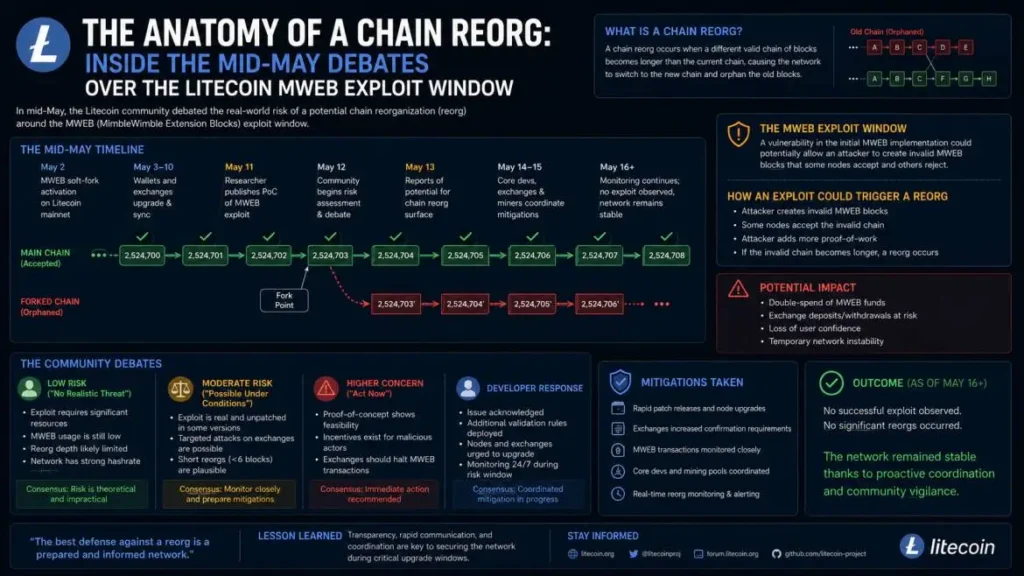
The Patch Window Controversy: Security Frameworks Under Fire
The mid-May industry debates focus heavily on the communication strategy employed during the remediation process. Security analysts from groups like SEAL911 have pointed out a significant “patch window gap” that highlights the trade-offs of disclosing vulnerabilities in decentralized networks.
Core developers first identified the MWEB input validation flaw in March 2026, following the initial inflation anomaly. To prevent bad actors from weaponizing the flaw, developers committed a quiet code fix to repositories and worked directly with dominant mining pools to deploy the updated rules. The goal was to secure a majority of the network’s hash power before making the vulnerability public.
However, this strategy left a window of vulnerability open. Sophisticated attackers were able to monitor code modifications and node behavior to map out the network’s topology. By identifying which nodes remained unpatched, the attackers timed their April strike to exploit the gap between upgraded and non-upgraded entities.
Critically, infrastructure providers—including Remote Procedure Call (RPC) services like QuickNode and decentralized cross-chain bridge protocols—were kept out of the loop during the early remediation phase. This lack of communication allowed the un-upgraded, invalid chain to propagate to external platforms, causing downstream losses despite the primary ledger remaining intact.
Institutional Impact: Cross-Chain Vulnerability and Systemic Risk Assessment
While the core ledger was quickly corrected by the 13-block reorganization, the incident highlights the financial risks that settlement finality issues can introduce to multi-chain ecosystems.
The NEAR Intents Exploit and Multi-Chain Swap Exposure
The primary financial losses from this incident occurred within cross-chain swap layers rather than on the Litecoin network itself. Automated market makers and programmatic intent protocols rely on rapid settlement confirmation to execute atomic cross-chain swaps.
During the April 25 divergence, the un-upgraded fork accepted fraudulent peg-out transactions that routed assets to decentralized exchanges. Cross-chain swap infrastructure, specifically the NEAR Intents protocol, processed these transactions on the invalid chain before the 13-block reorg executed. Once upgraded miners reclaimed the network history and wiped the invalid chain, the assets on the Litecoin side vanished from the valid ledger state. This resulted in an estimated $600,000 double-spend loss for cross-chain liquidity providers.
Pros and Cons of Extension-Block Architecture
- Pros:
- Provides opt-in transaction privacy without altering the fundamental codebase of the primary layer.
- Keeps the core ledger lightweight by isolating complex cryptographic proofs to an alternate execution environment.
- Maintains backward compatibility for legacy node operators who do not require privacy features.
- Cons:
- Introduces complex validation surfaces where the base layer and extension block communicate.
- Creates risks of node fragmentation when upgrades are not adopted uniformly across the network.
- Can mask inflation anomalies within private transaction pools if consensus code verification fails.
Network Remediation and Current Protocol Health: Evaluating Core v0.21.5.5
In response to the late-April disruption and the subsequent security post-mortems, developers released Litecoin Core v0.21.5.4, followed quickly in mid-May by version 0.21.5.5. This latest release provides permanent fixes for the network’s validation vulnerabilities.
Version 0.21.5.5 modifies the consensus engine to require strict verification of MWEB input metadata during the block-connection phase. It also includes protective measures for peer-to-peer messaging that prevent malformed or mutated block data from triggering memory drops or processing stalls on active nodes. Extensive automated testing frameworks have been added to screen incoming blocks for structural anomalies before they are passed to the mining layer.
Network data indicates that over 92% of the active hash rate has migrated to the v0.21.5.5 codebase. Block generation times have stabilized at the standard 2.5-minute baseline, and cross-chain bridge services have resumed standard operations with increased confirmation block requirements to protect against future reorg risks.
For institutional investors and node operators, the Litecoin MWEB exploit serves as a reminder of the unique challenges that come with maintaining privacy extensions on public blockchains. While the rapid deployment of versions 0.21.5.4 and 0.21.5.5 demonstrates the core team’s ability to coordinate under pressure, the incident highlights the need for better communication with infrastructure providers and more transparent patch-management strategies moving forward.
Stay Ahead of Protocol Security Risks
As digital asset networks update their codebases to support advanced features, staying informed on protocol-level vulnerabilities is essential for managing institutional crypto risk. Subscribe to our weekly research brief to receive real-time technical analyses, on-chain data reviews, and direct updates on network security developments.
FAQ
– What exactly was the Litecoin MWEB exploit ?
- The exploit was a validation flaw in the block-connection code of Litecoin’s MimbleWimble Extension Block (MWEB) privacy layer. It allowed an attacker to manipulate input metadata so that a small transaction input of 1–2 LTC was misread as a valid basis for a much larger peg-out output of 85,034 LTC, creating a temporary on-chain inflation risk.
– Why did Litecoin experience a 13-block chain reorganization?
- The 13-block reorganization occurred because of a node split on April 25, 2026. Un-upgraded nodes incorrectly accepted an invalid MWEB transaction sequence, while upgraded nodes rejected it. Once the upgraded nodes gained a majority of the network’s hash power, they overwrote the invalid history, aligning the entire network back to a single, corrected ledger state.
– Were any user funds lost or diluted on the core Litecoin network?
- No user funds were lost or diluted on the primary Litecoin ledger. The initial 85,034 LTC inflation anomaly was contained through quick coordination with major mining pools, and the majority of the assets were recovered. The remaining 850 LTC bounty was covered personally by Charlie Lee, ensuring the asset pool remained completely whole.
– How were cross-chain swap protocols like NEAR Intents affected?
- Cross-chain swap platforms suffered isolated financial losses because they processed atomic swaps on the un-upgraded, invalid fork chain before finality was achieved. When the 13-block reorg removed those invalid blocks from history, the corresponding LTC transactions disappeared, resulting in a double-spend-like loss of roughly $600,000 for external liquidity providers.
– What fixes are included in Litecoin Core v0.21.5.5?
- Litecoin Core v0.21.5.5 introduces permanent validation rules that require strict cross-referencing of MWEB input metadata against active UTXO states during block connection. It also updates peer-to-peer messaging layers to prevent malformed or mutated blocks from causing processing stalls or DoS vulnerabilities on active network nodes.
Financial and Security Disclaimer: This article is provided purely for informational, educational, and analytical purposes. It does not constitute investment, financial, legal, or technical security advice. Cryptocurrency networks involve high structural volatility and software risks. Readers should conduct independent due diligence and consult qualified technical or financial specialists before committing capital or deploying operational infrastructure.