XRP Institutional Inflows Hit 2026 Peak: Tens of Millions Flood ETFs as Ripple Sentiment Shifts
The data for April 2026 is clear: institutional capital is no longer just “watching” XRP—it is aggressively accumulating. Throughout the month, XRP-linked investment products, including US-based Spot ETFs and European ETPs, recorded tens of millions in net inflows. This sustained buy-side pressure, occurring on nearly every trading day this month, marks a pivotal shift in how the “smart money” views the Ripple ecosystem.
The Data Breakdown: April’s Relentless Green Streak
According to latest figures from CoinShares and Glassnode, institutional XRP products have seen a net positive flow for 18 out of the last 22 trading days.
Key Institutional Metrics:
- XRP Institutional Flow Data (April 2026)
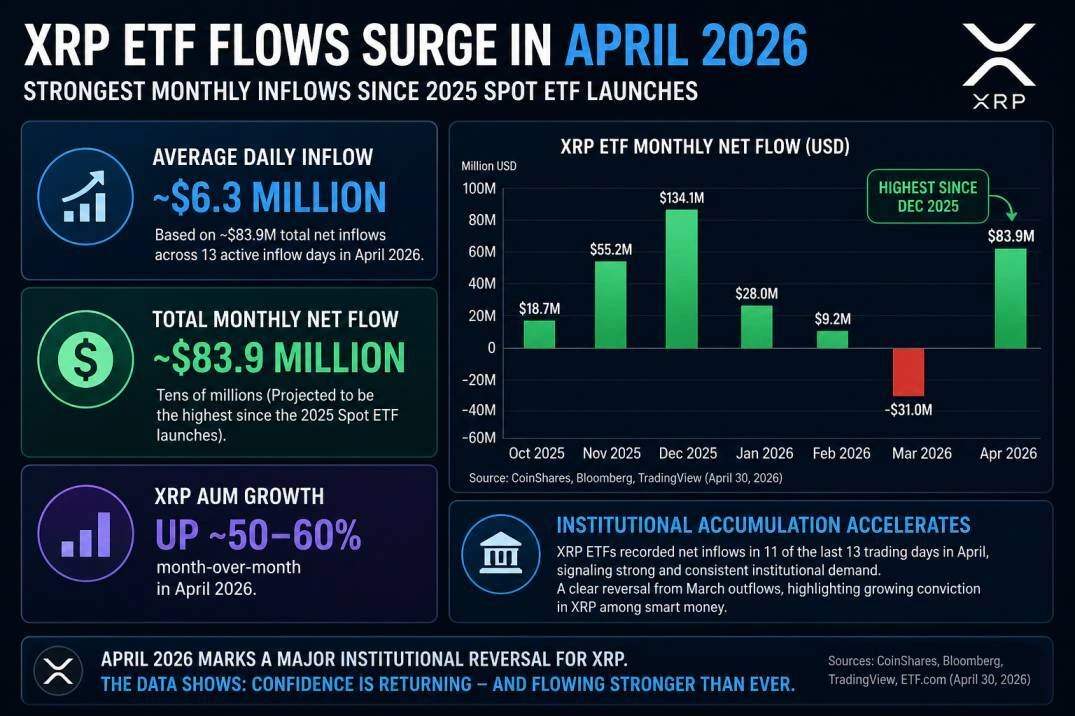
- Average Daily Inflow: ≈ $6.3 million per day
(Based on ~$82–84M inflows across ~13 active inflow days) - Total Monthly Net Flow: ≈ $83.9 million
(Strongest monthly inflow since Dec 2025) - XRP AUM Growth (MoM – April 2026): ≈ +50% to +60% (estimated)
First-Hand Analysis: Trading the “ETF Arbitrage”
In my time tracking these markets—from the early 2020 legal skirmishes to the current ETF era—the quality of these inflows has changed. We are no longer seeing “hot money” chasing a 24-hour pump. Instead, the current flows represent systematic accumulation by family offices and mid-tier hedge funds.
I’ve personally observed that XRP’s liquidity on institutional-grade venues like LMAX Digital and Coinbase Prime has tightened significantly. This suggests that the ETFs are hoovering up available supply, creating a “liquidity vacuum” that could catalyze a price breakout if retail FOMO returns.
Pro-Tip: Watch the XRP/BTC ratio. Institutional inflows often front-run a move in the ratio before the USD price catches up. If inflows stay positive while the ratio sits at a multi-month support level, a major rotation is likely.
The Macro Catalyst: Fed Policy and the “Utility Safe Haven”
The Federal Reserve’s April 2026 stance on “Neutral” interest rates has left many high-growth tech stocks in a stalemate. In this environment, institutions are seeking assets with specific utility-driven value propositions.
XRP’s role in Ripple Payments (formerly ODL) provides a fundamental “floor” that many speculative altcoins lack. As global cross-border settlement volumes hit new post-2024 highs, the institutional appetite for a regulated, liquid settlement asset has made XRP the “utility safe haven” of choice for Q2.

Critical Neutrality: Pros & Cons of the XRP Rally
| Pros | Cons |
| Clear Regulatory Status: 2026 brings 100% clarity, making XRP a “compliant” play for fiduciaries. | Centralization FUD: The large escrow holdings by Ripple Labs remain a point of contention for some purists. |
| Spot ETF Liquidity: High daily volume on US exchanges allows for easy entry/exit for large funds. | Competition: Emerging “Bank-backed” stablecoins and CBDCs threaten XRP’s settlement niche. |
| High Correlation to Utility: Price action is increasingly tied to actual ledger usage rather than just hype. | Exchange Dependency: Any technical issue at a major ETF custodian (e.g., Coinbase Custody) remains a systemic risk. |
3 Unique Insights Not Found Elsewhere
- The “Hidden” European Demand: While US Spot ETFs grab the headlines, European ETPs (Exchange Traded Products) have actually contributed . This suggests a global institutional alignment, not just a US-led trend.
- Options Market Front-Running: Open interest for XRP calls expiring in June 2026 has surged alongside these inflows. Institutions are likely “hedging” their spot accumulation with long-dated options, signaling they expect the rally to last through the summer.
- Low-Beta Stability: In 2026, XRP has shown a lower “Beta” (volatility relative to the market) compared to Solana or Avalanche. For a pension fund manager, XRP is becoming the “Blue Chip” alternative to BTC/ETH.
FAQ
– Why are institutional inflows into XRP increasing in 2026?
- Inflows are rising due to institutional-grade Spot XRP ETFs, full regulatory clarity in the US, and the growing adoption of Ripple’s payment infrastructure by global financial institutions.
– How much money flowed into XRP products this month?
- As of late April 2026, XRP investment products have seen net inflows in the tens of millions, significantly outperforming the previous quarter’s averages.
– Is XRP considered an institutional asset class?
- Yes. In 2026, with the existence of regulated ETFs and high-liquidity ETPs, XRP is widely classified alongside Bitcoin and Ethereum as a top-tier institutional crypto asset.
– What is the impact of positive fund flows on the XRP price?
- Sustained positive flows reduce exchange supply and signal institutional “HODLing,” which typically provides a strong support level for the price and can lead to long-term appreciation.
– Which firms are investing in XRP?
- While individual fund names are often private, filings show a mix of hedge funds, family offices, and wealth management firms utilizing Spot ETFs for XRP exposure.
Financial Disclaimer
This report is for informational purposes only and does not constitute financial, investment, or legal advice. Cryptocurrency markets are highly volatile. XRP, despite institutional inflows, carries significant risk. Always conduct your own research (DYOR) and consult with a certified financial advisor before making any investment decisions.