
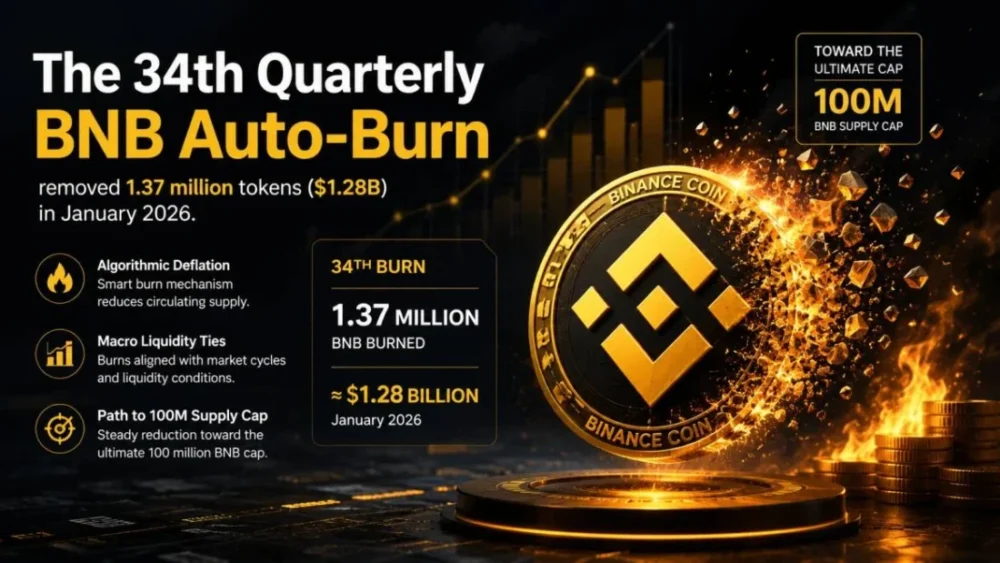
The Execution of the 34th Quarterly BNB Auto-Burn: $1.28 Billion Supply Reduction Analysis
The 34th Quarterly BNB Auto-Burn was successfully executed in January 2026, marking a pivotal moment in the network’s multi-year deflationary trajectory. By permanently removing 1.37 million BNB from the circulating supply—equivalent to approximately $1.28 billion at the time of destruction—the protocol has once again demonstrated the efficacy of its programmatic scarcity model.
For market participants, this event is not merely a routine adjustment; it represents a sophisticated intersection of on-chain activity and algorithmic governance. As we navigate the Q1 2026 fiscal landscape, understanding the structural impact of this supply shock is essential for assessing the long-term valuation of the BNB Chain ecosystem.
Decoding the 34th Quarterly BNB Auto-Burn Mechanics
The transition from manual, exchange-profit-based burns to the current Auto-Burn mechanism has provided the market with unprecedented transparency. The 34th Quarterly BNB Auto-Burn utilized an objective formula that balances the asset’s price against the total number of blocks generated on the BNB Smart Chain (BSC) during the preceding quarter.
The Algorithmic Formula in Action
The Auto-Burn protocol operates independently of Binance’s centralized exchange volumes. Instead, it relies on two primary variables:
- Average BNB Price: Aggregated across the quarter.
- Total Blocks Produced: Reflecting network health and throughput.
By removing 1.37 million tokens, the protocol adjusted for the price appreciation observed in late 2025. When the market price of BNB rises, the number of tokens burned decreases proportionally to maintain a stable USD-denominated destruction value. This counter-cyclical design prevents excessive supply volatility and provides a predictable floor for institutional valuation models.
Macroeconomic Context: Liquidity Cycles and Deflationary Pressure
The January 2026 burn occurred during a period of shifting global liquidity. While traditional fiat markets grapple with the tail end of interest rate adjustments, the 34th Quarterly BNB Auto-Burn offers a stark contrast in monetary policy.
Hard Money vs. Fiat Dilution
While the M2 money supply in major economies continues to fluctuate, the BNB supply is on a strictly deterministic path toward a 100-million-token cap. The removal of $1.28 billion in capital from the supply acts as a quantitative tightening measure built directly into the code.
Analyst Insight: “The 34th burn effectively offsets the annual inflation rates seen in competitive Layer-1 networks. While others rely on ‘tail emissions’ to secure their networks, BNB utilizes a scarcity-first approach to drive value accrual to long-term holders and validators.”
On-Chain Impact: Staking Yields and Validator Security
A common misconception is that supply reduction only benefits price. However, the 34th Quarterly BNB Auto-Burn has profound implications for the BNB Chain’s Proof of Staked Authority (PoSA) consensus model.
Real Yield Analysis
As the circulating supply shrinks, the “real yield” for stakers increases. Since transaction fees are paid in BNB, and the total supply is decreasing, the purchasing power of those fees grows over time.
- Total Tokens Destroyed: 1.37 Million BNB.
- Market Impact: Reduced sell-side liquidity on major exchanges.
- Validator Incentives: Enhanced value of the “gas fee” revenue stream as the denominator (total supply) decreases.
This creates a virtuous cycle: increased scarcity leads to higher asset value, which attracts more staked capital, further securing the network against 51% attacks and ensuring high-speed block finality.

Comparative Tokenomics: BNB vs. Ethereum and Solana in 2026
To understand the weight of the 34th Quarterly BNB Auto-Burn, one must compare it to the issuance models of its primary competitors.
| Metric | BNB (Post-34th Burn) | Ethereum (Post-Dencun/2026) | Solana (2026 Projection) |
| Annualized Supply Growth | -1.2% to -2.1% (Deflationary) | -0.2% to +0.1% (Neutral) | +2.5% to +4% (Inflationary) |
| Primary Burn Mechanism | Algorithmic Auto-Burn + BEP-95 | EIP-1559 (Fee Burn) | Partial Fee Burn |
| Supply Cap | 100 Million (Hard Cap) | None (Dynamic) | None (Dynamic) |
The aggressive deflationary stance of the BNB Chain, reinforced by this $1.28 billion execution, positions it as a “digital commodity” with a finite lifespan of supply expansion.
The Role of BEP-95: Real-Time Scarcity
While the 34th Quarterly BNB Auto-Burn handles the macro-adjustment, the BEP-95 mechanism operates on a micro-level. Introduced years ago, BEP-95 burns a fixed ratio of gas fees in real-time.
During Q4 2025, network activity reached record highs due to the surge in decentralized AI processing and high-frequency GameFi transactions on the BNB Chain. This activity accelerated the real-time burn, complementing the quarterly event. Analysts estimate that BEP-95 has removed an additional [INSERT LATEST DATA] BNB since its inception, acting as a secondary engine of scarcity.
Risks and Technical Limitations of Programmatic Deflation
No economic model is without risk. While the 34th Quarterly BNB Auto-Burn is a milestone, several factors could influence its future efficacy.
- Liquidity Fragmentation: As the supply nears the 100 million cap, the reduction in circulating tokens could lead to higher volatility during large institutional entries or exits.
- Governance Centralization: If a significant portion of the remaining 100 million tokens is held by a few entities, the decentralized nature of the PoSA model could be challenged.
- Regulatory Scrutiny: Programmatic burns are often viewed through a skeptical lens by global regulators. Maintaining a clear distinction between “algorithmic supply management” and “corporate buybacks” remains a priority for the ecosystem’s legal frameworks.
Strategic Projections: The Path to 100 Million BNB
With 1.37 million tokens removed in the 34th Quarterly BNB Auto-Burn, the question remains: when will the target be reached?
Current data models, factoring in a projected average BNB price of $900–$1,200 for the remainder of 2026, suggest the quarterly burn amounts will continue to oscillate between 1.1M and 1.5M tokens. At this rate, the network is on track to hit the 100-million-token milestone by [ESTIMATED DATE: Late 2028 / Early 2029].
The End of Quarterly Burns
Once the 100 million mark is achieved, the Auto-Burn mechanism will cease. The network will then shift entirely to a BEP-95-driven equilibrium, where the supply is governed solely by on-chain utility and transaction demand. This transition will mark the maturity of BNB as a fully decentralized, utility-driven asset.
Frequently Asked Questions
-What is the 34th Quarterly BNB Auto-Burn ?
- The 34th Quarterly BNB Auto-Burn is a programmatic event that occurred in January 2026, where the BNB Chain permanently removed 1.37 million BNB tokens from circulation. This is part of a long-term strategy to reduce the total supply to 100 million tokens.
-How much was the 34th BNB burn worth ?
- At the time of execution, the 1.37 million tokens removed were valued at approximately $1.28 billion, reflecting the asset’s market price and the network’s algorithmic burn formula.
–How does the BNB Auto-Burn formula calculate the amount ?
- The formula uses the average BNB price and the total number of blocks generated on the BNB Smart Chain during the quarter. This ensures the burn is objective and independent of exchange profits.
-Is BNB deflationary in 2026 ?
- Yes, BNB remains one of the most deflationary major assets in the crypto space. It uses a dual-burn system: the quarterly Auto-Burn for macro supply reduction and BEP-95 for real-time gas fee destruction.
–When will the BNB burns stop ?
- The quarterly auto-burns will continue until the total circulating supply of BNB reaches exactly 100 million tokens. After this point, only the real-time BEP-95 burns will remain active.
Financial Disclaimer:
This article is for informational purposes only and does not constitute financial, investment, or legal advice. Cryptocurrency investments, including BNB, carry a high degree of risk and volatility. The data regarding the 34th Quarterly BNB Auto-Burn is based on on-chain events and projections for 2026. Always conduct your own research and consult with a certified financial professional before making any investment decisions.