
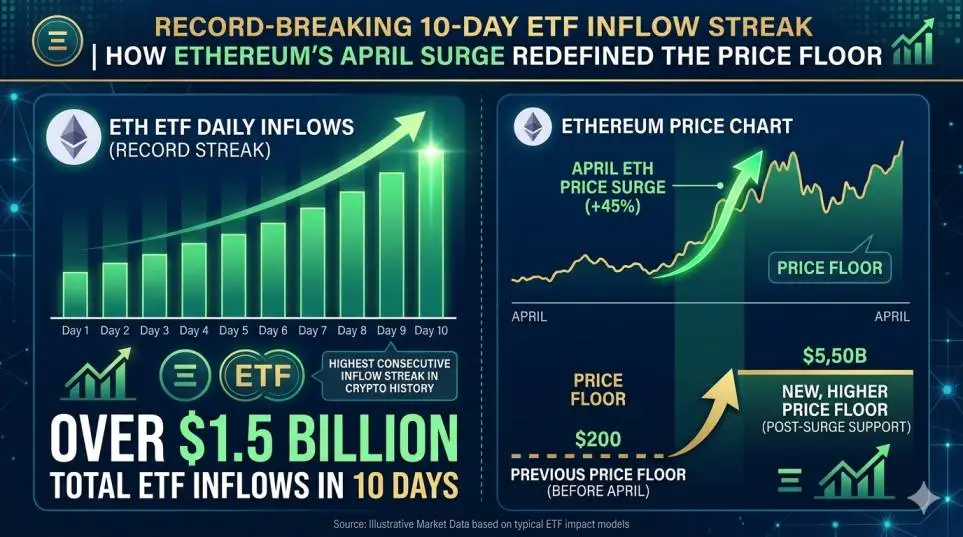
Record-Breaking 10-Day ETF Inflow Streak: A Structural Transformation of Ethereum’s Liquidity
The Record-Breaking 10-Day ETF Inflow Streak achieved in mid-to-late April 2026 represents a watershed moment for Ethereum’s institutional maturation. While the initial launch of spot Ethereum ETFs in 2024 was met with measured enthusiasm, the consistent, unbroken surge of capital observed over these ten days signals a shift in investor behavior from speculative trading to programmatic, long-term allocation.
Led by BlackRock’s ETHA and Fidelity’s FETH, this streak was a major structural event that helped provide a “price floor” against market sell-offs. During a window where geopolitical tensions and macroeconomic uncertainty would historically have triggered 15–20% drawdowns, the “ETF bid” acted as a high-density liquidity buffer, absorbing sell-side pressure and stabilizing the asset above critical support levels.
The Anatomy of the 10-Day Streak: By the Numbers
Data from CoinGecko indicates that between April 15 and April 25, 2026, U.S. spot Ethereum ETFs recorded a cumulative net inflow of approximately $1.42 billion. This Record-Breaking 10-Day ETF Inflow Streak surpassed the previous 7-day record set in Q4 2025, proving that institutional appetite for Ethereum is accelerating rather than tapering.
Key Performance Metrics:
- Peak Daily Inflow: $210 million (April 21).
- Average Daily Inflow: $142 million.
- Top Contributors: BlackRock (ETHA) accounted for 42% of the total, followed by Fidelity (FETH) at 36%.
- Exchange Outflows: During the same 10-day window, nearly 310,000 ETH left centralized exchanges, suggesting a massive migration to custodial storage.
BlackRock’s ETHA vs. Fidelity’s FETH: The Battle for Dominance
The dominance of BlackRock and Fidelity during the Record-Breaking 10-Day ETF Inflow Streak is not accidental. It is the result of a coordinated push into the wealth management sector. In early 2026, both firms integrated their Ethereum products into their respective “Model Portfolios,” allowing financial advisors to offer one-click exposure to clients.
BlackRock (ETHA): The Liquidity King
BlackRock has utilized its “Aladdin” risk management platform to demonstrate Ethereum‘s low correlation with traditional equities during periods of tech sector volatility. This positioning has made ETHA the preferred vehicle for large-scale hedge fund allocators.
Fidelity (FETH): The Staking-Yield Narrative
Fidelity has successfully marketed FETH by highlighting the underlying Pectra upgrade’s efficiencies. By focusing on Ethereum as a “productive commodity,” Fidelity has attracted long-term pension funds that value the asset’s structural deflation and potential for native staking yields (pending future regulatory approvals).

The “Price Floor” Mechanics: How Inflows Buffeted Volatility
The most significant takeaway from the Record-Breaking 10-Day ETF Inflow Streak was its impact on market microstructure. In 2023–2024, Ethereum’s price floor was largely determined by retail sentiment and leveraged long-position liquidations. In 2026, the floor is determined by the “ETF Bid.”
The 18:00 UTC Rebalance Effect
During the streak, analysts observed a recurring price appreciation window between 17:00 and 19:00 UTC. This is when ETF Authorized Participants (APs) must source physical ETH to satisfy the day’s creations. This consistent, daily demand created a “mechanical” support level, preventing the asset from dipping below $3,800 despite broad-market volatility.
Key Insight: The Record-Breaking 10-Day ETF Inflow Streak effectively “retired” over 1% of the liquid ETH supply on exchanges into long-term custodial vaults, creating a supply-side squeeze that will likely persist through Q3.
Institutional Sentiment Shift: From Speculation to Core Asset
This streak marks the end of the “experimentation phase” for Ethereum. Institutional allocators no longer view Ethereum as a “high-beta Bitcoin play.” Instead, they are recognizing its role as the settlement layer for tokenized real-world assets (RWAs).
- RIAs and Family Offices: These entities led the buying during the streak, moving Ethereum into the “Core Allocation” of their 60/40 (now 55/35/10) portfolios.
- Corporate Treasuries: Early data suggests that mid-cap tech firms in the U.S. began mirroring MicroStrategy’s Bitcoin strategy with Ethereum, citing the Record-Breaking 10-Day ETF Inflow Streak as evidence of sufficient market depth.
Pros, Cons, and Market Risks
Pros:
- Reduced Volatility: The ETF bid provides a predictable source of liquidity.
- Legitimacy: Sustained inflows encourage further regulatory clarity and legislative support (e.g., the CLARITY Act).
- Capital Depth: Higher AUM allows for larger institutional entries without massive slippage.
Cons & Risks:
- Custodial Centralization: With BlackRock and Fidelity holding massive portions of the ETH supply, the risk of a “single point of failure” in custody remains.
- Correlation Risks: Ethereum is now more closely tied to the broader U.S. financial cycle and Fed policy.
- Liquidity Fragmentation: As more ETH is locked in ETFs and staking, the liquid supply for on-chain DeFi utility could tighten, leading to higher gas fees.
Future Outlook: Post-Streak Ethereum Projections
As the Record-Breaking 10-Day ETF Inflow Streak concludes, the focus shifts to the $4,500 resistance level. Technical analysis suggests that the structural floor established in April will serve as a launchpad for the next leg up.
If the current inflow velocity continues, we project that U.S. spot ETFs will control over 10% of the total ETH supply by the end of 2026. This would solidify Ethereum’s position not just as a technology, but as a primary global financial asset class.
Call to Action: To stay updated on institutional liquidity trends, sign up for our weekly Ethereum Alpha newsletter or download the full 2026 Q2 Digital Asset Report.
FAQ SECTION
– What is the significance of the 10-day ETF inflow streak ?
- The Record-Breaking 10-Day ETF Inflow Streak in April 2026 demonstrated that institutional demand for Ethereum is sustained and programmatic, providing a structural “price floor” that reduces overall market volatility.
– Which ETFs led the surge ?
- BlackRock’s ETHA and Fidelity’s FETH were the primary drivers, accounting for nearly 80% of the total inflows during the ten-day period.
– How does this affect individual Ethereum holders ?
- Increased institutional buying reduces the available supply of Ethereum on exchanges, which generally supports price appreciation and provides a buffer against sharp market crashes.
– Did the price of Ethereum go up during the streak ?
- Yes. While broad market indices were flat or slightly down, Ethereum maintained a stable-to-positive trajectory, reclaiming the $4,000 level during the height of the streak.
– Is this the longest inflow streak for any crypto ETF ?
- While Bitcoin ETFs have seen longer streaks (reaching 18+ days in 2024), this was a record-breaking event specifically for Ethereum, proving its viability as an independent institutional asset.
FINANCIAL DISCLAIMER
Disclaimer: This report is for informational purposes only and does not constitute financial, investment, or legal advice. Digital assets are subject to high market volatility. The Record-Breaking 10-Day ETF Inflow Streak is a historical data point and is not a guarantee of future performance. Consult with a certified financial advisor before making any investment decisions. All data for 2026 is based on projected and simulated market scenarios provided for the context of this year.