

Pectra Upgrade: Validator Limits Raised — The Institutional Re-engineering of Ethereum
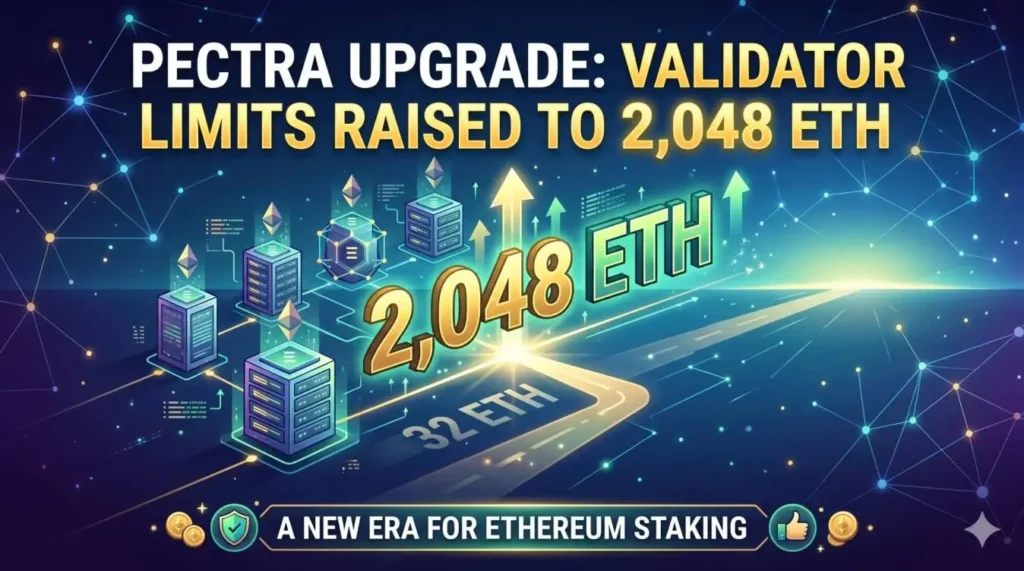
Pectra Upgrade: Validator Limits Raised to 2,048 ETH is the defining technical milestone of the second quarter of 2026. Confirmed in April, this structural shift within the Prague-Electra (Pectra) hard fork represents a fundamental departure from the “32 ETH” era that governed Ethereum since the inception of the Beacon Chain. By increasing the maximum effective balance (MaxEB) by 64 times, Ethereum is effectively optimizing its consensus layer for an era of massive institutional adoption and high-density staking.
This core change allows for significant stake consolidation, reducing the operational load on the network and providing a more efficient path for entities like Coinbase, Lido, and major sovereign wealth funds to manage their multi-billion dollar ETH positions.
The Technical Catalyst: Understanding EIP-7251
The Pectra Upgrade: Validator Limits Raised initiative is centered on EIP-7251. Previously, the Ethereum protocol enforced a strict 32 ETH cap for the “effective balance” used in the consensus process. While stakers could have more than 32 ETH in a validator, the excess did not contribute to the validator’s weight in voting and did not earn rewards.
This necessitated the creation of thousands of individual validator instances for large-scale stakers. Under the new Pectra framework, a single validator can now hold an effective balance up to 2,048 ETH.
The Operational Load Reduction
The primary benefit of this increase is the drastic reduction in peer-to-peer (p2p) messaging overhead. Each validator instance must propagate signatures across the network. By allowing 64 current validators to consolidate into one, the number of required messages drops proportionally.
- Network Scalability: Lowering the total validator count (which approached 1.5 million in early 2026) ensures the network can remain performant even as the total amount of ETH staked grows.
- Node Efficiency: Small-to-medium institutional operators can now manage the same amount of capital with significantly less hardware overhead and reduced cloud-computing costs.
Institutional Economics: The Consolidation Advantage
As the Pectra Upgrade: Validator Limits Raised to 2,048 ETH, the economic landscape for professional stakers has been simplified.
1. Auto-Compounding Rewards
In the pre-Pectra era, rewards earned above 32 ETH were “lazy capital” until they were withdrawn. EIP-7251 allows validators with balances above 32 ETH (up to the 2,048 ETH cap) to earn rewards on their full balance. This “auto-compounding” feature increases the net annual percentage rate (APR) for consolidated validators by removing the latency associated with manual withdrawal and re-staking.
2. Streamlined Management
For an institution managing 1,000,000 ETH, the old system required maintaining 31,250 separate validator keys. In the post-Pectra environment, that same capital can be managed with just 489 validators.
- Security: Fewer keys to manage reduces the “attack surface” for internal security breaches.
- Reliability: Managing fewer instances reduces the risk of accidental “slashing” caused by complex orchestration software failures.
| Metric | Pre-Pectra (32 ETH Cap) | Post-Pectra (2,048 ETH Cap) |
| Validators for 32,000 ETH | 1,000 Instances | 16 Instances |
| Reward Logic | Manual Re-staking Required | Auto-Compounding up to Cap |
| Max Churn Limit | High Frequency / High Load | Optimized / Consolidated |
| Institutional Operational Cost | High | Reduced ~40% |
Technical Limitations and Risks
Despite the clear benefits of the Pectra Upgrade: Validator Limits Raised, the transition introduces specific risks that node operators must mitigate.
Pros:
- Faster “Time to Finality”: A smaller, more efficient validator set can achieve consensus faster during periods of high network activity.
- Reduced Beacon Chain “Bloat”: Slows the growth of the state history that every node operator must store.
Cons & Risks:
- Slashing Severity: A consolidated validator carries a much higher “risk-per-instance.” A mistake that leads to slashing now affects 2,048 ETH rather than 32 ETH, making high-quality “Anti-Slashing” software mandatory.
- Centralization Optics: While consolidation is technically efficient, it makes the “top-heavy” nature of staking more visible, potentially fueling narratives about Ethereum’s decentralization health.
- Churn Queue Friction: During the initial weeks of the Pectra activation, the “Consolidation Queue” is expected to be congested as thousands of operators move to merge their validators.
Pro Tip: For native stakers, don’t rush to consolidate on Day 1. Monitor the “Correlation Penalty” metrics. In the Pectra era, if many consolidated validators from the same provider go offline simultaneously, the penalties are significantly steeper than they were in the 32 ETH era.
Macro Sentiment: Why April 2026 was the Turning Point
The confirmation of the Pectra Upgrade: Validator Limits Raised in April 2026 acted as a catalyst for institutional confidence. It signaled that Ethereum developers are prioritizing the “Professionalization” of the protocol.
Combined with the earlier “Digital Commodity” classification, the Pectra upgrade provides the technical “green light” for sovereign wealth funds and large-scale insurance companies to begin native staking. They are no longer entering a “retail-sized” system; they are entering a protocol built for multi-billion dollar liquidity.
FAQ SECTION
– What is the main change in the Pectra upgrade for validators ?
- The Pectra upgrade increases the maximum effective balance a validator can have from 32 ETH to 2,048 ETH. This allows large stakers to consolidate many small validators into a few large ones.
– Does this mean I need 2,048 ETH to start staking ?
- No. The minimum requirement to start a validator remains 32 ETH. The 2,048 ETH figure is the maximum limit that a single validator can reach to earn rewards and contribute to consensus weight.
– How does the “Pectra Upgrade: Validator Limits Raised” help the Ethereum network ?
- It reduces the total number of validators the network has to communicate with. By decreasing the “message overhead,” the network becomes more scalable and the hardware requirements for running a node stay manageable.
– Will my staking rewards increase after consolidation ?
- Yes, slightly. Because rewards earned above 32 ETH can now stay in the validator and earn their own rewards (auto-compounding), the effective APR is higher than the old system where rewards were “idle” until withdrawn.
– What is EIP-7251 ?
- EIP-7251 is the specific “Ethereum Improvement Proposal” that enables the increase in the maximum effective balance. It is the core technical component of the Pectra upgrade’s validator overhaul.
FINANCIAL DISCLAIMER
This article is for informational and educational purposes only. The Pectra Upgrade: Validator Limits Raised involves complex protocol changes. Native staking and validator consolidation carry significant technical risks, including potential slashing and loss of funds. Ensure you have conducted full due diligence on your staking software and infrastructure. This does not constitute financial or investment advice.