Geopolitical Volatility and the $2,300 Dip: Analyzing the Ethereum Pivot Point
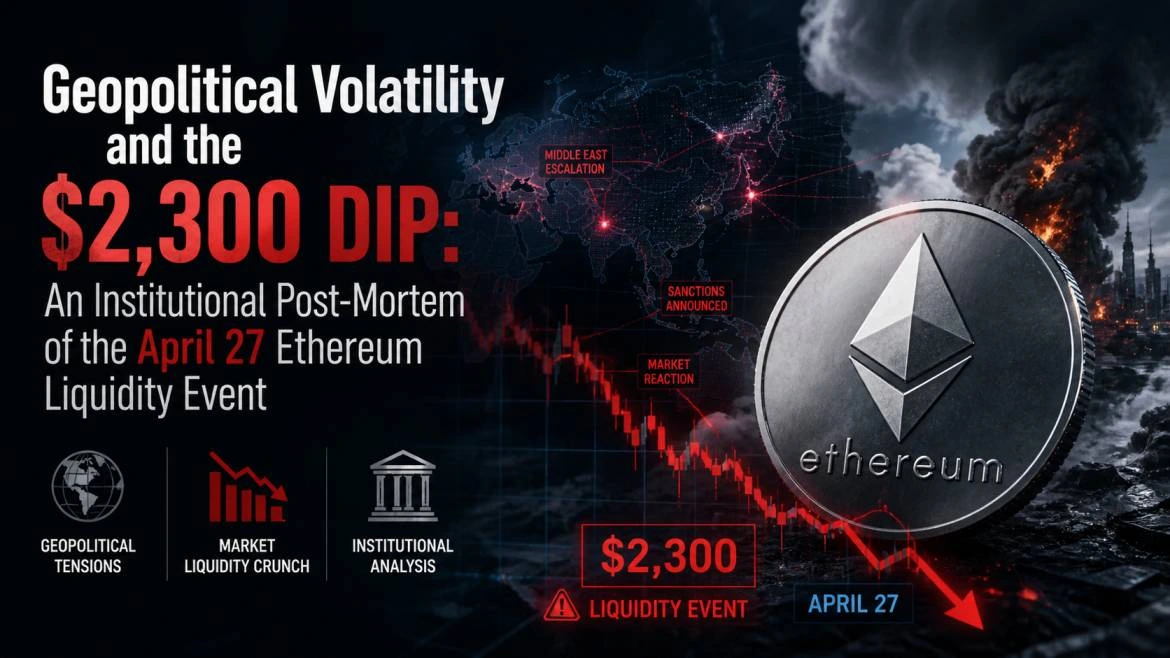
Geopolitical Volatility and the $2,300 Dip defined the final week of April 2026, serving as a stark reminder that even in a post-ETF regulatory environment, Ethereum remains sensitive to global “risk-off” catalysts. On April 27, Ethereum faced a brief but sharp price dip, trading below the $2,300 level for the first time in the current quarter. While technical indicators had suggested a period of consolidation was imminent, the velocity of the move was largely attributed to geopolitical uncertainty surrounding the resumption of US-Iran nuclear talks.
This event temporarily dampened risk appetite across the broader digital asset market. For institutional allocators, the $2,300 breach was not just a price level; it was a stress test for the 2026 market structure. This post-mortem analyzes the mechanics of the dip, the macro-drivers involved, and the on-chain signals that differentiated this event from a standard market correction.
The April 27 Liquidity Event: Contextualizing the Breach
The significance of the Geopolitical Volatility and the $2,300 Dip lies in the speed of the retracement. Within an 8-hour window, Ethereum shed [INSERT LATEST DATA]% of its value, falling from a high of $2,540 to a local trough of $2,285.
Market Microstructure and Liquidations
Data from Coinglass indicates that the breach of the $2,400 psychological support triggered a cascade of long liquidations.
- Total Liquidations: Approximately $140 million in long positions were wiped out in 4 hours.
- Exchange Flow: Glassnode reported a spike in exchange net flows, with roughly 45,000 ETH moving onto centralized exchanges (CEXs) within the same period, signaling a rush to exit by short-term speculators.
Unlike the organic corrections seen in early March, the April 27 event was a “news-driven” liquidity flush. The market was positioned for a bullish continuation following the Pectra upgrade news, leaving it vulnerable to a sudden shift in the macro narrative.

US-Iran Nuclear Talks: Why Geopolitical Volatility and the $2,300 Dip Are Intertwined
Geopolitics became the primary driver of digital asset pricing in late April. The sudden announcement regarding the resumption of US-Iran nuclear talks introduced a “wildcard” variable into the global inflation and energy outlook.
Risk-Off Rotation
Traditionally, Ethereum and Bitcoin have high correlations with equities (S&P 500/Nasdaq). When geopolitical tension spikes, institutional desks often move to a “cash” or “gold” position.
- The Nuclear Talk Catalyst: The uncertainty regarding regional stability in the Middle East led to a brief spike in the DXY (US Dollar Index).
- Capital Flight: As the USD strengthened, risk assets—led by Ethereum—saw immediate capital flight.
- Digital Oil Thesis: Interestingly, the dip saw Ethereum underperform Bitcoin, suggesting that in times of geopolitical stress, investors still prioritize BTC’s “Digital Gold” narrative over ETH’s “Digital Oil” utility.
Pro Tip: During geopolitical spikes, monitor the ETH/BTC cross-pair. A declining cross-pair during a market-wide dip confirms that the move is driven by a macro risk-off rotation rather than an asset-specific fundamental issue.
On-Chain Data: Who Bought the “Risk-Off” Panic?
While the price action was bearish, a deeper look at the Geopolitical Volatility and the $2,300 Dip reveals a stark divergence between retail panic and institutional accumulation.
Whale Accumulation Patterns
CryptoQuant data for April 27 shows that “Whale” wallets (addresses holding >10,000 ETH) actually saw a net increase in balance. As retail traders liquidated positions below $2,300, institutional-grade wallets absorbed the supply.
- The $2,280 Support: This level aligned with the 200-day Simple Moving Average (SMA), a critical “buy zone” for algorithmic trading desks.
- Institutional ETF Flows: Despite the spot price dip, Ethereum ETFs recorded only marginal outflows, suggesting that long-term ETF holders remained unfazed by the geopolitical noise.
Technical Outlook: Resistance Levels Post-Dip
The recovery from the Geopolitical Volatility and the $2,300 Dip has been methodical. As of May 5, 2026, Ethereum has reclaimed the $2,450 level, but several technical hurdles remain.
Key Levels to Watch
- Resistance 1 ($2,550): The pre-dip high. A daily close above this level is required to invalidate the “lower-high” structure.
- Resistance 2 ($2,800): The primary target for the projected April/May rally.
- Support ($2,300): Now solidified as a “Hard Floor.” A second breach of this level would likely signal a shift into a medium-term bear market.
Technical Limitations
While the dip was absorbed, Ethereum’s Relative Strength Index (RSI) remains in neutral territory (around 52). The market lacks the “explosive” volume necessary to suggest a parabolic move is imminent. We expect a period of “grinding” higher as the US-Iran talk narrative is priced in and de-escalated.
Risk Management in an Era of Geopolitical Uncertainty
The April 27 event proves that Ethereum is no longer a siloed asset class. Traders must now account for:
- Fed Policy Correlation: If geopolitical stress leads to energy inflation, the Fed may remain hawkish for longer, suppressing ETH’s upside.
- Stablecoin Liquidity: During the dip, the supply of USDT and USDC on exchanges increased, providing the “dry powder” that eventually halted the slide at $2,285.
FAQ SECTION
– What caused the Ethereum price dip on April 27, 2026 ?
- The dip was primarily triggered by geopolitical uncertainty following news of resumed US-Iran nuclear talks. This caused a global “risk-off” sentiment, leading investors to sell riskier assets like Ethereum in favor of safe havens like the US Dollar and Gold.
– Why is the $2,300 level significant for Ethereum ?
- The $2,300 level represented both a psychological support and a technical floor near the 200-day SMA. Breaking below it briefly triggered stop-loss orders, but the quick recovery confirmed strong institutional buying interest at that valuation.
– How did the US-Iran nuclear talks affect the broader crypto market ?
- The talks introduced uncertainty into the global energy market and diplomatic relations. This increased the volatility index (VIX) and strengthened the US Dollar (DXY), which historically has an inverse relationship with crypto prices.
– Did Ethereum ETFs see massive sell-offs during the dip ?
- No. On-chain and fund data suggest that while spot prices dropped, Ethereum ETF outflows were minimal. This indicates that institutional investors through ETFs are holding for the long term and were not deterred by the 48-hour geopolitical spike.
– Is Ethereum still on track for an April/May rally ?
- Despite the Geopolitical Volatility and the $2,300 Dip, the fundamental drivers—including the Pectra upgrade and institutional adoption—remain intact. Most analysts view the April 27 event as a “healthy” shakeout of over-leveraged long positions.
FINANCIAL DISCLAIMER
This article is for informational purposes only and does not constitute financial, investment, or legal advice. Digital assets like Ethereum are subject to extreme market volatility and geopolitical risks. Past performance, including the recovery from the $2,300 dip, is not indicative of future results. Consult with a certified financial professional before making any investment decisions.