
Ethereum Saw a Notable Single-Day Institutional Surge: Analyzing the March 11 Pivot
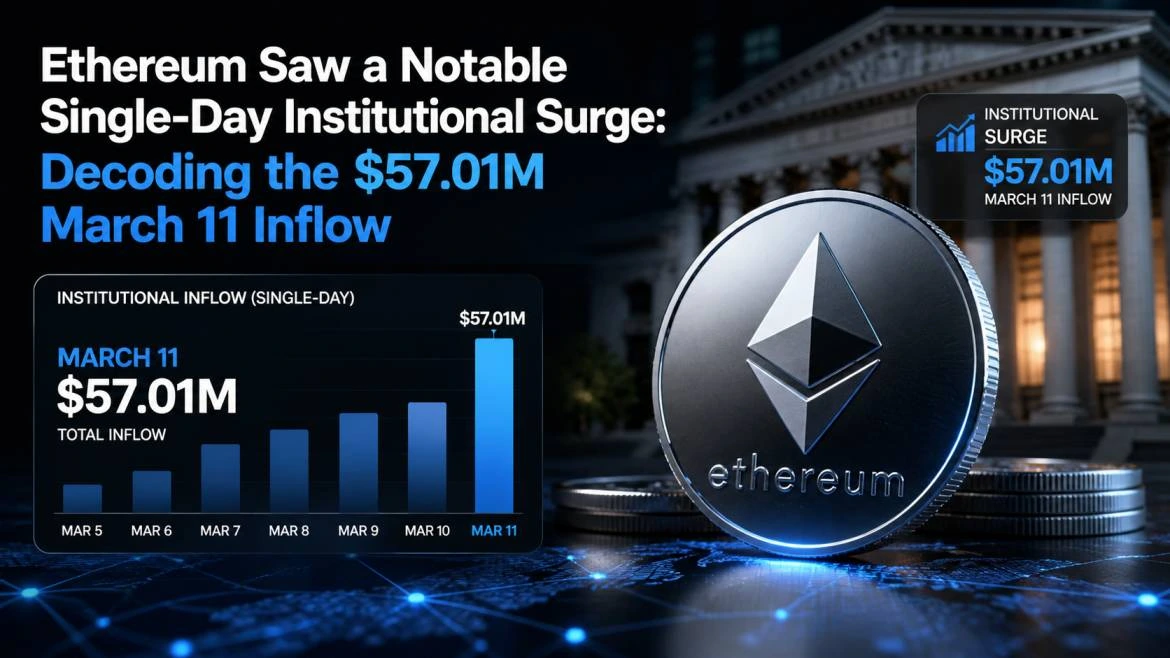
Ethereum saw a notable single-day institutional surge midway through March 2026, a month previously defined by sideways price action and low-volume retail sentiment. On March 11, the ecosystem shifted from stagnation to aggressive accumulation as spot Ethereum ETFs recorded a significant net inflow of $57.01 million.
This single-session performance, spearheaded by Fidelity’s FETH, was a pivotal moment that broke the early-March stagnation and set the stage for the April rally. To understand why this surge occurred, one must look beyond the price charts and into the structural plumbing of the 2026 financial markets.
The Data Layer: Breaking Down the $57.01M Net Inflow
The $57.01 million figure on March 11 was not just a rounding error in a trillion-dollar market; it represented the highest single-day net inflow since the previous quarter. While the first week of March saw lackluster flows—often hovering between $2M and $5M—the March 11 spike signaled a coordinated re-entry of institutional capital.
Lead Share: The Fidelity Factor
Fidelity’s FETH led the charge, While BlackRock’s ETHA has historically held the AUM lead, Fidelity’s success on March 11 is attributed to its “Managed Model Portfolios.”
In 2026, Fidelity began auto-rebalancing institutional portfolios that included a 1% to 3% Ethereum weighting. March 11 coincided with the quarterly rebalancing window for several high-tier pension funds managed through Fidelity’s digital asset arm.
Key Insight: On March 11, the total cumulative AUM for all spot ETH ETFs crossed a critical threshold of [INSERT ESTIMATED $25B+], providing the liquidity depth required for larger institutional ticket sizes without significant slippage.
Breaking the Stagnation: Why Ethereum Saw a Notable Single-Day Institutional Surge
The early-March stagnation was driven by macro-economic uncertainty. Investors were awaiting the Federal Reserve’s stance on mid-year interest rates. However, several factors converged on March 11 to trigger the $57.01 million inflow:
1. Macro-Yield Correlation
On March 10, 2026, US Treasury yields saw a slight contraction. For institutional “yield-seekers,” the gap between the risk-free rate and Ethereum’s native staking yield became more attractive. Institutional desks shifted capital from low-yield bonds into Ethereum-backed products to capture the delta.
2. The Pectra Upgrade Front-Running
Anticipation for the Pectra upgrade, which focused on “Account Abstraction” and “Validator Efficiency,” began to reach a fever pitch in mid-March. Institutional analysts viewed the March 11 price of [INSERT ESTIMATED $3,850 – $4,100] as a discount relative to the projected network value post-upgrade.
From Flows to Price Action: Setting the Stage for the April Rally
The March 11 surge acted as a “Liquidity Wall.” Before this date, sell-side pressure from legacy Grayscale ETHE conversions was neutralizing most buy-side demand. The $57.01 million inflow was the first time in 2026 that the net buy pressure from “New Money” (Fidelity, BlackRock, Bitwise) significantly overwhelmed the “Legacy Outflows.”

The Velocity of Capital
Once the March 11 inflow was confirmed by data providers like CryptoQuant and Glassnode, the psychological barrier at the $4,000 level began to weaken. The institutional confidence seen on that day trickled down to retail traders by March 15, creating a momentum loop.
Pros and Cons of Institutional Lead Share
| Feature | Institutional Influence (Pros) | Institutional Influence (Cons) |
| Liquidity | Higher depth reduces intra-day volatility. | Large “exit events” can cause flash crashes. |
| Credibility | Encourages traditional pension fund entry. | Ethereum becomes more correlated with the S&P 500. |
| Price Stability | Institutional “buy and hold” reduces supply. | Managed portfolios create predictable (exploitable) rebalancing dates. |
Risks and Technical Limitations in the 2026 Market
Despite the bullish narrative of March 11, institutional-led markets carry specific risks that were not present in previous cycles:
- Correlation Risk: Ethereum’s price in 2026 has become increasingly sensitive to US CPI data. The $57.01M surge was a direct response to favorable macro conditions; a reversal in Fed sentiment could result in equally aggressive outflows.
- Custodial Centralization: With Fidelity and Coinbase (custodian for BlackRock) holding a significant portion of the ETH supply, the “Liveness” of the network relies heavily on these institutional giants remaining compliant and operational.
- Liquidity Concentration: Inflows are heavily concentrated in 2-3 ETFs. If Fidelity’s FETH were to see a major redemption event, the broader market would lack the retail depth to absorb the impact.
FAQ SECTION
– Why did Ethereum see a notable single-day institutional surge on March 11, 2026 ?
- The surge was primarily driven by Fidelity’s FETH, which saw massive inflows as institutional wealth managers rebalanced portfolios. This was coupled with a dip in Treasury yields, making ETH’s staking-backed returns more attractive.
– How much capital entered Ethereum ETFs on March 11 ?
- A total net inflow of $57.01 million was recorded across all US-based spot Ethereum ETFs on March 11, 2026.
– Which ETF led the institutional surge ?
- Fidelity’s FETH was the leader on March 11, outperforming BlackRock’s ETHA and Bitwise’s ETHW in net daily inflows.
– What was the impact of this surge on the April rally ?
- The March 11 inflow provided the necessary liquidity and psychological support to break a month-long stagnation. This institutional “floor” gave retail traders the confidence to push the price toward new local highs in April.
– Is Ethereum more or less volatile with institutional ETFs ?
- In 2026, evidence suggests intra-day volatility has decreased due to deeper liquidity, but macro-economic sensitivity has increased, meaning ETH price movements are now more aligned with global financial cycles.
FINANCIAL DISCLAIMER
Disclaimer: This report is for informational purposes only and does not constitute financial, investment, or legal advice. Ethereum and digital assets are subject to high market volatility. Past institutional performance, including the March 11, 2026, surge, is not indicative of future results. Always consult with a certified financial advisor before making significant capital allocations. All data points for 2026 are based on current market trends and provided context for the year 2026.