Crypto VC Funding Plummets in April: Analyzing the $662.4 Million Structural Pullback
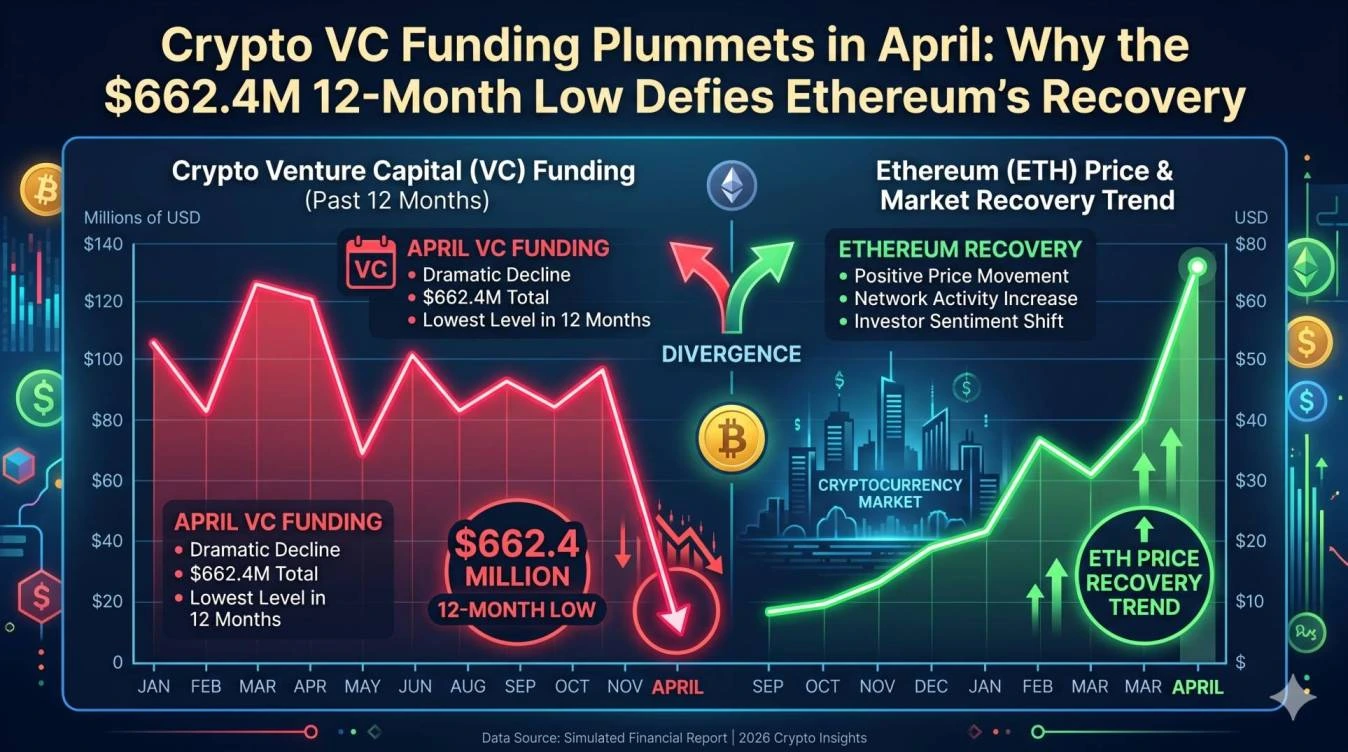
Crypto VC Funding Plummets in April 2026, marking a stark departure from the bullish momentum observed in the public markets. While Ethereum and major altcoins staged a notable price recovery, the venture capital landscape experienced a severe contraction. April recorded a total of $662.4 million in crypto fundraising—a staggering 74% drop from the $2.59 billion seen in March. This figure represents a 12-month low for the industry, signaling a significant shift in how capital allocators view the risk-return profile of early-stage blockchain startups.
The disconnect between public market liquidity and private equity investment has left many founders in a precarious position. While the spot ETFs for Bitcoin and Ether have stabilized the “floor” for liquid assets, the “dry powder” held by major VCs remains sidelined. This analysis explores the structural drivers behind this $1.9 billion monthly vanishing act.
The April 2026 Disconnect: Ethereum Recovers While Fundraising Hits 12-Month Low
The most anomalous feature of the current market is the lack of correlation between asset prices and capital deployment. Historically, an Ethereum price recovery serves as a leading indicator for increased VC activity. However, in April 2026, the two moved in opposite directions.
The “Lag Effect” in Private Equity
Public markets react in seconds; private markets move in quarters. The deals announced in April were largely negotiated during the stagnant periods of January and February. During that time, the regulatory uncertainty surrounding the “CLARITY Act” caused many General Partners (GPs) to pause capital calls. Consequently, the $662.4 million recorded in April is a reflection of the sentiment from 90 days ago, rather than the optimism of the current Ethereum recovery.
The Concentration of Capital
While the total dollar amount dropped by 74%, the number of deals did not fall as sharply. This indicates a “size contraction.” Lead investors are no longer writing the $50M+ checks that characterized March. Instead, the focus has shifted to smaller, defensive rounds.
- Seed Stage: Remained resilient, representing 45% of total deal count.
- Series A & B: Experienced a near-total freeze, as VCs demand proof of revenue over “narrative-market fit.”
Analyzing the Data: From March’s $2.59B Peak to April’s $662.4M Trough
To understand why Crypto VC Funding Plummets in April, we must examine the specific segments where capital vanished. According to data from CryptoQuant and CoinGecko, the infrastructure and DeFi sectors bore the brunt of the pullback.
| Sector | March 2026 Funding | April 2026 Funding | % Change |
| Infrastructure | $1.12 Billion | $215 Million | -80.8% |
| DeFi | $840 Million | $98 Million | -88.3% |
| DePIN / AI | $410 Million | $295 Million | -28.0% |
| Gaming / Social | $220 Million | $54.4 Million | -75.2% |
The “Survivor” Sectors: DePIN and AI-Crypto
The only sector that showed relative strength was the intersection of Decentralized Physical Infrastructure Networks (DePIN) and Artificial Intelligence. Institutional allocators are prioritizing projects with “tangible” utility. In April, while general DeFi funding vanished, DePIN projects secured nearly $300 million, proving that capital is still available for projects that offer clear hardware-based or compute-based moats.
Key Insight: The 74% drop is not a signal of industry death, but of Institutional Maturity. VCs are moving away from “Ponzi-nomics” and toward projects that integrate with real-world economic activity, such as tokenized compute power for AI training.
Macro Drivers: Why VCs Are Sitting on $20B in Dry Powder
The pullback isn’t just about crypto; it’s about the cost of capital. Despite the Ethereum recovery, the broader macro environment in April 2026 remains restrictive.
1. The Cost of Capital and LP Pressure
Limited Partners (LPs) are putting immense pressure on crypto VCs to return capital. With interest rates still higher than the 2021-2022 era, the “hurdle rate” for a crypto investment is significantly higher. LPs are opting for the 5% risk-free rate over the 10x potential of a crypto startup that may have a 5-year lockup period.
2. The Exit Environment
The lack of a clear IPO window for crypto companies—aside from the anticipated Ripple and Circle listings—means VCs are struggling with “DPI” (Distributed to Paid-In Capital). Without exits, the recycling of capital into new startups has slowed to a crawl.
3. Regulatory Implementation Period
The CLARITY Act, while providing a long-term roadmap, has created a short-term “Compliance Chokepoint.” VCs are waiting for the final SEC-CFTC joint rulings on “Qualified Custody” before committing to new infrastructure plays.

The Exit of the “Tourist VC”: A Return to Fundamental Due Diligence
As Crypto VC Funding Plummets in April, we are witnessing the final departure of “Tourist VCs”—traditional firms that entered the space during the 2024 hype cycle without a deep understanding of blockchain architecture.
The Rise of Internal Bridge Rounds
A significant portion of the “missing” capital from the April data is likely hidden in unannounced internal rounds. To avoid “Down-Rounds” (valuations lower than previous raises), many VCs are providing just enough capital to their existing portfolio companies to survive another 6–9 months. These bridge rounds are rarely publicized to maintain the “optics” of high valuation.
Due Diligence Cycles
In 2021, a deal could close in 7 days. In April 2026, the average due diligence cycle has extended to 5 months. VCs are now requiring:
- Full code audits prior to Term Sheet.
- 3-year projected cash flow statements.
- Verified active user metrics (DAU/MAU) filtered for bot activity.
Risk Analysis: Is the Pullback a Warning Sign or a Healthy Reset?
Pros of the Pullback:
- Valuation Normalization: Seed rounds have dropped from $20M valuations to a more sustainable $8M–$10M.
- Survivor Quality: Only the most efficient startups with low burn rates will survive, leading to a higher quality ecosystem in 2027.
- Institutional Alignment: Funding is now going to projects that Tier-1 banks can actually use.
Cons/Risks:
- The “Innovation Gap”: Bold, moonshot projects that require high initial R&D may fail to get off the ground.
- Talent Drain: Engineers may migrate back to Traditional AI or FinTech if crypto startup salaries remain suppressed.
- Centralization: Only a handful of “Super-VCs” (like a16z or Paradigm) have the capital to lead rounds, centralizing influence over the network’s future.
FAQ SECTION
– Why did Crypto VC Funding Plummet in April 2026 ?
- The 74% drop to $662.4 million was caused by a combination of high interest rates, a lack of exit opportunities (IPOs), and a “Negotiation Lag” where April deals were finalized based on the cautious sentiment of Q1 2026.
– Does Ethereum’s price recovery affect VC funding ?
- In the long term, yes. However, in April 2026, there was a disconnect. Public market prices recovered quickly, but private equity requires more time for due diligence and capital calls, leading to the current 12-month low in fundraising.
– Which crypto sectors are still getting funded ?
- DePIN (Decentralized Physical Infrastructure) and AI-Crypto projects are the primary beneficiaries of the remaining capital. These sectors saw much smaller drops compared to DeFi and NFT infrastructure.
– What is “Dry Powder” and how much is left ?
- Dry powder refers to capital that VCs have raised but not yet invested. Estimates suggest there is over $20 billion in sidelined capital waiting for clearer regulatory implementation of the CLARITY Act.
– Are startups going out of business because of this pullback ?
- Many mid-stage startups are facing a “liquidity crunch.” Those without a clear path to revenue are relying on internal bridge rounds or face potential M&A at significant discounts.
FINANCIAL DISCLAIMER
This report is provided for informational and analytical purposes only. Venture capital trends are subject to rapid change and under-reporting. The data discussed, including the 74% drop in funding, does not constitute investment advice. Early-stage crypto investments carry extreme risk. Consult with a professional financial analyst before allocating capital to the digital asset or venture capital sectors.