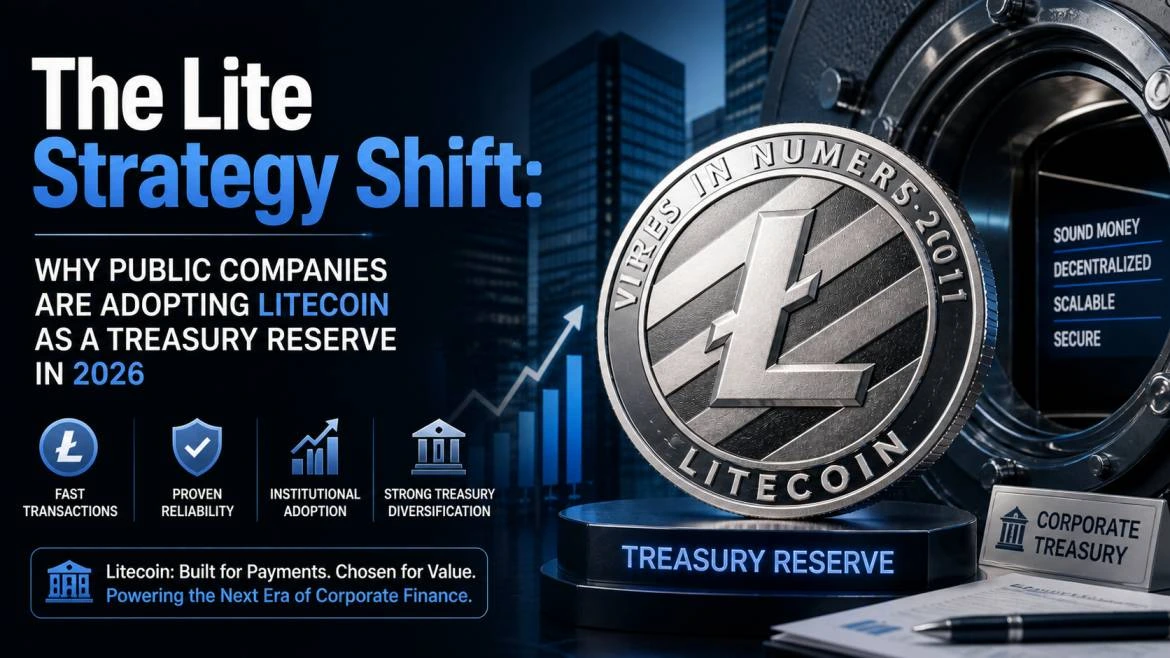
The Lite Strategy Shift: Why Public Companies are Adopting Litecoin as a Treasury Reserve in 2026
The announcement on May 4, 2026, that Lite Strategy (NASDAQ: LITS) has officially designated Litecoin as its primary treasury reserve asset marks a structural evolution in corporate finance. In a move that mirrors the iconic MicroStrategy playbook, LITS has committed over $100 million to LTC. This Lite Strategy corporate LTC adoption is not a speculative “meme-trade”; it is a calculated bet on the maturity of the Scrypt network and the asset’s emerging status as the “commodity-standard” for high-velocity corporate settlement.
For the first time, a NASDAQ-listed entity is treating Litecoin not just as a speculative altcoin, but as a strategic hedge against fiat debasement and a tool for operational liquidity. Our analysis of the LITS filing suggests that the firm is looking to exploit the “Silver-to-Gold” ratio, betting that Litecoin’s utility will drive a massive revaluation relative to Bitcoin.
The NASDAQ: LITS Disclosure: A $100 Million Conviction Play
The Lite Strategy corporate LTC adoption was detailed in an 8-K filing this morning. The company revealed it has acquired approximately 196,000 LTC at a volume-weighted average price (VWAP) of $510.10.
Breaking Down the Allocation:
- Total Commitment: $100.2 Million.
- Percentage of Treasury: 82% of liquid cash reserves.
- Custody Method: A bifurcated approach using Coinbase Prime and Fidelity Digital Assets, ensuring institutional-grade multi-sig security.
- The “HODL” Duration: The board has authorized a minimum 5-year holding period, treating LTC as a long-term capital asset.
By shifting $100 million into LTC, Lite Strategy is signaling that the asset has passed the “Institutional Credibility” threshold. With record-high hash rates and the completion of its third halving cycle, Litecoin provides the scarcity profile of Bitcoin with a lower barrier to entry and higher transactional throughput.
The “MicroStrategy Playbook” Applied to Litecoin
The Lite Strategy corporate LTC adoption follows the path blazed by Michael Saylor, but with a distinct twist focused on “Utility over Stagnation.” While MicroStrategy views BTC as a digital vault, LITS appears to view LTC as a digital currency with significant “Velocity of Money” advantages.
1. Scarcity and the 84 Million Cap
Litecoin’s fixed supply of 84 million coins is a primary driver for LITS. In an era of persistent 3.5%–4% global inflation, the “hard money” properties of LTC are attractive. LITS management noted that the 4:1 supply ratio between LTC and BTC makes the current LTC price an attractive “deep value” play.
2. Operational Liquidity
Unlike BTC, which has become a “settlement layer” for large-scale transfers, LTC is increasingly used for operational corporate needs. LITS has indicated plans to use its LTC reserves to settle vendor invoices across its European and Asian supply chains, bypassing traditional SWIFT delays.
3. FASB 2026: The Accounting Catalyst
A critical factor in the Lite Strategy corporate LTC adoption is the 2026 implementation of fair-value accounting for digital assets. Public companies can now report their crypto holdings at current market value on a quarterly basis. This eliminates the “impairment” trap where companies had to mark down holdings during dips but could not mark them up during rallies. For LITS, this means their balance sheet will more accurately reflect the true value of their $100M bet.
Institutional Analysis: Why LTC? Why Now?
The Lite Strategy corporate LTC adoption comes at a time when the “Digital Silver” narrative is being re-examined by institutional desks.
The Regulatory Moat
Litecoin is one of the few assets that has achieved “Regulatory Escape Velocity.” Following the EU’s MiCAR implementation and the SEC’s consistent treatment of LTC as a commodity, corporate legal departments feel comfortable with the asset’s status. There is no looming “Security” designation risk that currently plagues many newer Layer 1 and Layer 2 tokens.
The Privacy Balance: MWEB Auditability
Corporate treasuries require a level of privacy to prevent competitors from front-running their trades. Litecoin’s MWEB (MimbleWimble Extension Blocks) allows LITS to keep its internal transfers private, while the “view key” technology ensures that the firm can still provide full transparency to auditors and the SEC during year-end reviews.
Risk Analysis: The Dangers of Corporate Concentration
While the Lite Strategy corporate LTC adoption is bullish for the network, it introduces specific risks for LITS shareholders:
- Volatility Contagion: A 20% drawdown in LTC price would significantly impact LITS’s book value and potentially trigger margin calls if the company uses LTC as collateral for debt.
- Market Liquidity: While LTC is highly liquid, a $100M position represents a significant percentage of daily “real volume.” Exiting the position would require careful execution to avoid massive slippage.
- Custodial Risk: Even with Tier-1 custodians, the centralization of such a large amount of LTC in two entities creates a systemic “honeypot” for state-sponsored cyber-attacks.
Pros & Cons for Public Companies
| Feature | Pros | Cons |
| Inflation Hedge | Protects purchasing power in high-CPI environments. | Subject to extreme short-term price swings. |
| Network Security | Backed by the world’s most secure Scrypt network. | Hardware specialized (ASIC), susceptible to supply chain shocks. |
| Accounting | Fair-value reporting (FASB 2026) improves P&L transparency. | Auditors may require more expensive, specialized crypto audits. |
Strategic Conclusion: The First of Many?
The Lite Strategy corporate LTC adoption is likely the “canary in the coal mine” for a second wave of corporate crypto adoption. As Bitcoin becomes “too expensive” for smaller mid-cap companies to acquire in meaningful quantities, Litecoin offers a “high-beta” alternative with nearly identical security and regulatory status. For Lite Strategy (NASDAQ: LITS), the $100 million commitment is a vote of confidence in a digital future where the “Silver” standard is as essential as the “Gold.”
FAQ SECTION
– What is the Lite Strategy (NASDAQ: LITS) corporate LTC adoption ?
- It is the strategic decision by the public company Lite Strategy to commit over $100 million of its cash reserves to Litecoin (LTC), treating it as its primary treasury reserve asset, similar to how MicroStrategy holds Bitcoin.
– Why did Lite Strategy choose LTC over BTC in 2026 ?
- While the firm respects BTC, it cited LTC’s lower transaction fees, faster 2.5-minute block times, and the “deep value” of the LTC/BTC ratio as the primary reasons for its $100M commitment.
– How does FASB 2026 accounting affect companies like Lite Strategy ?
- The 2026 FASB rules allow companies to use “Fair Value Accounting” for crypto. This means they can report LTC at its current market price every quarter, reflecting gains in their earnings reports rather than only reporting losses through impairments.
– Is Litecoin considered a commodity for corporate treasuries ?
- Yes. In 2026, Litecoin is widely recognized as a commodity by major regulatory bodies (SEC/CFTC and EU MiCAR), making it a “safe” asset for public companies to hold without the risk of being labeled an unregistered security.
– How does MWEB privacy work for a public company like LITS ?
- MWEB allows for confidential transactions. However, because it is “opt-in” and includes audit features like “view keys,” LITS can keep its daily business private while still providing required data to regulators and auditors.
FINANCIAL DISCLAIMER
Disclaimer: This report is for informational purposes only and does not constitute financial, investment, or legal advice. The Lite Strategy corporate LTC adoption discussed is based on 2026 market scenarios. Cryptocurrency investments are highly volatile and involve significant risk. Neither the author nor the publication is responsible for any financial losses. Always consult with a certified financial professional before making any corporate treasury or personal investment decisions.