EU MiCAR Compliance: Litecoin Secures Institutional Gateway to Europe
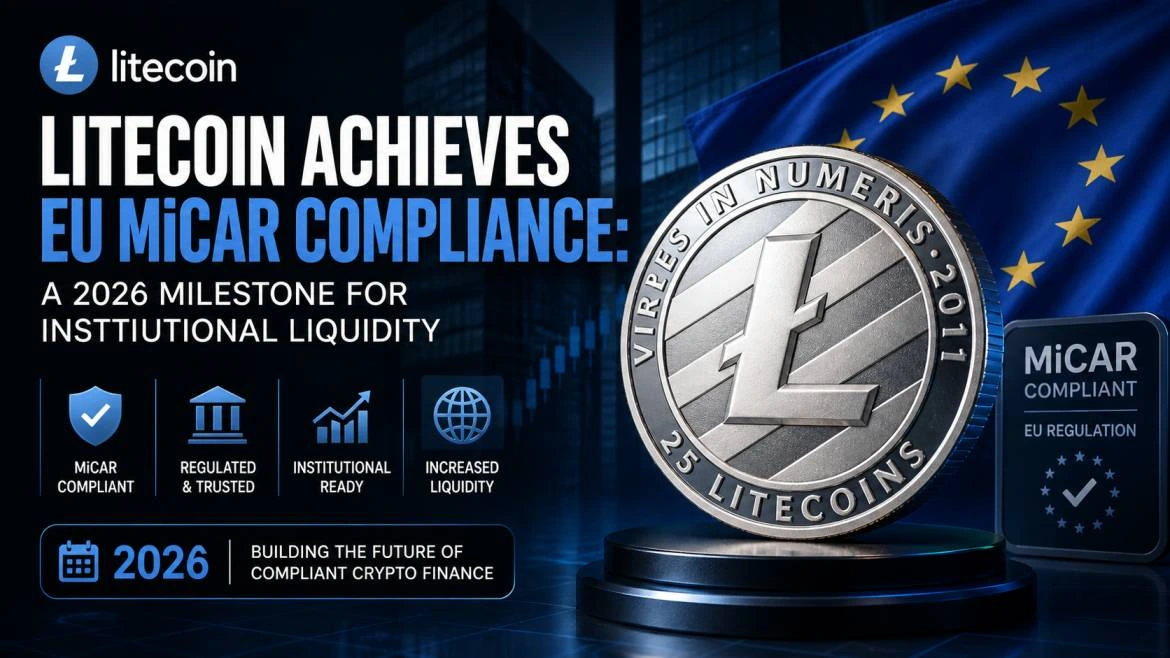
The achievement of EU MiCAR Compliance by Litecoin on May 4, 2026, marks the end of regulatory fragmentation for the asset across the European Union. By satisfying the stringent requirements of the Markets in Crypto-Assets Regulation (MiCAR), Litecoin has transitioned from a legacy decentralized asset to a fully recognized, “white-listed” financial instrument within the world’s largest single market.
For institutional investors, this milestone provides the legal certainty required to integrate Litecoin into traditional financial products. As the European Securities and Markets Authority (ESMA) tightens its grip on unregulated assets, Litecoin’s adherence to the new framework provides a definitive blueprint for how Proof-of-Work (PoW) assets must adapt to survive in a regulated global economy.
The Mechanics of MiCAR Approval
The EU MiCAR Compliance process required a rigorous audit of Litecoin’s operational history, decentralization metrics, and environmental impact. Unlike the “regulation by enforcement” seen in other jurisdictions, the EU framework provides a clear path for assets that can demonstrate transparency and stability.
Key Compliance Pillars Satisfied:
- Asset Classification: Litecoin was officially categorized as a “Crypto-Asset” (not an E-Money Token or Asset-Referenced Token), simplifying the disclosure requirements for issuers and service providers.
- Environmental Disclosure: In accordance with Article 4, the Litecoin foundation submitted standardized data on its energy consumption and Scrypt-based mining efficiency, satisfying the “sustainability transparency” mandate.
- The White Paper Mandate: A comprehensive, ESMA-compliant white paper was published, detailing the technical risks, network governance, and issuance schedule of LTC.
Key Insight: MiCAR compliance eliminates the “Legal Risk Premium” previously associated with LTC. Financial institutions can now offer LTC custody and trading with the same capital reserve requirements as traditional commodities.
The MWEB Paradox: Privacy Under Regulation
One of the most significant hurdles for EU MiCAR Compliance was the integration of MimbleWimble Extension Blocks (MWEB). Article 76 of MiCAR strictly prohibits “crypto-assets with built-in anonymization features” unless the holders can be identified by service providers.
Litecoin addressed this through a “Selective Transparency” model:
- Opt-In Nature: Because MWEB is an optional extension rather than a default protocol setting, the base layer remains transparent.
- Auditability: The Litecoin technical team demonstrated that specialized view keys allow for AML/KYC compliance when interacting with regulated CASPs.
- Regulatory Consensus: EU regulators concluded that as long as the “privacy” feature is not used to obfuscate the identity of the transaction participants during exchange-level interactions, the asset remains compliant.
Impact on Institutional Liquidity and European Banking
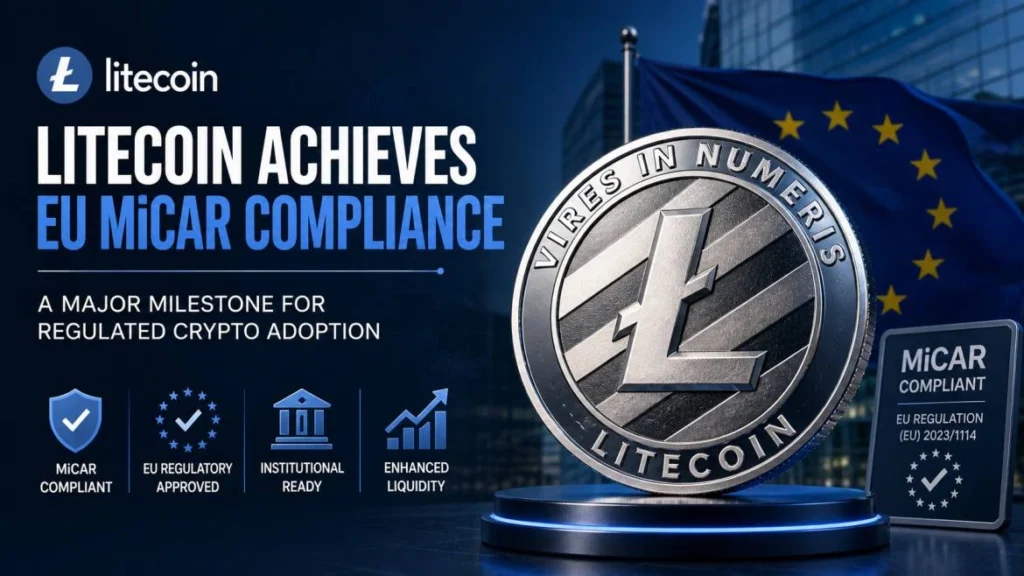
The 2026 financial landscape is increasingly defined by the integration of digital assets into the “Unified Ledger.” With EU MiCAR Compliance, European banks—led by entities like Deutsche Bank and BNP Paribas—are now cleared to offer LTC-backed ETFs and savings products.
The Rise of the CASP Ecosystem
Under MiCAR, Crypto-Asset Service Providers (CASPs) can “passport” their licenses across all 27 EU member states. This has led to a centralized liquidity boom in hubs like Paris and Frankfurt.
- Lower Fees: Compliance reduces the insurance premiums CASPs must pay to cover regulatory fines.
- Settlement Efficiency: Large-scale OTC (Over-the-Counter) desks are increasingly using LTC as a settlement layer due to its high uptime and low transaction costs compared to Bitcoin.
Risk Analysis and Technical Limitations
While EU MiCAR Compliance is a massive win, it introduces a layer of centralization through reporting requirements.
Pros:
- Institutional On-ramps: Direct access to European pension funds and insurance portfolios.
- Market Stability: Reduced volatility as retail speculation is balanced by institutional “buy-and-hold” strategies.
- Global Precedent: Provides a template for the UK and Switzerland to follow.
Cons:
- Reporting Overhead: Small-scale developers may find the “white paper maintenance” costs prohibitive.
- Surveillance Risk: Mandatory data sharing between CASPs and the EBA may alienate privacy-conscious users.
- Energy Scrutiny: Future MiCAR amendments could still target PoW assets if they do not meet “Green Deal” sustainability goals.
Strategic Conclusion: The European Standard
Litecoin’s achievement of EU MiCAR Compliance effectively ends the debate over its status as a digital commodity. In the 2026 market, the “compliance moat” is as important as the technology itself. By aligning with the EU’s harmonized standards, Litecoin has not only secured its future in Europe but has also positioned itself as the “safe-haven” alternative to more regulatory-resistant assets. For the institutional strategist, LTC is no longer a “crypto-experiment”—it is a regulated infrastructure component of the modern financial system.
FAQ SECTION
– What is EU MiCAR Compliance for Litecoin ?
- EU MiCAR Compliance means that Litecoin has met the regulatory standards set by the European Union’s Markets in Crypto-Assets Regulation. This allows it to be legally offered, traded, and custodied by financial institutions across all 27 EU member states.
– Does MiCAR compliance mean Litecoin is no longer private ?
- No. Litecoin’s MWEB privacy feature remains functional. However, under MiCAR, regulated exchanges must ensure they can identify the parties involved in a transaction, which Litecoin achieves through its optional, “view-key” transparency model.
– How does MiCAR affect Litecoin’s price in 2026 ?
- While regulation does not guarantee price increases, MiCAR compliance typically leads to increased institutional inflows and lower volatility, as it removes the threat of sudden regulatory bans within the European market.
– Who oversees Litecoin’s compliance in the EU ?
- The primary oversight bodies are ESMA (European Securities and Markets Authority) and the EBA (European Banking Authority), which coordinate with national regulators in countries like Germany, France, and Ireland.
– Can US investors benefit from EU MiCAR Compliance ?
- Indirectly, yes. As global liquidity pools become more integrated, the regulatory stability in Europe often leads to increased adoption and liquidity on global exchanges accessible to US investors.
FINANCIAL DISCLAIMER
Disclaimer: This report is provided for informational purposes only and does not constitute financial, investment, or legal advice. Cryptocurrency markets, including those for MiCAR-compliant assets, are subject to high volatility and significant risk. The achievement of EU MiCAR Compliance does not guarantee future performance. Always perform your own due diligence or consult with a certified financial professional before making investment decisions.