
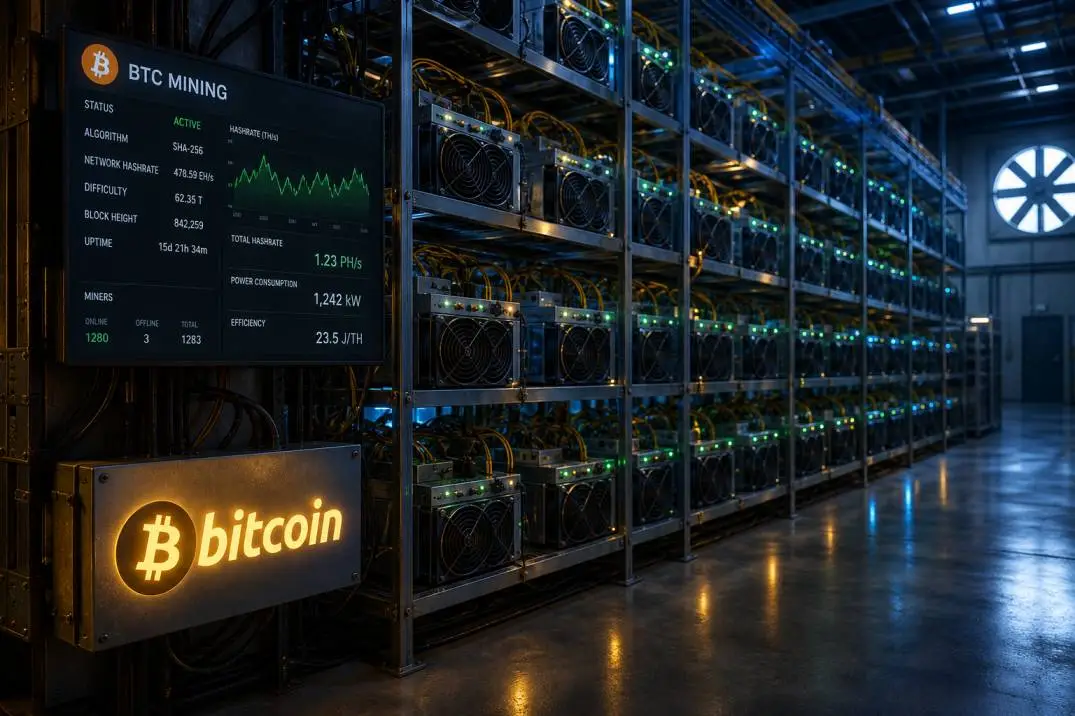
The Great Pivot: Bitcoin Miners Emerge as AI Infrastructure Giants in 2026
The Q1 2026 earnings season has confirmed what analysts have suspected for eighteen months: the era of the “pure-play” Bitcoin miner is over. On May 2, Riot Platforms released a landmark Q1 report that signals a permanent structural shift. While Riot’s Bitcoin production remained a core pillar, its newly minted High-Performance Computing (HPC) and AI division contributed $33 million in quarterly revenue—a figure growing at a 40% CAGR.
This shift is not a choice; it is an existential requirement. As of May 2026, the Bitcoin network hash rate has stabilized at a staggering 1.8 Zetahash per second (ZH/s). With the global average cost to mine a single Bitcoin now hovering around $44,600 (and all-in cash costs exceeding $80,000 for legacy fleets), the margin for error has evaporated.
The Profitability Squeeze: Why $45k Production Costs Are the New Baseline
The Bitcoin “halving” cycles of the past were often offset by immediate price appreciation. However, in 2026, the difficulty adjustment and the professionalization of the network have created a “difficulty floor” that punishes inefficiency.
- Hash Price Compression: Hash prices have reached cyclical lows of $29/PH/s/day, leaving mid-generation machines (like the S19 series) deep in the red.
- Energy as a Moat: Public miners that secured 15-year Power Purchase Agreements (PPAs) at $0.03/kWh are the only survivors.
- The Capital Expenditure Trap: Upgrading to the latest Bitmain S23 or SEALMINER A3 hardware requires billions in capex, leading boards to ask: Why not spend that capital on GPUs with 80% margins?
Callout: The Multi-Revenue Model
Key Insight: In 2026, the most successful “miners” are actually energy arbitrageurs. They mine BTC when price/difficulty is favorable, sell power back to the grid during peak demand, and host AI workloads for steady USD cash flow.
Riot Platforms & The AMD Strategic Leap
The Riot Platforms Q1 earnings report highlighted its Corsicana facility as the blueprint for the future. By securing a strategic lease with AMD, Riot has transitioned from a company that simply “runs machines” to one that provides hyperscale digital infrastructure.
Q1 2026 Riot Financial Snapshot (Estimated/Reported)
| Metric | Q1 2026 Value | YoY Change |
| HPC/AI Revenue | $33.4 Million | +210% |
| Avg. Cost to Mine 1 BTC | $44,600 | +38% |
| Operational Hash Rate | 31.5 EH/s | +12% |
| Liquidity Position | $1.9 Billion | Strong |
The $33 million in HPC revenue is significant because of its margin profile. Unlike Bitcoin mining, where revenue is subject to the whims of the spot market, AI hosting contracts are typically 5–12 year fixed-price agreements in USD.
The Institutional Edge: Why AI Needs Miners
The AI “Gold Rush” of 2026 has a major bottleneck: Power and Space. While Big Tech has the capital to buy GPUs, they cannot build data centers fast enough.
1. The Interconnection Queue
In major markets like Texas (ERCOT) and the PJM Interconnection, the wait time to bring a new 100MW load online is now 5 to 7 years. Bitcoin miners already have the transformers, substations, and fiber in place.
2. High-Density Power
Modern AI chips (like the NVIDIA Blackwell series) require 100kW+ per rack. Bitcoin mining facilities are uniquely designed for this density, unlike traditional enterprise data centers built for low-intensity office workloads.
3. Stranded Energy Utilization
Miners excel at operating in remote areas with “stranded” renewable energy. AI training—which is less latency-sensitive than real-time inference—can thrive in these remote, energy-rich hubs.
Technical Reality Check: It’s Not Just “Swapping Plugs”
While the pivot sounds lucrative, it is technically demanding. Bitcoin mining is “forgiving”—if a machine goes down, the network continues. AI workloads are stateful and require 99.99% uptime.
- Cooling Requirements: Mining typically uses air cooling. High-end GPUs require liquid cooling or advanced immersion, necessitating a $50M–$100M retrofit for most older sites.
- Networking Layer: AI training requires InfiniBand or ultra-high-speed Ethernet to allow GPUs to communicate. This is a level of networking complexity that traditional miners have rarely managed.
- Operational Staff: Moving from “rebooting ASICs” to “managing a Kubernetes cluster for AI” requires a different caliber of talent.
The Risk Analysis: The Dangers of Diversification
Diversification is not without peril. Analysts point to several “Red Flags” for investors:
- AI Overcapacity: If the AI bubble bursts, miners who spent billions on retrofits may find themselves with “over-engineered” sheds and no tenants.
- Regulatory Scrutiny: Legislation like Texas SB 6 now allows the state to remotely shut down large loads during grid emergencies. This is manageable for BTC mining but potentially catastrophic for AI training runs.
- Dilution: Many miners are issuing equity to fund their AI pivots, diluting existing shareholders in the hope of future “AI multiples.”
Strategic Conclusion: The Death of the “Pure Play”
As we move through the remainder of 2026, the market will likely split into two camps: The Infrastructure Providers (Riot, IREN, Core Scientific) and The Efficiency Purists (CleanSpark, HIVE).
The infrastructure providers will be valued as HPC utilities, commanding higher P/E multiples and attracting ESG-conscious institutional capital. The purists will remain highly leveraged “calls” on the price of Bitcoin. For the savvy investor, the opportunity lies in identifying which miners can successfully manage the technical transition to AI without losing their core competency in the Bitcoin network.
FAQ SECTION
– Why are Bitcoin miners pivoting to AI in 2026 ?
- The primary driver is the “profitability squeeze.” With the network hash rate at 1.8 ZH/s and mining costs rising to $44,600+, miners are using their existing power infrastructure to host AI workloads, which offer stable, high-margin USD revenue compared to volatile BTC.
– Can any Bitcoin mining site run AI GPUs ?
- No. Most mining sites require significant retrofitting for cooling (liquid cooling) and networking (InfiniBand) to support modern AI chips like NVIDIA’s H100 or B200 series.
– How much revenue did Riot Platforms report from AI in Q1 2026 ?
- Riot reported $33.4 million in revenue from its data center and HPC arm, signaling a permanent shift toward diversified infrastructure.
– What is the biggest advantage miners have in the AI race ?
- The biggest advantage is “Time to Market.” Miners own grid-connected land and power purchase agreements (PPAs) that would take 5+ years for new AI competitors to secure from scratch.
– How does the “AI pivot” affect Bitcoin’s network security ?
- While some power is being redirected, the network remains secure at 1.8 ZH/s. However, the pivot may lead to more “industrialized” and centralized mining as only the largest firms can afford the hybrid model.
FINANCIAL DISCLAIMER
Disclaimer: The information provided in this article is for informational purposes only and does not constitute financial, investment, or legal advice. Cryptocurrency mining and AI infrastructure investments involve significant risk. All data points for May 2026 are based on current market trends and projections available as of the time of writing.