
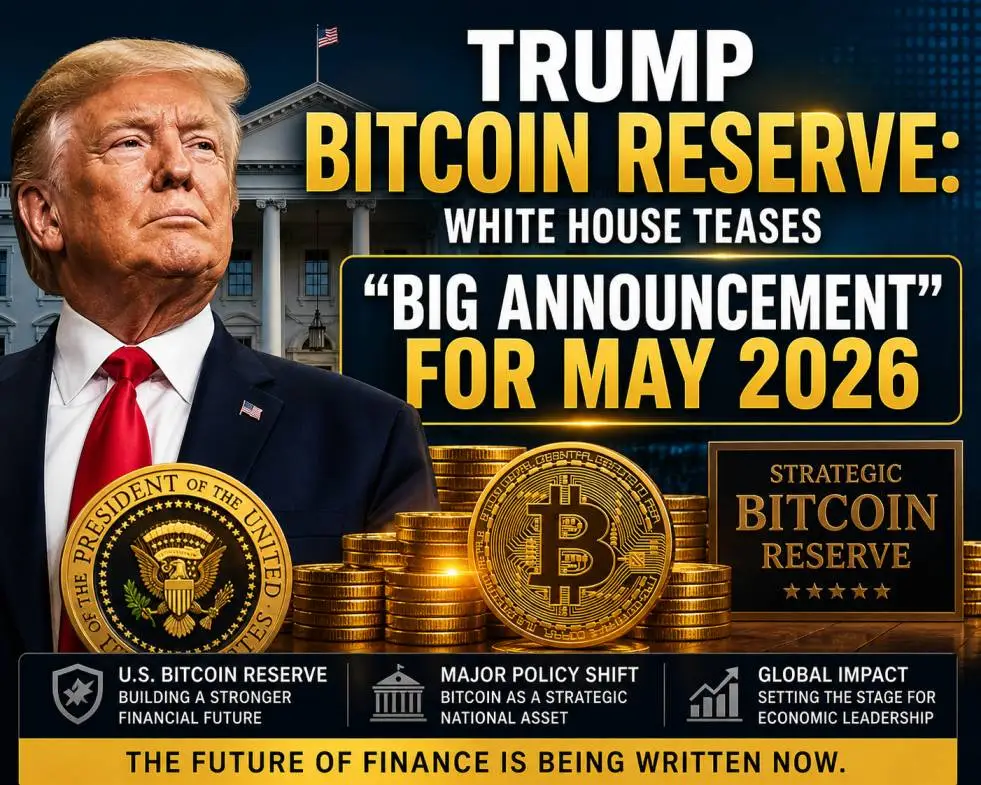
Trump Bitcoin Reserve: White House Teases “Big Announcement” for May 2026
The era of “accidental” Bitcoin ownership for the United States is coming to an end. On May 3, 2026, White House crypto adviser Patrick Witt—speaking at the Bitcoin 2026 conference in Las Vegas—signaled that a formal, substantive update regarding the Trump Bitcoin Reserve announcement is imminent.
For the past year, the administration has operated under a March 2025 executive order that halted the sale of government-seized Bitcoin. However, Witt’s latest comments suggest the White House is ready to move beyond “no-sale” policies toward a proactive, legislatively backed Strategic Bitcoin Reserve plan.
Patrick Witt and the Breakthrough in Federal Bitcoin Policy
As the Executive Director of the President’s Council of Advisors for Digital Assets, Patrick Witt has been the primary architect of the administration’s “Digital Gold” framework. His revelation that the team has reached a “breakthrough on the legal framework” suggests the administration has found a way to bridge the gap between executive action and permanent federal law.
Currently, the US government is the world’s largest known sovereign holder of Bitcoin, with a treasury of approximately 328,372 BTC. Valued at roughly $25 billion at current market prices, these holdings represent 1.56% of the total circulating supply. Until now, these assets were scattered across various agencies—the DOJ, IRS, and FBI—primarily as the result of criminal forfeitures.
The Shift from Forfeiture to Strategy
The core of the upcoming announcement is expected to detail the consolidation of these disparate holdings into a single, unified custody structure managed by the Treasury.
- Custody Mechanics: Transitioning from “forfeiture wallets” to institutional-grade, multi-sig federal vaults.
- The “No-Sale” Mandate: Codifying the prohibition on selling these assets into a multi-decade holding period.
- Fiscal Integration: Exploring how Bitcoin can serve as a “neutralizer” for dollar debasement on the national balance sheet.
Inside the Numbers: The Path to 1 Million BTC
While the current holdings are significant, the Strategic Bitcoin Reserve proposal introduced by Senator Cynthia Lummis (now rebranded as the U.S. Reserve Modernization Act) sets a far more ambitious target: 1 million Bitcoins over a five-year period.
The 2026 Acquisition Roadmap (Estimated)
| Phase | Target Holdings | Source of Funds |
| Current (Q2 2026) | 328,372 BTC | Forfeitures / Seizures |
| Phase 1 (2026-2027) | 500,000 BTC | Revaluation of Gold Certificates |
| Phase 2 (2027-2029) | 750,000 BTC | Excess Fed Remittances |
| Final Target (2031) | 1,000,000 BTC | Budget-Neutral Reallocation |
Key Insight: To reach 1 million BTC, the US would need to acquire approximately 134,000 BTC per year for the next five years. This represents nearly 70% of all newly issued Bitcoin via mining in that same period, creating a massive supply-side squeeze.
The U.S. Reserve Modernization Act: From EO to Law
A critical component of the Trump Bitcoin Reserve announcement will be its coordination with the legislative branch. Patrick Witt noted that the executive branch intends to act before the 2026 National Defense Authorization Act (NDAA) markup in late May.
The Legislative “Clarity Act”
Senator Lummis confirmed that the Clarity Act is heading to markup this month. This legislation provides the statutory authority required to:
- Establish Bitcoin as a Tier 1 Reserve Asset.
- Allow the Treasury to issue “Bitcoin Certificates” similar to the gold certificates currently held on the Fed’s balance sheet.
- Ensure that a change in administration cannot simply “liquidate” the reserve via a future executive order.
Geopolitical Game Theory: The Sovereign Race
The White House’s focus on a Strategic Bitcoin Reserve has triggered a “front-running” effect among other nation-states. Reports from Q1 2026 indicate that sovereign wealth funds (SWFs) in the Middle East and Europe are no longer just observing—they are accumulating.
- Mubadala (Abu Dhabi): Disclosed a ~$460 million allocation into Bitcoin-linked instruments.
- Luxembourg (FSIL): Became the first European SWF to allocate 1% of its AUM directly to Bitcoin.
- Geopolitical Hedge: Nations are beginning to view Bitcoin as “insurance” against a US-led digital asset monopoly. If the US successfully locks up 5% of the supply, other nations may be forced to compete for the remaining “float” at significantly higher valuations.
Risk Analysis: The Fiscal Volatility Trade-off
While the pivot to a Strategic Bitcoin Reserve is seen as a masterstroke by proponents, institutional critics warn of significant risks:
Pros
- Scarcity Hedge: Protects the US balance sheet against long-term fiat inflation.
- Geopolitical Leverage: Positions the US as the “Liquidity Gatekeeper” of the digital age.
- Psychological Floor: A permanent US “Bid” creates a massive confidence level for institutional capital.
Cons & Technical Limitations
- Volatility Drawdowns: A 50% correction in BTC price would result in a $10B+ “paper loss” for the Treasury, creating political ammunition for detractors.
- Custody Vulnerability: While multi-sig is secure, the centralization of 1 million BTC in government hands creates a single “honeypot” for state-sponsored cyber warfare.
- Market Distortion: Government-scale buying could decouple Bitcoin from its “organic” price discovery, leading to an illiquid market.
Strategic Conclusion: The Institutional “Buy” Signal
The Patrick Witt “big announcement” tease is more than a procedural update; it is a signal to global markets that the US government is officially “long” Bitcoin. For institutional investors, the transition from a speculative asset to a Strategic Bitcoin Reserve provides the final piece of the regulatory and fiscal puzzle.
As the formal plan is unveiled later this month, the market will likely move from analyzing “if” a reserve happens to “how fast” the US can accumulate its first million coins. In the 2026 financial landscape, being “zero-weighted” in Bitcoin is increasingly seen by sovereign actors as the greatest risk of all.
FAQ SECTION
– What is the “Trump Bitcoin Reserve” announcement?
- The announcement refers to a formal plan teased by the White House to consolidate and expand US government Bitcoin holdings into a permanent Strategic Bitcoin Reserve, potentially targeting 1 million BTC.
– Who is Patrick Witt in the context of the Bitcoin Reserve ?
- Patrick Witt is the Executive Director of the White House Digital Assets Presidential Advisory Committee and a key adviser to President Trump on crypto policy. He is the primary architect of the current reserve framework.
– How much Bitcoin does the US government currently hold ?
- As of May 2026, the US government holds approximately 328,372 BTC, largely acquired through criminal forfeitures and law enforcement seizures.
– What is the U.S. Reserve Modernization Act ?
- Formerly known as the BITCOIN Act of 2025, this is a legislative proposal by Senator Cynthia Lummis designed to codify the Strategic Bitcoin Reserve into law and authorize the purchase of up to 1 million BTC over five years.
– Is the Strategic Bitcoin Reserve budget-neutral ?
- Proponents argue the plan is budget-neutral by utilizing existing seized assets and the revaluation of Treasury gold certificates to fund additional Bitcoin purchases without increasing the national debt.
FINANCIAL DISCLAIMER
Disclaimer: This publication is for informational and educational purposes only. The information contained herein does not constitute financial, investment, legal, or tax advice. Digital assets and cryptocurrency products are subject to extreme market volatility, technical limitations, and evolving regulatory changes. Institutional and individual investors must conduct independent due diligence or consult with a certified financial professional prior to executing any capital allocations or digital asset investment strategies. The publisher and author assume no liability for any direct or consequential financial losses resulting from the use of this content.