

Ethereum Pectra Upgrade Activates on Mainnet as Market-Wide Correction Sparks $210M Liquidation Cascade
The highly anticipated Ethereum Pectra upgrade successfully launched on the mainnet, implementing the most profound structural changes to the network’s execution and consensus layers since the transition to Proof-of-Stake. However, the technical milestone was immediately met with extreme market turbulence. On May 15–16, 2026, a sudden systemic market correction pulled Bitcoin below $78,700, dragging Ethereum down in a sharp 3.42% single-day decline to an intraday low of $2,204—its lowest trading level since mid-April. This sharp downward velocity triggered a massive cascading effect across leverage markets, forcing crypto exchanges to liquidate over $210 million in trader positions within a single hour, with more than $120 million concentrated solely in the ETH and BTC markets.
This dual event highlights the widening divergence between Ethereum’s long-term institutional engineering roadmap and short-term speculative market dynamics. While core developers finalized the implementation of Prague (the execution layer upgrade) and Electra (the consensus layer upgrade), derivatives markets faced a classic leverage wipeout exacerbated by macroeconomic liquidity drains and algorithmic cascade execution.
The Dual Architecture of the Pectra Hard Fork: Execution Meets Consensus
The Ethereum Pectra upgrade is a consolidated effort composed of multiple Ethereum Improvement Proposals (EIPs) designed to optimize performance, enhance developer primitives, and streamline the user experience. By merging the Prague and Electra developments, the network addresses critical inefficiencies across both major infrastructure layers.
Historically, upgrades have focused heavily on scalability via Layer 2 rollups—such as the blob space introduced by the Dencun fork. Pectra pivots back to core efficiency and user account security, laying structural foundations for decentralized applications (dApps) and institutional staking frameworks alike. Among its primary achievements are the restructuring of validator limits and a radical evolution in wallet capability.
Institutional Staking Boost: Decoupling Node Overhead from Capital Efficiency
Prior to the hard fork, the maximum effective balance of an Ethereum validator was rigidly capped at 32 ETH. If an entity held 32,000 ETH, it was required to deploy and maintain 1,000 discrete validator nodes, each requiring separate keys, computing infrastructure, and network communication overhead.
Through the implementation of EIP-7251, the Ethereum Pectra upgrade raises the maximum effective validator staking cap from 32 ETH to 2,048 ETH. The minimum requirement to activate a node remains 32 ETH, but the ceiling expands sixty-four fold. This shift directly addresses operational bottlenecks for institutional staking providers, custodial platforms, and spot ETF issuers managing massive node clusters.
This change yields significant benefits across the network structure:
- Reduction in Peer-to-Peer Messaging: Fewer active validator instances mean less communication overhead across the consensus layer. This optimizes bandwidth and strengthens the network’s stability during periods of severe congestion.
- Auto-Compounding Rewards: Previously, staking rewards earned above the 32 ETH threshold sat idle on the Beacon Chain, requiring manual withdrawal and node recycling to achieve compound yields. EIP-7251 allows rewards to directly compound within the single node’s effective balance up to the 2,048 ETH limit.
- Simplified Validator Exit and Activation Flows: Consolidated nodes reduce the depth of the activation and exit queues, making large-scale capital entry and exit significantly more predictable.
Pro Tip: The Consolidation Premium
Institutional node operators should execute consolidation requests via the newly deployed execution-layer triggerable mechanisms (EIP-7002) rather than exiting and re-entering the staking pool. This bypasses wait times in the activation queue and prevents unnecessary opportunity cost in yield accumulation.
EIP-7702 and the Paradigm Shift in Smart Wallet Features
For retail users, the most meaningful element of the Ethereum Pectra upgrade is EIP-7702, authored by Vitalik Buterin as a direct replacement for EIP-3074. This proposal introduces a new transaction type that grants regular Externally Owned Accounts (EOAs)—such as traditional hardware or software wallets—ephemeral smart contract capabilities during execution.
Instead of forcing users to migrate their capital from standard accounts to complex smart contract wallets (under standard account abstraction frameworks), EIP-7702 allows an EOA to specify an authorization list. For the duration of a signed transaction, the account adopts the code specified by a chosen smart contract template, executing advanced logic before reverting to its standard state.
This temporary programmability unlocks several features:
- Transaction Batching: Users can authorize an ERC-20 approval, a token swap, and a subsequent deposit into a yield protocol within a single cryptographic signature, completely eliminating sequential transaction friction.
- Gas Fee Sponsorship: Third-party applications, protocols, or layer-2 bridges can sponsor user gas fees or accept payment in arbitrary tokens (e.g., USDC or native protocol tokens) instead of requiring the user to hold raw ETH for gas.
- Delegated Permissions: Users can assign temporary, restricted control parameters to their accounts, such as establishing daily spending caps or authorizing automated recurring micro-payments without compromising their underlying master private keys.
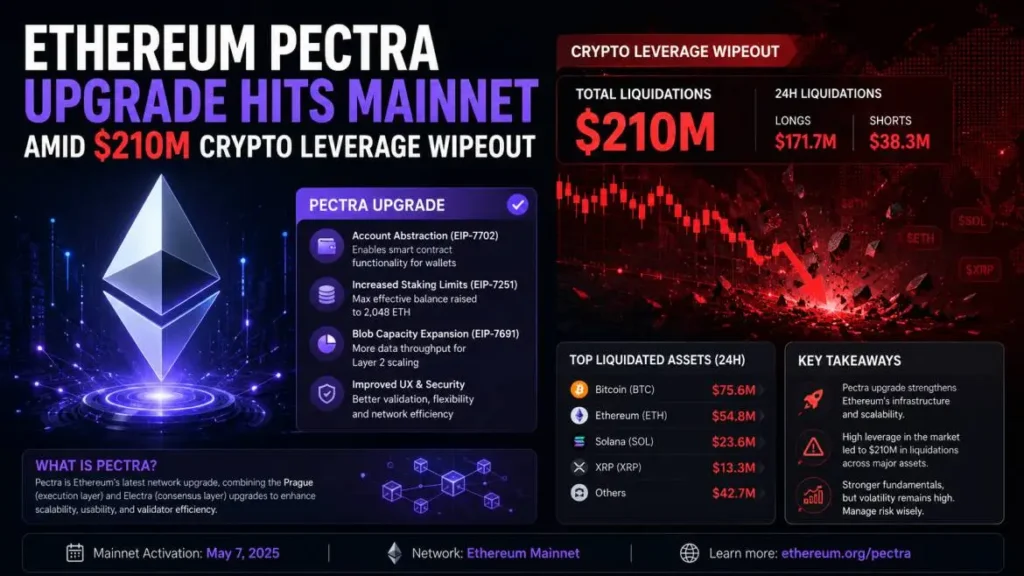
Anatomy of a Market Crash: The $210M Leverage Wipeout
As the mainnet successfully integrated these upgrades, systemic weaknesses within the derivatives market sparked a severe flush of speculative positions. Between May 15 and May 16, a sharp accumulation of spot selling pressure broke the technical support lines of major digital assets. Bitcoin plummeted below its psychological benchmark of $78,700, establishing a localized downtrend that quickly infected the broader altcoin ecosystem.
Ethereum bore a significant share of the damage, sustaining a 3.42% single-day collapse to touch an intraday low of $2,204. This price action unwound heavily levered long contracts on major derivatives exchanges, including Binance, OKX, and Bybit.
The liquidation mechanics operated via automated clearing engines. As spot prices breached the liquidation thresholds of high-leverage perpetual swap positions, exchanges systematically market-sold the collateral onto thinning spot order books. This created a classic feedback loop: the forced selling drove prices lower, hitting the next cluster of stop-losses and liquidation levels, culminating in over $210 million wiped from long positions in a 60-minute window.
This market structural vulnerability was exacerbated by a macro reduction in global stablecoin liquidity velocity and uncertainty regarding short-term Fed interest rate paths. This dynamic demonstrates that despite major base-layer improvements like the Ethereum Pectra upgrade, the asset class remains highly sensitive to leverage structural design and capital flows.
Risk Assessment: Protocol Optimization vs. Market Volatility
An institutional evaluation of the network’s current state requires assessing both the long-term benefits of the protocol updates and the operational challenges introduced by this transition.
Advantages of the Current Framework
- Infrastructure Efficiency: Staking platforms reduce their compute costs by running fewer validator keys, optimizing margins across the board.
- Frictionless Retail Onboarding: Ephemeral smart capabilities allow applications to offer smooth web2-style onboarding experiences without complex wallet setups.
- Base Layer Network Resiliency: Lower consensus message loads mitigate risks of block propagation delays and performance drops during market crashes.
Limitations and Operational Risks
- Centralization Vectors via Consolidation: While raising the validator cap lowers costs for major institutions, it could inadvertently disadvantage solo validators who remain limited to smaller capital allocations, altering the economics of decentralized block production.
- EIP-7702 Authorization Exploits: Malicious actors can construct authorization profiles that trick users into signing away temporary permissions that drain funds, shifting the security burden onto user interface developers and wallet providers.
- Liquid Staking Smart Contract Overhauls: Major decentralized protocols face significant smart contract execution risks as they migrate historical 32-ETH bucket architectures into the new variable-balance model.
Macro Implications of the Ethereum Pectra Upgrade
From a macro perspective, the successful launch of the Ethereum Pectra upgrade signals that core developers can deliver complex upgrades reliably. This predictability is highly encouraging for institutional investment and corporate integration.
By addressing validator overhead, Ethereum strengthens its position as the preferred settlement engine for asset tokenization, institutional staking infrastructure, and regulated spot ETFs. The short-term leverage washouts seen on May 15–16 are structural artifacts of current derivatives markets, but the underlying network upgrades provide a clearer path toward long-term capital efficiency and network scalability.
FAQ SECTION
– What is the primary objective of the Ethereum Pectra upgrade ?
- The Pectra upgrade integrates the Prague execution layer and the Electra consensus layer to improve validator operations, enhance wallet capabilities through account abstraction features, and lower infrastructure communication overhead across the network.
– How does EIP-7251 alter institutional Ethereum staking ?
- EIP-7251 increases the maximum effective balance for a validator node from 32 ETH to 2,048 ETH. This adjustment allows large staking entities and fund managers to consolidate their operations into fewer nodes, lowering bandwidth use, simplifying operations, and enabling native yield auto-compounding.
– What user advantages does EIP-7702 offer to standard wallet holders ?
- EIP-7702 allows traditional Externally Owned Accounts (EOAs) to temporarily act as smart contract wallets during transactions. This enables multi-step transaction batching, gas fee sponsorship by third parties, and customizable wallet permissions without requiring a permanent wallet migration.
– What triggered the $210 million crypto liquidation event on May 15–16 ?
- The $210 million liquidation cascade was triggered by a market-wide correction that pushed Bitcoin below $78.7K. This decline pulled Ethereum down 3.42% to an intraday low of $2,204, setting off automated liquidation engines across derivatives platforms that closed out overleveraged long positions.
– Do everyday token holders need to take action after the Pectra hard fork ?
- No. Standard users holding ETH or ERC-20 tokens do not need to take any action. The upgrade applies directly to the base network layer. Wallet upgrades and performance enhancements will roll out automatically through standard interface software providers.
FINANCIAL DISCLAIMER
Financial Disclaimer: This article is provided purely for informational, educational, and analytical purposes and should not be interpreted as financial, investment, legal, or tax advice. Cryptocurrency investments, digital asset trading, and blockchain participation carry substantial risks of capital loss due to asset volatility, protocol alterations, security vulnerabilities, and regulatory shifts. Readers must conduct independent research and consult certified financial specialists before executing any capital deployments or market positions. Historical network or market behavior does not guarantee future results.