
The Ethereum Foundation Leadership Restructuring: Institutionalizing L1 Scaling and Predictable Engineering Delivery
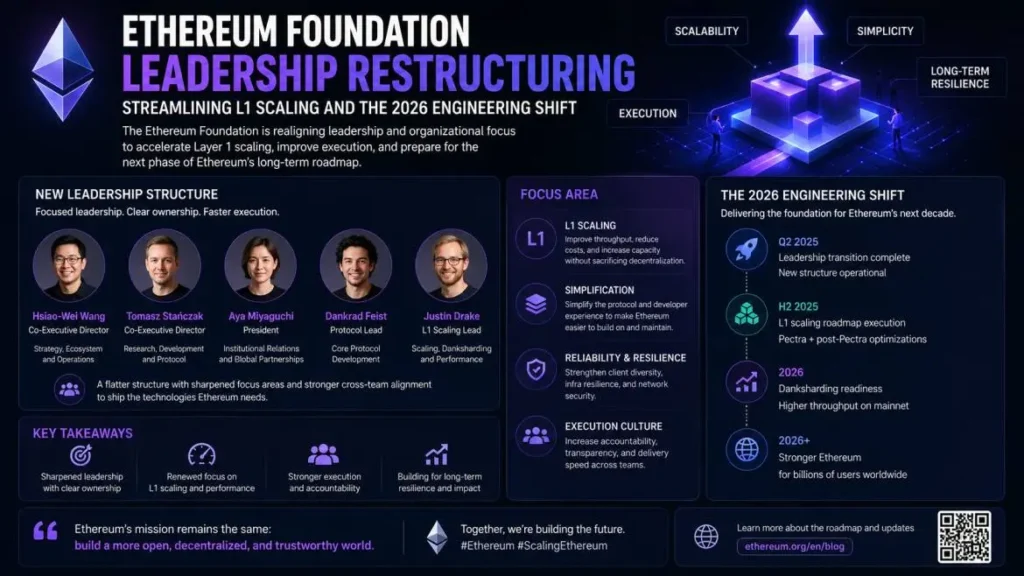
The Ethereum Foundation Leadership Restructuring, quietly executed within its core protocol division in mid-May 2026, marks a critical pivot from a research-first collective to an institutional engineering organization. This administrative reorganization comes during widening internal debates regarding the speed of Layer-1 scaling, execution mechanics versus rollup dependencies, and the prioritization of censorship resistance. Longtime protocol leaders Barnabé Monnot and Tim Beiko are departing the organization, while Alex Stokes takes an extended sabbatical. Responsibilities have transitioned to a new triumvirate of co-leads within the Protocol Cluster: Will Corcoran, Kev Wedderburn, and Fredrik Svantes.
This leadership transition signifies more than a routine human resources realignment; it reflects a deep re-engineering of how the world’s largest smart contract network coordinates development. As Ethereum enters a mature phase defined by the upcoming Glamsterdam and Hegotá upgrades, the organization is altering its internal architecture to prioritize predictable, biannual software delivery over open-ended academic research.
Key Insight: The End of Research-First Hegemony The consolidation of the Protocol Cluster demonstrates that Ethereum’s core research phase is largely complete. The network’s primary challenge has shifted from defining cryptographic ideals to executing complex engineering optimizations under intense production conditions.
Inside the Technical Catalyst for the Ethereum Foundation Leadership Restructuring
The operational foundations for this shift were established in June 2025 when the Ethereum Foundation formally consolidated its research and development departments into a unified “Protocol Cluster.” Prior to this consolidation, protocol development operated in a decentralized, sometimes fragmented manner, with separate teams pursuing independent tracks for execution layer scaling, consensus mechanism modifications, and data availability. While this model fostered intellectual diversity, it frequently led to deployment delays and coordination friction among independent client teams (such as Geth, Nethermind, Besu, and Lighthouse).
The successful delivery of the Pectra and Fusaka hard forks in 2025 demonstrated the viability of a more disciplined engineering model. By establishing a rigid, semi-annual upgrade cadence, the Foundation proved it could ship complex protocol updates without the multi-year delays that characterized the early history of the network. However, maintaining this pace required an organizational design that reduced dependency on a few key coordinators.
The Ethereum Foundation Leadership Restructuring directly addresses this organizational vulnerability. By establishing clear ownership over specific development tracks, the new leadership model eliminates the structural bottlenecks associated with centralized coordination. The restructured division is organized around three permanent strategic pillars: Scale, Improve UX, and Harden the L1. This replaces the ad-hoc task forces of the past with permanent engineering tracks designed to outlast individual contributors.
The Changing of the Guard: Monnot, Beiko, and Stokes Pass the Torch
The departures of Barnabé Monnot and Tim Beiko represent the conclusion of an era in Ethereum’s governance history. Monnot’s work over nearly six years was instrumental in shaping the economic foundations of the network, including the early simulation and implementation of EIP-1559, MEV market dynamics, and staking design parameters. His research provided the mathematical validation needed to alter Ethereum’s fee structure and economic incentives safely.
Tim Beiko’s role as the primary coordinator of the All Core Developers (ACD) meetings made him the operational face of Ethereum’s execution layer upgrades. Beiko managed the complex consensus-building process among disparate, competitive client teams, guiding the network through major milestones including the historic transition to Proof-of-Stake (The Merge) and the introduction of data blobs via EIP-4844.
Alex Stokes’ concurrent sabbatical removes another critical bridge between the consensus and execution environments. Together, these departures create a significant transition in institutional memory. The transition has been described by some internal protocol contributors as structurally distinct, emphasizing the deep shift in operational style between the outgoing coordinators and the incoming technical managers.
The New Triumvirate: Corcoran, Wedderburn, and Svantes Take the Reins
To replace this decentralized but highly individualized coordination model, the Ethereum Foundation has elevated three technical specialists to co-lead the Protocol Cluster. This new leadership team is structured around specific engineering deliverables rather than general project management:
- Fredrik Svantes (Protocol Security Research): Svantes assumes leadership over the network’s foundational security infrastructure, including the newly established “Trillion Dollar Security” project. His mandate focuses on formal verification of client code, expanded multi-layer auditing, and mitigating systemic risks arising from complex cryptographic upgrades.
- Kev Wedderburn (zkEVM Team Lead): Wedderburn is tasked with driving the zkEVM attester client from a functional prototype to production-ready mainnet integration. This role is vital for aligning Ethereum’s base layer with zero-knowledge verification frameworks, reducing the computational burden of state validation for Layer-1 nodes.
- Will Corcoran (Protocol Implementation & Post-Quantum Security): Corcoran focuses on core execution stability, the integration of post-quantum cryptographic signature schemes, and the engineering schedules for the upcoming hard forks. His role emphasizes predictable delivery timelines and testing environments across all major software clients.
This structural alignment ensures that instead of relying on a single coordinator to manage broad developer consensus, dedicated leads possess direct operational accountability for the core pillars of the technical roadmap.
Core Institutional Debates: L1 Throughput vs. Rollup Hegemony
The administrative restructuring occurs amid intense philosophical and technical debates within the core developer community regarding the long-term scaling strategy of the network. Over the past three years, Ethereum’s official roadmap has heavily favored a rollup-centric scaling model, utilizing Layer-1 primarily as a secure data availability layer while migrating user transaction execution to Layer-2 networks (such as Arbitrum, Optimism, and Base).
While this strategy successfully lowered transaction fees for end-users on Layer-2, it has introduced unexpected economic and systemic side effects. Critics within the community argue that excessive reliance on rollups has fragmented liquidity, complicated the user experience, and extracted economic value from the Layer-1 asset. This structural tension has forced a reassessment of how aggressively the base layer itself should scale.
The L1 Execution vs. Rollup Centric Realignment
The newly reorganized Protocol Cluster is addressing this fragmentation by combining the previously separate “Scale L1” and “Scale Blobs” teams into a single, unified “Scale” track. This structural change recognizes that Layer-1 execution throughput and data availability capacity are interconnected engineering challenges.
Advocates for Layer-1 scaling have gained momentum, pushing for a substantial increase in the base layer gas limit. Throughout 2025, the community successfully raised the gas limit floor from 30 million to 60 million units per block. However, for 2026, developers are targeting a gas floor toward 100 million units, with technical targets extending to 200 million. Achieving this safely requires deep execution engine optimizations rather than simple parameter changes, as higher gas limits increase the computational load on node operators, risking validator centralization.
The Search for Enshrined Solutions: ePBS and FOCIL
Beyond throughput, the restructuring aims to resolve systemic vulnerabilities in the block construction market. The current reliance on out-of-protocol MEV (Maximal Extractable Value) infrastructure, such as MEV-Boost, has introduced censorship vulnerabilities and centralization vectors at the block builder level.
To address this, the new leadership team is prioritizing two major protocol additions:
- Enshrined Proposer-Builder Separation (ePBS / EIP-7732): This proposal integrates the division of labor between block proposers (validators) and block builders directly into the Ethereum consensus layer. By formalizing this relationship, ePBS protects validators from exploitation by sophisticated builders while reducing the infrastructure overhead required for secure block production.
- Forward Inclusion Lists (FOCIL): Designed to combat transaction censorship, FOCIL empowers multiple independent validators to force the inclusion of specific transactions into upcoming blocks. This mechanism ensures that even if a dominant block builder attempts to censor transactions based on regulatory pressure or economic malice, the network’s algorithmic neutrality remains secure.
Architectural Milestones: The Mechanics of Glamsterdam and Hegotá
The immediate operational test for the reorganized leadership team is the execution of the 2026 upgrade pipeline, which features the dual hard forks Glamsterdam and Hegotá. These upgrades represent the practical implementation of the three-track engineering strategy (Scale, UX, Harden L1).
Glamsterdam, scheduled for deployment in the first half of 2026, introduces architectural modifications designed to support the expanded gas limit floor safely. Chief among these is the implementation of Block-Level Access Lists (BALs) via EIP-7928. BALs require transactions to declare their state access requirements in advance, allowing execution clients to process transactions in parallel rather than sequentially, significantly reducing block processing latency.
Glamsterdam and the 200 Million Gas Limit Push
To prepare for a potential 200 million gas limit floor, Glamsterdam incorporates EIP-8037 state repricing. This proposal adjusts the gas costs associated with accessing and modifying Ethereum’s state data, ensuring that resource pricing reflects the actual hardware performance costs of modern node infrastructure.
| Feature Implementation | Structural Impact |
| EIP-7732 (ePBS) | Enshrines block building into consensus layer |
| EIP-7928 (BALs) | Enables parallel transaction execution |
| EIP-8037 (State Repricing) | Optimizes resource pricing for modern node hardware |
The Scale track is conducting multi-client benchmarking across Geth, Nethermind, Besu, and Erigon to monitor state growth and propagation delays on active devnets. These tests are essential to ensure that independent, home-based validators are not priced out by escalated hardware demands, preserving the network’s underlying decentralization.
Hegotá and the Era of Algorithmic Neutrality
Following Glamsterdam, the Hegotá upgrade will focus heavily on the “Harden the L1” and “Improve UX” tracks. Hegotá will introduce the functional prototypes of FOCIL, providing the network with native defense mechanisms against sophisticated censorship strategies.
Concurrently, Hegotá plans to advance native account abstraction through EIP-7701 and EIP-8141 (Frame Transactions). Building upon the foundation laid by EIP-7702 in the Pectra upgrade, these proposals aim to make smart contract wallets the default architecture across the network. This change eliminates the need for complex, third-party intermediaries like bundlers and relayers, allowing end-users to pay gas fees using arbitrary tokens and enjoy frictionless, secure interactions across Layer-2 networks.
Governance Strategy: Balancing Institutional Efficiency and Cryptopunk Values
The Ethereum Foundation Leadership Restructuring inside the core protocol division is part of a broader organizational alignment that began earlier in the year. In February 2026, the Foundation announced that Tomasz Stańczak had stepped down as co-executive director, with Bastian Aue assuming the role of interim co-executive director alongside Hsiao-Wei Wang.
This macro governance evolution reflects a concerted effort to balance the operational requirements of a multi-billion-dollar global infrastructure network with the decentralized principles of its founding ethos. Under Aue’s direction, the Foundation has articulated a long-term strategy focused on ensuring the protocol’s institutional longevity for centuries to come.
How the Ethereum Foundation Leadership Restructuring Aligns with the 2026 Roadmap
This long-term focus requires a transition away from personalized governance toward institutionalized, repeatable processes. The restructuring of the core protocol team directly supports this strategy by separating long-term security and engineering research from short-term feature development.
By establishing permanent leadership over specific technical tracks, the Foundation reduces the operational volatility associated with personnel turnover. This structure ensures that critical security initiatives, such as post-quantum cryptographic migration and zkEVM validation, receive sustained, multi-year funding and resources, independent of the shifting priorities of individual hard forks.
Risk Analysis: Decentralization Risks of a Product-Focused Governance Model
While an institutionalized engineering approach improves delivery predictability and corporate confidence, it introduces non-trivial risks to Ethereum’s decentralized social consensus:
- Technocratic Centralization: As the internal structure of the Protocol Cluster becomes more specialized, the barrier to entry for independent, non-aligned researchers increases. This can create an insulated technocracy where critical architectural decisions are made by a small cohort of Foundation-funded teams.
- Loss of Ecosystem Flexibility: The rigid adherence to a semi-annual engineering delivery schedule risks prioritizing predictable, incremental updates over unexpected, high-leverage innovations that require open-ended development timelines.
- Client Coordination Friction: If the reorganized core protocol tracks exercise too much top-down influence over the roadmap, it could alienate independent client teams, threatening the multi-client model that protects Ethereum from catastrophic software bugs.
Comparative Matrix: Structural Impact of the Leadership Restructuring
To evaluate the long-term implications of the Ethereum Foundation Leadership Restructuring, the following matrix compares the traditional research-driven model with the new productized protocol framework.
| Evaluation Metric | Traditional Research-Driven Model | Reorganized Protocol Cluster Model |
| Primary Focus | Open-ended cryptographic research and theoretical optimization. | Predictable engineering delivery, client optimization, and UX integration. |
| Upgrade Cadence | Ad-hoc, determined by the completion of “star proposals” (e.g., The Merge). | Structured, biannual hard fork schedules (Glamsterdam / Hegotá). |
| Leadership Structure | Centralized coordination individuals (e.g., Tim Beiko, Barnabé Monnot). | Decentralized Triumvirate track leads with specific accountabilities. |
| Scaling Strategy | Segregated tracks for Layer-1 throughput and Layer-2 blob space. | Unified “Scale” track balancing execution limits with data availability. |
| Censorship Mitigation | Relied on out-of-protocol Relayer/Builder market dynamics (MEV-Boost). | Native, enshrined protocol features (e.g., ePBS EIP-7732, FOCIL). |
| Security Framework | Reactive, post-specification external audits and bug bounties. | Proactive, formal verification through the “Trillion Dollar Security” track. |
Operational and Cryptoeconomic Advantages
From an institutional investor and enterprise perspective, this administrative reorganization reduces execution risk. The transition to a predictable, productized development lifecycle provides corporations and financial product issuers (such as spot Ethereum ETF managers) with visible timelines for underlying protocol changes.
Furthermore, the integration of ePBS and FOCIL directly addresses institutional concerns regarding transaction front-running, sandwich attacks, and regulatory censorship. By stabilizing these base-layer mechanics, Ethereum enhances its positioning as a reliable settlement layer for global financial assets.
Execution Vulnerabilities and Coordination Risks
The primary operational vulnerability of this new structure lies in the short-term loss of coordination experience. Replacing figures who possess years of relationship capital across independent client teams risks creating initial friction during multi-client testnet deployments.
If the new track leads fail to maintain open consensus channels with independent node operators and client developers, the network could face coordination delays during the Glamsterdam deployment. The upcoming devnets will provide the first clear evidence of whether this restructured governance model can maintain execution velocity without sacrificing community alignment.
FAQ SECTION
– What is the primary objective of the Ethereum Foundation Leadership Restructuring ?
- The primary objective of the Ethereum Foundation Leadership Restructuring is to transition the core protocol division from an ad-hoc, research-first coordination model to an institutionalized engineering framework. This change establishes permanent leadership tracks—Scale, UX, and Harden L1—designed to ensure predictable, biannual hard fork deliveries while reducing dependency on individual personnel.
– Who are the new leaders of the Ethereum core protocol division ?
- Following the departures of Barnabé Monnot and Tim Beiko, and the sabbatical of Alex Stokes, leadership has transitioned to a triumvirate of co-leads within the Protocol Cluster: Will Corcoran (Protocol Implementation and Post-Quantum Security), Kev Wedderburn (zkEVM Team Lead), and Fredrik Svantes (Protocol Security Research).
– How does this restructuring impact the Ethereum Layer-1 gas limit debate ?
- The restructuring consolidates the previously separate L1 Scaling and Blob Scaling teams into a single “Scale” track. This track is actively optimizing execution client infrastructure to support a safe increase of the Layer-1 gas limit floor toward 100 million and eventually 200 million units, balancing throughput demands with the hardware limitations of independent validators.
– What are ePBS and FOCIL, and why are they being prioritized ?
- Enshrined Proposer-Builder Separation (ePBS / EIP-7732) and Forward Inclusion Lists (FOCIL) are protocol modifications designed to protect Ethereum’s censorship resistance and decentralization. ePBS builds the division of labor between validators and block builders directly into the consensus layer, while FOCIL empowers independent validators to counter block-builder censorship by forcing the inclusion of transactions.
– What technical upgrades are planned for Ethereum in 2026 ?
- The 2026 roadmap features two major hard forks: Glamsterdam and Hegotá. Glamsterdam focuses on scaling via Block-Level Access Lists (BALs) and EIP-8037 state repricing to facilitate higher gas limits. Hegotá focuses on protocol resilience, introducing native account abstraction (EIP-7701/EIP-8141) and functional anti-censorship prototypes via FOCIL.
FINANCIAL DISCLAIMER
Disclaimer: This article is provided purely for informational and educational purposes. It does not constitute financial, investment, or legal advice. Crypto-asset investments, including Ether (ETH) and related decentralized protocol interactions, carry substantial risk of capital loss. Readers should conduct independent research and consult with qualified financial professionals before making any investment decisions involving digital assets.