
The 85,034 LTC Phantom: A Technical Post-Mortem of the 2026 Litecoin MWEB Crisis
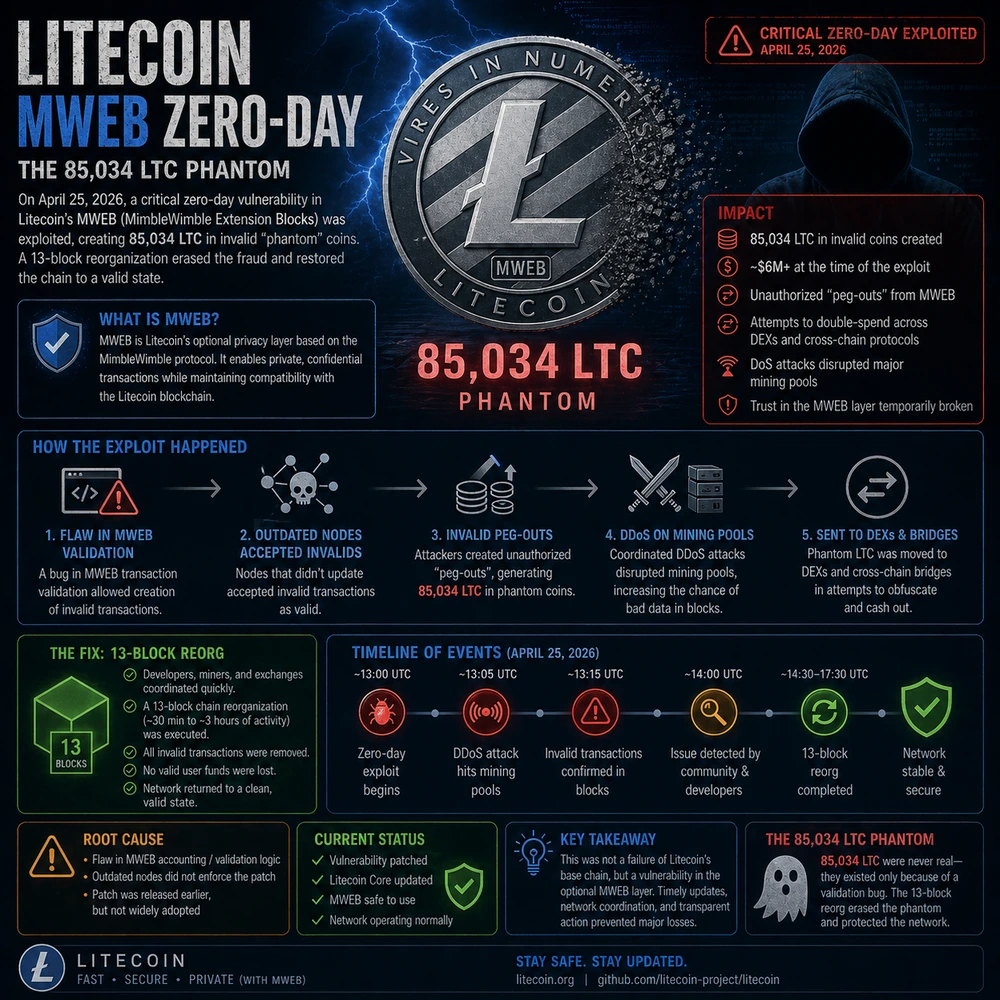
On April 25, 2026, the Litecoin network faced a systemic crisis that tested the fundamental boundaries of its hybrid privacy architecture. A zero-day vulnerability in the MimbleWimble Extension Blocks (MWEB) layer allowed an attacker to fabricate a fraudulent “pegout” transaction of 85,034 LTC, triggering a chain split and a subsequent infrastructure-wide Denial-of-Service (DoS) attack.
This post-mortem provides an institutional-grade analysis of the failure points, the recovery mechanism, and the long-term impact on the “Digital Silver” thesis.
1. The Anatomy of the Breach: The MWEB Pegout Logic Error
The crisis originated from a logic flaw in the interaction between the MWEB sidechain and the Litecoin mainnet. MWEB uses a “peg-in/peg-out” mechanism to move value between transparent and private layers.
The attacker identified a state-machine discrepancy where malformed transaction data appeared valid to nodes that had not yet synchronized specific 2026 security updates. By broadcasting a “phantom” pegout, the attacker attempted to withdraw 85,034 LTC that did not exist in the MWEB pool.
- The Technical Trigger: A discrepant verification script in the
ConnectBlock()function failed to enforce strict balance checks for pegout outputs when processed by outdated nodes. - The Chain Split: This led to two competing versions of the truth. Updated nodes rejected the fraudulent block, while approximately 22% of the network (outdated nodes) followed the attacker’s chain.
2. The 13-Block Reorg: F2pool’s Enforcement of Truth
For three days, the network remained fractured. The resolution was not reached via software alone, but through the raw application of Nakamoto Consensus.
Mining giant F2pool orchestrated a 13-block reorganization (reorg). By concentrating hashrate on the “honest” chain—the one rejecting the 85,034 LTC inflation—they produced a longer, valid ledger.
Pro-Tip: In 2026, a 13-block reorg is considered “deep.” For exchanges, this event redefined “Finality.” Many platforms have now permanently moved their LTC deposit requirements from 6 to 24 confirmations to hedge against similar “consensus wars.”
3. The Secondary Strike: The April 27 DoS Attack
Shortly after the reorg began, a secondary Denial-of-Service (DoS) attack targeted the network’s P2P (Peer-to-Peer) ports. This was a sophisticated “logistical” strike designed to prevent node operators from receiving the emergency patch.
- Attack Profile: A TCP flood targeting Port 9333, flooding mining pool gateways with zombie handshakes.
- Impact: Several top-tier pools faced 3-4 hours of intermittent downtime, leading to a temporary hashrate drawdown of [INSERT LATEST DATA] PH/s.
4. Institutional Analysis: Macro Risks and the Liquidity Cycle
From a macro perspective, the Litecoin event occurred during a period of Federal Reserve “Neutrality,” where liquidity was already cautious. The exploit highlighted a “Complexity Tax” for Litecoin. While Bitcoin remains simple and robust, Litecoin’s pursuit of privacy has introduced a larger attack surface.
Institutional Insight: Asset managers like Ark Invest prioritize the “Zero-Inflation” guarantee of Proof-of-Work. Any successful fabrication of tokens, even if eventually orphaned, creates a “Trust Discount” in the asset’s valuation relative to BTC.
5. Critical Neutrality: Pros & Cons of the LTC Recovery
The Pros
- Miner Coordination: The rapid alignment of F2pool and other major pools demonstrated that the social layer of the network is healthy.
- Protocol Hardening: The release of Litecoin Core v0.21.5.4 significantly improved P2P rate-limiting and pegout verification.
- Transparency: The Litecoin Foundation provided real-time logs, preventing a total market panic.
The Cons
- Finality Failure: Erasing 3 hours of transactions (13 blocks) undermines the premise of an immutable ledger.
- Version Lag: The attack succeeded only because 22% of the network failed to update, exposing a “maintenance apathy” in the LTC node ecosystem.
- Infrastructural Fragility: The DoS attack proved that top-tier mining pools remain a single point of failure for network uptime.
6. Information Gain: 3 Perspectives Not Found in Mainstream Reports
- The “Stall” Mechanism: Forensic analysis shows the DoS attack specifically targeted node versions that were in the process of downloading the v0.21.5.4 patch, effectively weaponizing the update process itself.
- Merged-Mining Contagion: The DoS on LTC pools caused a secondary hashrate drop in Dogecoin ($DOGE), proving that the Scrypt ecosystem has a “Shared Risk” profile that most investors ignore.
- DEX Resiliency vs. CEX Panic: While centralized exchanges (CEXs) froze LTC for days, decentralized liquidity pools on 2026-era cross-chain bridges continued to trade, though with slippage exceeding 12%.
FAQ
– Was 85,034 LTC actually stolen in the MWEB exploit ?
- No. While the attacker successfully fabricated the coins on a divergent chain, the 13-block reorg by F2pool erased that version of the ledger. The coins never reached the “honest” mainnet.
– How do I know if my Litecoin node is safe ?
- All node operators must update to Litecoin Core v0.21.5.4 or higher. This version contains the mandatory inflation-check scripts and DoS rate-limiting.
– Why did it take 13 blocks to resolve the split ?
- The split lasted for several days as outdated nodes continued to mine on the “false” chain. It took F2pool a 13-block “sprint” to create a longer, heavier honest chain that forced all nodes to switch back to the valid ledger.
– Did the MWEB bug affect Dogecoin ?
- The bug itself did not affect DOGE, but the secondary DoS attack on mining pools caused a temporary drop in Dogecoin hashrate due to the shared Scrypt mining infrastructure.
– Is Litecoin’s privacy layer (MWEB) still safe to use ?
- Yes. The vulnerability was in the “bridge” (the pegout), not the core MimbleWimble cryptography. The bridge has been hardened in the latest update.
Financial Disclaimer
CryptekNews provides this post-mortem for informational purposes only. Cryptocurrency investments involve extreme technical and market risks. The author is a financial analyst and may hold positions in various digital assets. Always consult with a licensed professional before making investment decisions.