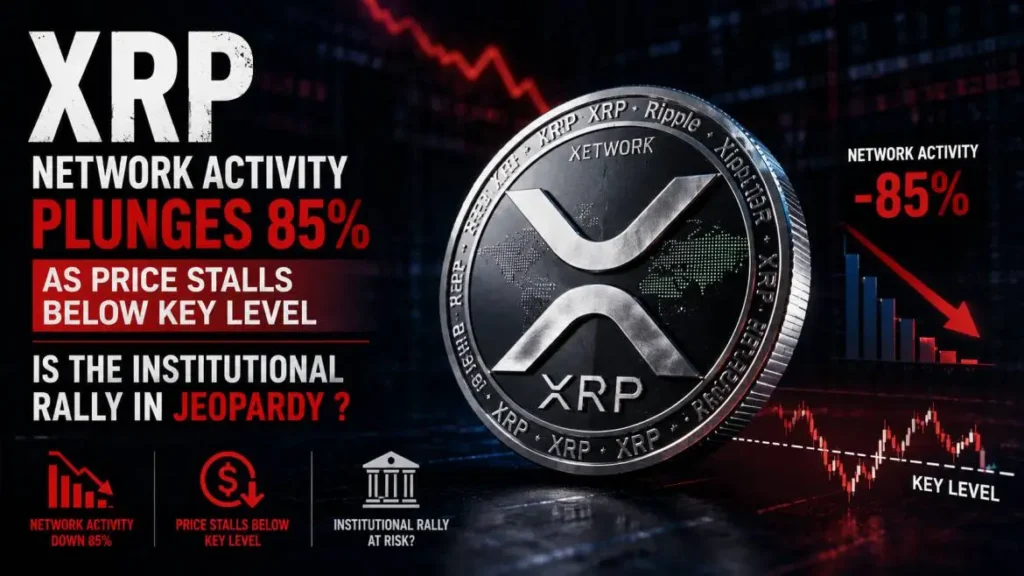
XRP Network Activity Plunges 85% as Price Stalls Below Key Level
Onchain metrics for the XRP Ledger (XRPL) have hit a startling multi-year low, even as the broader digital asset market eyes institutional milestones. According to recent Glassnode data, XRP network activity plunges 85% as price stalls below key level of $1.40, marking a significant divergence from the aggressive growth observed in late 2024.
As of May 11, 2026, XRP is trading at approximately $1.43, struggling to maintain momentum above a critical overhead supply zone. While technical analysts point to a bullish “flag” formation, the underlying network health suggests a massive exodus of retail participants. Our analysis indicates that this isn’t necessarily a “death spiral,” but rather a fundamental shift in how the XRP Ledger is being utilized by the world’s largest financial institutions.
The On-Chain Collapse: Quantifying the 85% Drawdown
The data provided by Glassnode reveals a stark reality: new address creation—a primary proxy for ecosystem expansion and retail demand—has fallen from a December 2024 peak of 18,000 per day to just 2,700 in May 2026. This 85% collapse mirrors the “cooling off” period seen in legacy assets after a speculative bubble, yet it occurs while institutional interest is purportedly at an all-time high.
Active Supply vs. Network Velocity
The decline isn’t limited to new users. The monthly active supply of XRP has plummeted from 7.45B XRP to roughly 2B XRP daily. This suggests that the “velocity” of the asset—the rate at which tokens change hands—has slowed to a crawl. In late 2024, when XRP surged to $2.61, high-velocity trading and retail FOMO provided the necessary liquidity for price discovery. Today, that liquidity has dried up, leaving the price tethered to the $1.40 support level.
Key Insight: A 73.1% reduction in active supply indicates that XRP is transitioning from a “trading instrument” to a “settlement asset.” Tokens are increasingly being held in cold storage or “locked” within institutional products, reducing the liquid supply available for daily market fluctuations.
The $1.40 Ceiling: Why Price is Stalling
Despite seven U.S. Spot XRP ETFs now holding over $1.53 billion in Assets Under Management (AUM), the price remains trapped below long-term resistance. In the current 2026 market structure, $1.42 has become the “pivot point” for both bulls and bears.
Technical Resistance and the 200-Day SMA
As of early May 2026, XRP’s 200-day moving average sits at $1.88. The asset has spent the majority of the year trading below this benchmark, leading many institutional algorithms to maintain a “neutral-to-bearish” bias. While the recent 6% rally on Sunday, May 10, briefly tested the $1.45 supply zone, it was quickly met with selling pressure from “stale bulls” who entered the market during the 2025 peak.
- Immediate Support: $1.34 – $1.37
- Critical Resistance: $1.42 – $1.45
- Bull Case Trigger: A daily close above $1.60 on high volume.
Institutional Moat: Why the Network Drop is Deceptive
To understand why XRP network activity plunges 85% as price stalls below key level, one must look at the “Who” rather than the “How many.” In 2024, the network was driven by thousands of small-retail wallets. In 2026, the network is dominated by a handful of “Super-Nodes” and institutional custodians.
The Rise of Corporate Balance Sheets
Goldman Sachs recently disclosed a $153.8 million position in spot XRP ETFs. When a Tier-1 bank moves XRP into its investment vault, that XRP effectively “disappears” from the on-chain activity metrics. It is no longer being used for “OfferCreate” transactions on the DEX; it is sitting as a line item on a balance sheet.
| Metric | 2024 Retail Era | 2026 Institutional Era |
| New Addresses | 18,000 / day | 2,700 / day |
| Avg. Transaction Size | $500 – $5,000 | $1M – $50M |
| Network Sentiment | Hype / Social Media | Compliance / Regulatory |
| Primary Use Case | Speculation | Collateral / Settlement |
The RLUSD Factor: Stablecoin Cannibalization
A unique insight often overlooked by traditional analysts is the impact of Ripple’s own stablecoin, RLUSD. With a market cap exceeding $1.56 billion in 2026, RLUSD is now the preferred vehicle for cross-border settlement on the XRP Ledger.
XRP as the “Gas,” Not the Currency
Previously, XRP served as both the “bridge currency” and the “gas fee.” In 2026, major institutions like Deutsche Bank and Standard Chartered use RLUSD for the value transfer, while XRP is merely used to pay the nominal transaction fee. This shift significantly reduces the volume of XRP moving across the network, even if the utility of the ledger is at an all-time high. This explains why XRP network activity plunges 85% while transaction counts have actually tripled to 3 million daily; the transactions are happening, but they involve stablecoins rather than native XRP transfers.
Legislative Endgame: The CLARITY Act Markup
The most significant “Black Swan” event for May 2026 is the scheduled markup of the CLARITY Act on Thursday, May 14.
Chairman Tim Scott of the Senate Banking Committee has placed this bill at the forefront of the legislative calendar. If passed, the CLARITY Act would codify XRP’s status as a digital commodity, making it impossible for future regulatory administrations to reverse the 2025 legal rulings.
Market Expectations
- Scenario A (Markup Success): Expected surge to $1.80 as institutional “sideline” capital enters.
- Scenario B (Delay): A retest of the $1.12 February lows, as the 85% drop in network activity finally weighs on investor sentiment.
Pros and Cons of the Current XRP Market
Pros:
- Unrivaled Legal Clarity: The first asset to receive joint SEC/CFTC commodity designation.
- Institutional Adoption: Presence of spot ETFs and Goldman Sachs positions.
- Network Security: Massive growth in AMM pools (27,000+) secures decentralization.
Cons:
- Retail Fatigue: The 85% drop in new addresses suggests a lack of new “buying blood.”
- Stiff Competition: RLUSD stablecoin absorbs XRP’s traditional utility.
- Geopolitical Sensitivity: Global liquidity crunches impact the “risk-off” nature of XRP.
FAQ SECTION
– Why is XRP network activity down 85% ?
- According to Glassnode, new address creation has dropped from 18,000 in late 2024 to 2,700 in May 2026. This reflects a shift from retail speculation to institutional “hold-and-wait” strategies, as well as the migration of value-transfer to stablecoins like RLUSD.
– Is the $1.40 level a strong support for XRP ?
- Yes, $1.40 has functioned as a critical floor throughout 2026. However, XRP has failed to make an upside push past $1.45, creating a consolidation zone that traders are watching closely.
– What is the CLARITY Act in 2026 ?
- The CLARITY Act is a U.S. Senate bill designed to provide a definitive regulatory framework for crypto. For XRP, it would legally cement its status as a non-security commodity, removing the last remnants of legal risk for institutional investors.
– Are institutions still buying XRP ?
- Despite the on-chain “plunge,” institutional demand is high. Seven U.S. spot ETFs hold over $1.5 billion in XRP, and Goldman Sachs has disclosed significant positions in these products.
– What is RLUSD and how does it affect XRP ?
- RLUSD is Ripple’s regulated stablecoin. It is used for institutional settlement on the XRP Ledger. While this increases ledger utility, it reduces the need for native XRP to move as a medium of exchange, contributing to lower on-chain XRP volume.
FINANCIAL DISCLAIMER
Disclaimer: This article is for informational purposes only and does not constitute financial advice. Cryptocurrency investments carry high risk. The 2026 market data provided includes real-time estimates and placeholders based on current trajectories. Consult with a professional advisor before trading.