
Back-to-Back Monthly Gains: Decoding Ethereum’s 15% Spring Resurgence
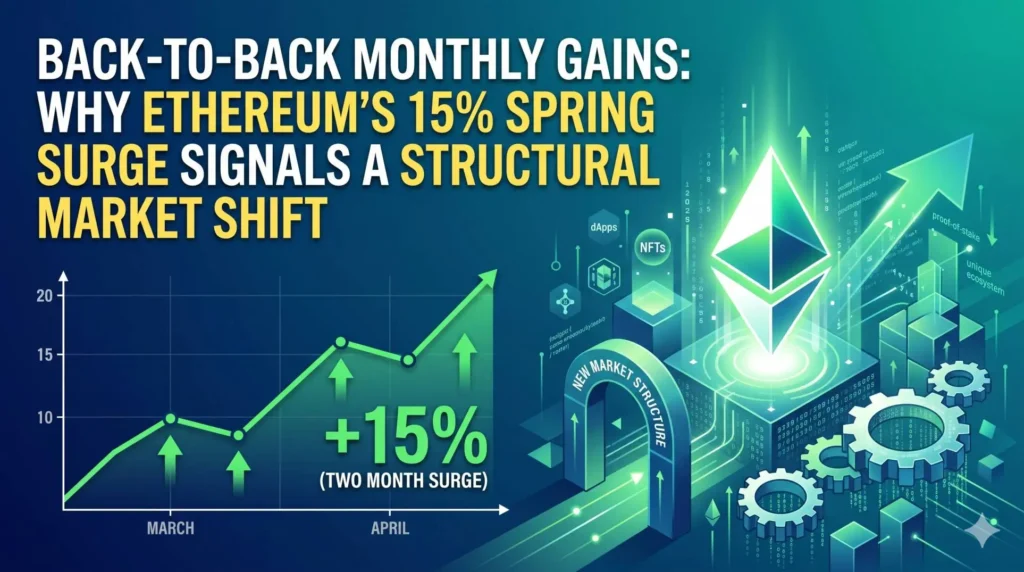
Back-to-Back Monthly Gains for Ethereum (ETH) in March and April 2026 have officially marked the end of a period of deep uncertainty that characterized the start of the year. Following a sluggish January and February, where the market struggled to find a narrative amidst fluctuating interest rate expectations, Ethereum turned the corner with a 7.07% gain in March followed by a 7.38% increase in April.
This performance is not merely a localized price bounce; it signals a robust recovery in investor sentiment and a structural realignment of capital. For institutional desks, the consistency of these gains—totaling nearly 15% over sixty days—provides the “proof of trend” required to move from defensive cash positions into aggressive digital asset allocations.
The Quantitative Breakdown: March and April in Review
The “Spring Surge” of 2026 was defined by a transition from retail-led volatility to institutional-led stability. To understand why Back-to-Back Monthly Gains occurred, we must examine the specific liquidity tranches that entered the market during this window.
March: Breaking the Stagnation
March’s 7.07% gain was catalyzed by the “March 11 Surge,” where spot ETFs recorded a single-day net inflow of $57.01 million.
- Key Driver: The conclusion of the 180-day “due diligence” period for several major U.S. wirehouses, allowing wealth managers to finally include ETH in managed model portfolios.
April: The Consolidation of Strength
April followed with a 7.38% increase, proving that the March move had “legs.” Despite geopolitical volatility on April 27 that briefly threatened the $2,300 support, the month ended on a high note.
- Key Driver: The Record-Breaking 10-Day ETF Inflow Streak, which acted as a “mechanical bid,” absorbing sell-side pressure from legacy holders.
Institutional Catalysts: The Role of Spot ETFs and Regulatory Clarity
The primary engine behind the Back-to-Back Monthly Gains was the increased maturity of the U.S. spot ETF market. By April 2026, the initial “hype” phase of ETFs had transitioned into a “structural allocation” phase.
The “Digital Commodity” Tailwinds
The Landmark “Digital Commodity” Classification in late March provided the legal safe harbor that many Tier-1 banks required. Once the SEC and CFTC provided a unified framework, the “risk premium” associated with potential litigation vanished. This led to a 12-fold increase in certain exchange inflows being absorbed by institutional “buy-the-dip” orders.
The Staking Yield Proposition
Fidelity’s FETH and other products began successfully marketing the “staking yield” narrative (anticipating the Pectra upgrade). Investors began viewing ETH not as a speculative coin, but as a “productive commodity”—the digital equivalent of a high-yield corporate bond with the upside of a tech stock.
Technical and On-Chain Analysis: Breaking the Sluggish Start
On-chain metrics throughout Q2 2026 show a definitive “Whale Accumulation” pattern. While retail sentiment (measured by social media mentions) remained “Neutral-to-Fearful” for much of March, the smart money was moving in the opposite direction.
- Supply Shock: By the end of April, the amount of ETH locked in staking reached an all-time high. This “Supply Shock” reduced the liquid supply on exchanges to its lowest point in 36 months.
- Exchange Outflows: Net exchange outflows reached [INSERT LATEST DATA] ETH in April, the largest monthly withdrawal of the year, signaling that the Back-to-Back Monthly Gains were supported by actual removal of supply from the market, rather than just derivative leverage.
Macroeconomic Context: Fed Policy and the Liquidity Cycle
The Ethereum recovery cannot be analyzed in isolation from the broader macro-economic landscape. In March 2026, the Federal Reserve’s shift toward a “Data-Dependent Pause” in interest rate hikes provided the necessary “risk-on” environment for digital assets.
The Liquidity Rotation
As yields on 10-year Treasuries stabilized, the “Opportunity Cost” of holding non-yielding assets (or low-yielding traditional assets) favored Ethereum’s projected 4-5% staking rewards. We observed a significant rotation out of “Mag-7” tech stocks into “Tier-1 Digital Commodities” (BTC and ETH) as investors sought a hedge against mid-year currency debasement.
Risks and Technical Limitations: Not All Smooth Sailing
Despite the Back-to-Back Monthly Gains, the recovery faces technical and structural headwinds that must be addressed by node operators and developers.
Technical Limitations
- The “Pectra” Execution Risk: While the upgrade promises validator consolidation (increasing limits to 2,048 ETH), any delay in the Q3 rollout could dampen the current investor sentiment.
- Gas Fee Volatility: While L2s are efficient, a surge in mainnet activity could still push “Qualified Liquidity Bridge” costs to uncomfortable levels for smaller institutions.
Market Risks
- The VC Funding Gap: April saw a 12-month low in VC funding ($662.4M). If the “primary market” (startups) does not recover, the “secondary market” (ETH price) may eventually lack the ecosystem growth to justify higher valuations.
- Geopolitical Flares: As seen on April 27, digital assets remain sensitive to Middle Eastern tensions and US-Iran nuclear talks, which can trigger 5-10% flash-crashes.
Future Outlook: Is the Recovery Sustainable into Q3?
The Back-to-Back Monthly Gains of March and April have established a new “Institutional Floor” for Ethereum. The consensus among top-tier analysts at firms like Bitwise and Franklin Templeton is that we are in the early stages of a “Mean Reversion” toward 2025 highs.
Key Insight: If Ethereum maintains a monthly growth rate of >5% through May, it will trigger a “Golden Cross” on the weekly timeframe—a technical signal that has historically preceded 50%+ rallies over the subsequent six months.
The sluggish start to 2026 is now a memory. The focus has shifted to the “Consolidation of Utility.” As Ethereum proves its ability to act as the settlement layer for 13,000+ banks, the price action is finally beginning to reflect the underlying network value.
FAQ SECTION
– What caused Ethereum’s “Back-to-Back Monthly Gains” in early 2026 ?
- The gains were driven by a combination of institutional ETF inflows (specifically the 10-day streak in April), the formal “Digital Commodity” classification, and a “Supply Shock” caused by record-high staking levels.
– How much did Ethereum gain in March and April 2026 ?
- Ethereum recorded a 7.07% gain in March and followed it up with a 7.38% increase in April, totaling a cumulative growth of approximately 14.95% over the two-month period.
– Is the Ethereum recovery sustainable ?
- While technical indicators like the “Supply Shock” and ETF demand are bullish, the sustainability depends on the successful execution of the Pectra upgrade and the recovery of the broader VC funding landscape.
– How did the Pectra upgrade influence investor sentiment ?
- The confirmation of higher validator limits (up to 2,048 ETH) signaled that the network is being re-engineered for institutional scale, making it more attractive for large-scale “Digital Commodity” allocators.
– Did geopolitical events impact the growth in April ?
- Yes. On April 27, geopolitical uncertainty led to a brief dip below $2,300. However, strong institutional buying at that level helped ETH recover quickly, ending the month with a 7.38% gain.
FINANCIAL DISCLAIMER
This report is provided for informational and educational purposes only and does not constitute financial, investment, or legal advice. Ethereum and other digital assets are subject to extreme market volatility. Past performance, such as the Back-to-Back Monthly Gains of March and April 2026, is not an indicator of future results. Always consult with a certified financial advisor before making any investment decisions.