

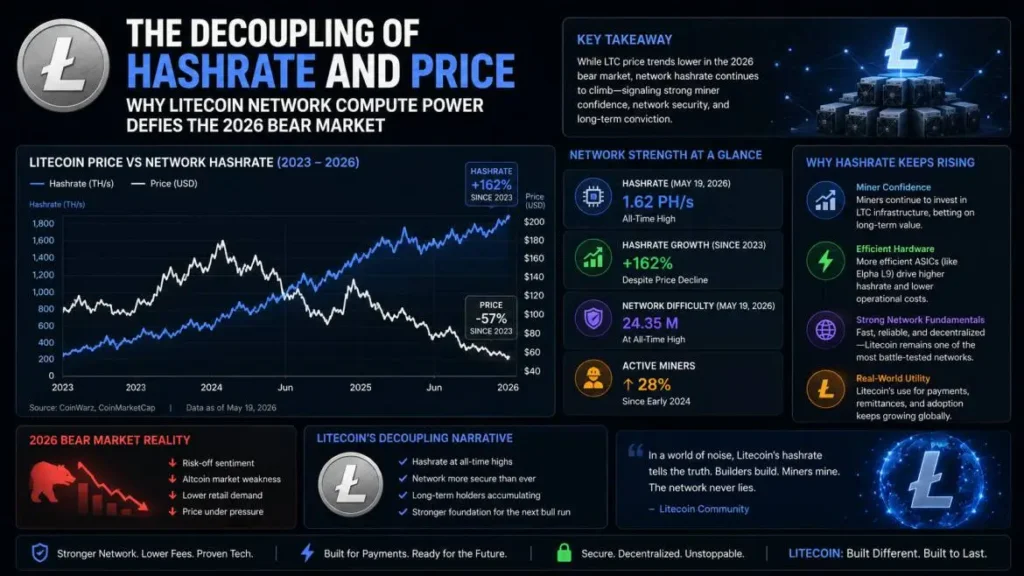
The Decoupling of Hashrate and Price: Why Litecoin Network Compute Power Defies the 2026 Bear Market
The expansion of the Litecoin network compute power to an unprecedented, stable baseline of 2.95 petahashes per second (PH/s) highlights a distinct divergence between asset spot prices and physical infrastructure commitment. Throughout the opening halves of recent market cycles, digital asset valuations have experienced pronounced macro contraction.
Yet, the cryptographic security architecture anchoring the Scrypt consensus engine continues to hit structural highs. Far from a sign of speculative enthusiasm, this trend reflects systemic shifts in mining industrialization, institutional capital allocation, and the commercial rollout of highly advanced microelectronics.
Litecoin Network Health Matrix (Mid-2026 Data Floor)
+-----------------------------------+-----------------------------------+
| Metric                            | Current Stabilized Baseline       |
+-----------------------------------+-----------------------------------+
| Total Network Compute Power       | 2.95 PH/s                         |
| Average Daily Transaction Count   | 178,000 Transactions              |
| Core Mining Algorithm             | Scrypt (Memory-Hard Proof of Work)|
| Primary Hardware Driver           | Bitdeer SEALMINER DL1 Air / ASICs |
+-----------------------------------+-----------------------------------+
Understanding why the Litecoin network compute power remains elevated requires looking beyond basic price charts. Instead, it demands an evaluation of specialized application-specific integrated circuit (ASIC) distribution timelines, the unique financial cushions of merged mining, and the long-term horizons of enterprise infrastructure operations.
Inside the Data: The Mechanics of the 2.95 Petahash Surge
Network computing health is driven by hardware efficiencies and raw capital expenditure. The consolidation of Litecoin’s total computing threshold at 2.95 PH/s represents a massive upgrade in the global network’s hardware layer. This scale is achieved even as market pricing dynamics pressure short-term operator profitability.
The Microelectronics Race: Bitdeer SEALMINER and Next-Gen Scrypt ASICs
The catalyst behind this processing expansion is the market arrival of specialized hardware architectures. Most notable is the commercial deployment of Bitdeer’s SEALMINER series, specifically the SEALMINER DL1 Air launched in early 2026.
ASIC Hardware Benchmark: Scrypt Algorithm Performance
+-------------------------------+-------------------+-------------------+-------------------+
| Hardware Unit                 | Hashrate Capacity | Power Draw        | Energy Efficiency |
+-------------------------------+-------------------+-------------------+-------------------+
| Legacy Enterprise Hardware    | ~15-19 GH/s       | 3,400 Watts       | ~180-200 J/GH     |
| Bitdeer SEALMINER DL1 Air     | 25 GH/s           | 3,725 Watts       | 149 J/GH          |
| Next-Gen Hydro Prototypes     | 30+ GH/s          | 3,900 Watts       | <130 J/GH         |
+-------------------------------+-------------------+-------------------+-------------------+
Unlike classic SHA-256 mining arrays, which rely almost exclusively on raw logic cell performance gains, the Scrypt algorithm requires high memory availability. Scrypt utilizes a sequential memory-hard function that demands a 1,024 KB scratchpad for data handling. This architectural choice historically created a performance ceiling for hardware designers due to memory bus bottlenecks on the die.
The 2026 class of ASICs addresses this issue by integrating custom-optimized Static Random-Access Memory (SRAM) pathways directly alongside the hashing cores. By lowering latency between processing steps and memory lookups, hardware like the SEALMINER DL1 Air delivers 25 GH/s at an efficiency of 149 Joules per Gigahash ($J/GH$). The widespread adoption of these high-yield silicon chips across institutional mining centers has effectively raised the floor for global computing power.
Merged Mining Infrastructure: The Dogecoin-Litecoin Symbiosis
A major factor shielding the Scrypt mining sector from spot market volatility is the structural reality of merged mining. Under standard AuxPoW (Auxiliary Proof of Work) frameworks, a miner submits completed cryptographic hashes to both the Litecoin network and the Dogecoin network simultaneously.
Key Insight: This dual validation model allows operators to capture secondary block rewards without spending an additional watt of electricity or modifying core hardware arrays.
When evaluating mining unit economics via the lens of hashprice—the expected dollar value generated per unit of compute power per day—the combined revenue of LTC and DOGE yields an entirely different profitability profile than an isolated asset analysis indicates. During phases where Litecoin spot prices trace down, the Dogecoin issuance allocation acts as a financial buffer. This incentive mechanism keeps large-scale industrial facilities powered on, preventing network security degradation.
Quantifying Fundamental Network Health vs. Bearish Price Action
Spot market liquidations and long-term network utility rarely share a linear relationship. While asset prices reflect changes in retail liquidity and macro asset flows, on-chain utility signals organic protocol demand.
                  [Global Energy Inputs & Data Centers]
                                   │
                                   ▼
                   [2.95 PH/s Scrypt Mining Power]
                                   │
         ┌─────────────────────────┴─────────────────────────┐
         ▼                                                   ▼
[Litecoin Network Consensus]                       [Dogecoin Network Consensus]
(178,000 Sustained Daily Tx)                       (AuxPoW Secondary Yield Pool)
         │                                                   │
         └─────────────────────────┬─────────────────────────┘
                                   ▼
                   [Optimized Miner Profitability]
Transaction Baselines: Evaluating the 178,000 Daily Transaction Floor
Alongside the Litecoin network compute power surge, processing trends show a highly resilient transaction base. The network maintains a steady baseline of roughly 178,000 transactions per day. This transaction floor reflects ongoing utility across real-world payment networks and second-layer protocols.
This level of continuous on-chain movement prevents block space from deflating. It ensures that transaction fees contribute a steady, predictable component to the overall pool of block rewards. This transactional volume distinguishes Litecoin from pure speculative tokens; the network operates as an active transactional highway, maintaining utility regardless of broader exchange trends.
Fee Economics and Miner Revenue Models
To understand the economic endurance of the network, one must look at the structural components of miner compensation. Let $R_{\text{total}}$ represent the total block reward revenue per epoch, defined by:
$$R_{\text{total}} = (B_{\text{LTC}} + F_{\text{LTC}}) \cdot P_{\text{LTC}} + (B_{\text{DOGE}} + F_{\text{DOGE}}) \cdot P_{\text{DOGE}}$$
Where:
- $B$ represents the protocol-defined base block subsidy.
- $F$ represents the aggregate transaction fees paid by users within that specific block.
- $P$ represents the prevailing spot market fiat price for each respective asset.
As long as the collective value of $R_{\text{total}}$ remains above the localized operational cost of power procurement, the global network infrastructure expands. The 2026 data indicates that even when $P_{\text{LTC}}$ faces pressure, the optimization of $B_{\text{DOGE}}$ paired with the transaction fee floor $F_{\text{LTC}}$ keeps institutional installations viable.
Institutional Shift: Industrialization of Scrypt Capital
The days of amateur desktop setups driving the Scrypt ecosystem are gone. The stability of modern network infrastructure is anchored by deep institutionalization.
From Retail Farms to Megawatt-Scale Operations
The ongoing deployment of units like the SEALMINER series highlights a structural shift toward institutional mining. Today’s network hashrate is increasingly managed by publicly listed data center operators, infrastructure funds, and joint-venture energy projects. These entities operate under multi-year investment horizons that look beyond short-term spot market fluctuations.
Structural Evolution of Scrypt Ecosystems
┌──────────────────────────────────────┬──────────────────────────────────────┐
│ Legacy Retail Mining (Pre-2022)      │ Institutional Era (2026 Baseline)     │
├──────────────────────────────────────┼──────────────────────────────────────┤
│ Ambient air-cooled home farms        │ Hydro-regulated, megawatt facilities │
│ Spot-market dependent operation      │ Structured energy hedges & PPAs      │
│ High vulnerability to fee spikes     │ Multi-asset optimization frameworks  │
└──────────────────────────────────────┴──────────────────────────────────────┘
Institutional operators utilize structured Power Purchase Agreements (PPAs) that lock in fixed electrical input costs for 24 to 60 months. For these facilities, turning off machines during market dips violates minimum take-or-pay energy commitments. Consequently, hardware continues hashing to generate cash flow against fixed energy liabilities, insulating global network security from sudden changes in spot asset valuations.
Impact of Federal Reserve Policy and Global Energy Costs
The macro economic environment of 2026 further shapes how capital is deployed into physical mining infrastructure. With Federal Reserve policy focusing on higher-for-longer interest benchmarks to combat systemic structural inflation, speculative retail capital has retreated from high-risk digital assets. Conversely, infrastructure capital seeks tangible, yield-producing hardware investments.
Large-scale datacenters view high-efficiency Scrypt ASICs as fixed computational infrastructure. By placing installations near stranded natural gas sites, hydro-electric plants, or nuclear micro-generation nodes, operators transform excess energy into highly secure network security. This structural approach positions cryptographic computation as a predictable component of international energy management strategies.
Risk Analysis and Technical Limitations of the Compute Boom
While record-high compute power signals a robust security foundation, an analytical view must evaluate the latent risks and technical vulnerabilities inherent in rapid hardware concentration.
Centralization Hazards of Advanced Hardware
The concentration of processing capacity within premium ASIC lines presents a clear centralization vector. As chip design demands increasingly precise lithography processes, manufacturing capacity narrows to a handful of silicon foundries, predominantly TSMC and Samsung.
If a single manufacturing group or design company controls a dominant portion of the active hardware market, they possess outsized influence over:
- The downstream allocation of network hardware distribution.
- The deployment of proprietary firmware optimizations.
- The geographical pooling of cryptographic hash power.
This trend challenges the foundational premise of distributed network governance, making the ecosystem vulnerable to regional regulatory disruptions or supply chain shocks.
Capital Expenditure Strain on Legacy Operations
As the baseline hashrate approaches 2.95 PH/s, the mining difficulty engine automatically scales upward to maintain consistent block production times. This programmatic adjustment increases the computing cost required to secure block subsidies.
Operational Impact Matrix by Operator Classification
+------------------------------------+------------------------------------+
| Legacy Retail Operators            | Enterprise Scale Mining Guilds     |
+------------------------------------+------------------------------------+
| High vulnerability to difficulty   | Long-term capital buffers for chip |
| increases                          | iterative cycles                   |
| Sub-optimal power contracts        | Direct megawatt energy indexing    |
| Capital asset obsolescence risks   | High capacity to absorb downturns  |
+------------------------------------+------------------------------------+
Older generation units operating above 180 $J/GH$ face compression in their net margins. This pressure accelerates the exit of smaller independent operations, concentrating network validation power within enterprise-grade mining syndicates that possess the capital buffers required to survive rapid hardware transitions.
Strategic Comparison: Pros and Cons of Current Litecoin Mining Architecture
                       [Scrypt Security Ecosystem]
                                   │
         ┌─────────────────────────┴─────────────────────────┐
         ▼                                                   ▼
   [PROS / ADVANTAGES]                               [CONS / LIMITATIONS]
   • High ASIC Security Floor                        • Supply Chain Concentration
   • Multi-Asset Revenue Streams                     • Margin Squeeze on Small Players
   • Predictable Utility Base                        • Energy Capital Demands
Advantages / Pros
- High ASIC Security Floor: A computing baseline of 2.95 PH/s makes the network exceptionally secure against 51% reorganization exploits. Executing an attack would require buying cost-prohibitive amounts of specialized hardware.
- Multi-Asset Revenue Optimization: Merged mining with Dogecoin allows operators to capture two independent block reward streams, improving capital efficiency per megawatt.
- Predictable Utility Base: Steady transaction levels ensure consistent block creation and fee generations, sustaining the network independent of speculative cycles.
Vulnerabilities / Cons
- Supply Chain Concentration: Reliance on specialized next-gen ASICs concentrates systemic hardware dependencies within a small circle of silicon designers and foundries.
- Margin Squeeze on Independent Operators: Upward adjustments in network difficulty phase out older hardware, accelerating institutional centralization.
- Energy Capital Demands: Maintaining a multi-petahash network structure requires deep integration with industrial electrical grids, exposing operators to shifting national energy regulations.
The Forward Outlook: Will Price Follow Hashrate?
Historically, crypto networks have shown a long-term relationship between processing power expansions and subsequent price discovery. While hashrate does not act as a direct psychological driver for retail spot buyers, it signals institutional interest and establishes a higher cost-of-production floor.
As older, less-efficient ASICs are replaced by high-performance hardware, the underlying cost to mine a single Litecoin adjusts to reflect the cost base of these enterprise operations. When weak market conditions clear out speculative participants, the networks that remain backed by verifiable utility and strong processing foundations are well-positioned for structural growth. The 2.95 PH/s threshold proves that despite quiet spot markets, the physical foundation securing Litecoin is built for institutional scale.
FAQ SECTION
-What is driving the recent surge in Litecoin network compute power?
- The primary driver behind the expansion to 2.95 PH/s is the commercial rollout of highly advanced Scrypt ASIC mining systems, such as Bitdeer’s SEALMINER series. These units offer significantly better processing capabilities and power efficiency than previous-generation hardware. This allows institutional data centers to scale up operations even during down market phases.
-How does merged mining affect Litecoin’s overall network security?
- Merged mining allows operators to simultaneously mine Litecoin and Dogecoin without using extra electricity. The combined income streams provide a critical financial cushion for miners. This prevents widespread capitulation and hardware disconnects when Litecoin prices decline, keeping total computing power high.
-What does a processing capacity of 2.95 petahashes actually mean?
- A capacity of 2.95 petahashes per second means the mining units distributed across the global network are executing 2.95 quadrillion cryptographic hashing calculations every second. This metric represents the total processing capacity dedicated to securing the transaction ledger from manipulation or rollback.
-Is the Litecoin network maintaining steady transaction numbers?
- Yes. The network maintains a highly stable transaction baseline of approximately 178,000 transactions per day. This ongoing volume shows steady protocol utility and economic activity across payment and layer-2 solutions, independent of changing exchange spot prices.
-What are the main centralization risks associated with hashrate increases?
- The primary risk is hardware supply chain concentration. Developing high-efficiency silicon requires state-of-the-art semiconductor foundries, which limits ASIC production to a small number of international companies. Furthermore, rising network difficulty pushes out smaller operations, concentrating network validation power within large institutional facilities.
FINANCIAL DISCLAIMER
Regulatory and Market Risk Disclosure: The insights shared in this publication are for informational and educational purposes only. They do not constitute financial, investment, legal, or tax advice. Digital asset markets are highly volatile, and cryptographic network fundamentals—including hashrate, mining difficulty, and operational chip margins—can shift rapidly due to technological breakthroughs, energy policy changes, or market conditions. Past performance of network metrics is not a reliable indicator of future spot price outcomes. Readers must conduct thorough due diligence and consult with a certified financial professional before allocating capital to digital assets or specialized computational infrastructure.