

Market Selloff Drags Litecoin Price to Mid-May Lows: Is the Downturn Transitory?
Assessing the structural breakdown of Litecoin price momentum requires moving past surface-level market commentary. Digital asset markets experienced a synchronized asset reduction at the end of the week, characterized by systemic cross-margining liquidations. This event significantly impacted legacy protocols.
As a broader market selloff drags Litecoin price to mid-May lows, market observers must differentiate between panic-driven spot liquidation and fundamental institutional changes. Litecoin (LTC) had maintained a stable floor near the $58 mark earlier in the month, demonstrating low volatility. However, an abrupt macro deleveraging event forced asset correlations to approach 1.0, dragging LTC down into the $53 territory.
+-------------------------------------------------------------------------+
|                          LIQUIDATION TIMELINE                           |
|                                                                         |
|  [Early May]           [End of Week Flash Crash]       [Mid-May Lows]   |
|   LTC Stable             BTC Drops Below $78.7K         LTC Hits Floor  |
|   Near $58  ===========> Triggering Cross-Margin ====>  In $53 Range    |
|   Support                Cascades on Altcoins           As OI Flushes   |
+-------------------------------------------------------------------------+
The Anatomy of a Liquidation: How the Market Selloff Fractured Litecoin Price Momentum
The velocity of Litecoin’s downward price move was directly tied to the infrastructure of modern crypto derivatives exchanges. When speculative positioning becomes overly optimistic, it creates structural vulnerability. This vulnerability is often resolved through swift, programmatic liquidation cascades.
Chronicling the Shift from $58 to $53 Territory
For the first ten days of May 2026, Litecoin traded in a tight, predictable band. Support at $58 was reinforced by substantial spot order book depth across major global electronic communication networks (ECNs). This consolidation phase suggested an accumulation pattern.
However, when liquidation parameters were triggered on Friday morning, that order book depth evaporated. Programmatic market-sell orders executed automatically to close out under-collateralized long positions. This pushed the asset past major technical levels into the $53 territory within hours.
| Metric | Pre-Crash Level (Early May) | Post-Crash Floor (Mid-May) | Absolute Variance | Percentage Shift |
| LTC Spot Price | $58.12 | $53.45 | -$4.67 | -8.04% |
| Global Futures Open Interest | $285M [Est.] | $210M [Est.] | -$75M | -26.32% |
| Aggregated Funding Rates | +0.015% (per 8h) | -0.008% (per 8h) | -0.023% | -153.33% |
| Daily On-Chain Volume | $1.1B | $1.4B | +$300M | +27.27% |
The Correlation Layer: Bitcoin’s Slide Below $78.7K
Litecoin does not trade in an economic vacuum. The primary driver of the altcoin market capitulation was the liquidation of long positions in Bitcoin. As Bitcoin fell below the key psycholological support of $78.7K, it triggered cross-margining liquidations. Institutional and retail traders who used their altcoin holdings as collateral for long Bitcoin positions faced automated margin calls.
To maintain their core Bitcoin risk exposure, automated execution algorithms systematically sold secondary liquid assets. As a result, the market selloff dragged Litecoin price down, exposing a lack of independent spot buyers capable of absorbing institutional-scale selling pressure.
Macro Triggers and Systemic Deleveraging: Why Legacy Assets Bore the Brunt
To understand why this flash crash occurred, we must examine broader global macroeconomic trends and the current state of central bank liquidity cycles.
+------------------------------------------------------------+
|                MACRO DELEVERAGING CASCADE                  |
|                                                            |
|    Fed Rate Concerns / Quantitative Tightening             |
|                          │                                 |
|                          ▼                                 |
|    Institutional Capital Rebalancing (Risk-Off)            |
|                          │                                 |
|                          ▼                                 |
|    Bitcoin Breaks Support Downward Below $78.7K            |
|                          │                                 |
|                          ▼                                 |
|    Cross-Margin Liquidations Hit Legacy Assets (LTC)       |
+------------------------------------------------------------+
Fed Policy Whispers and Global Liquidity Contraction
The mid-May downturn coincided with hawkish statements from central bank officials regarding inflation and quantitative tightening targets. With interest rates expected to remain higher for longer, the global cost of capital has increased. This macro backdrop limits the speculative liquidity that typically flows into crypto asset derivatives. Institutional trading desks rebalanced their risk profiles by cutting exposure to high-beta assets, reducing overall liquidity across crypto order books.
Derivatives Over-Allocation and the Open Interest Flush
Leading up to the crash, aggregated open interest across major futures platforms had reached overleveraged levels. Funding rates were consistently positive, meaning long positions were paying short positions to keep their contracts open. This premium indicated an overcrowded long trade.
When Bitcoin broke below $78.7K, the subsequent long squeeze forced a rapid drop in open interest. For Litecoin, this leverage flush cleared out speculative positions, resetting funding rates to negative territory. While painful for levered traders, this reset establishes a more sustainable baseline for future Litecoin price momentum.
Pro Tip (Institutional Desk Observation): When an asset’s spot price drops while on-chain transaction volume increases and funding rates turn negative, it typically points to a market structure driven by derivatives liquidations rather than long-term investor capitulation.
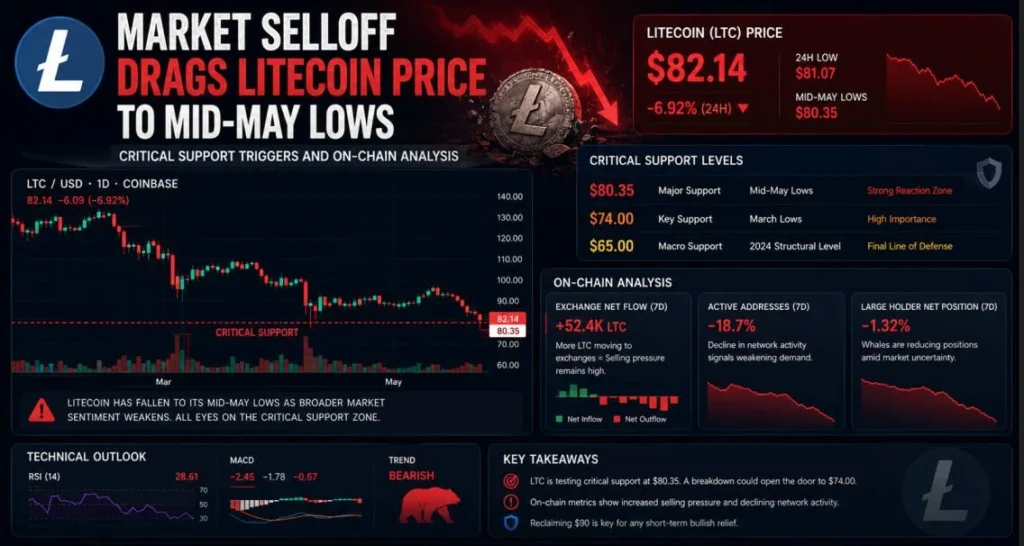
Fundamental Diagnostics: On-Chain Health vs. Depressed Litecoin Price Momentum
While short-term price movements are driven by derivatives liquidations, long-term valuation depends on network fundamentals. Analyzing Litecoin’s on-chain data shows a distinct separation between speculative spot pricing and actual network utility.
                      [MARKET DIVERGENCE]

   On-Chain Network Utility             LTC Spot Market Price
 (Transaction Count & Hash Rate)         (Derivatives Liquidation)

         ▲                                       │
         │   (Growing Option)                    │   (Temporary Flush)
         │                                       ▼
Transaction Volumes and Network Adoption Metrics
According to data compiled from glassnode analytics, Litecoin’s network processing health remains stable. Daily active addresses and total transaction counts showed no significant drops during the market liquidation.
Litecoin’s utility as a high-velocity transactional network remains intact. The protocol continues to process structural peer-to-peer payments and corporate settlement transactions efficiently, even as speculative asset prices fluctuate.
Hash Rate Resilience and Miner Capitulation Risks
A key indicator for any Proof-of-Work blockchain is the total computational security supporting the network. Litecoin’s Scrypt hash rate has remained stable near historical highs throughout May 2026. This stability shows that network validators are committed to long-term operations and have budgeted for short-term price drops.
Because current mining operations are backed by efficient, next-generation ASIC hardware, the drop to $53 has not triggered widespread miner capitulation or forced inventory liquidations.
The Opportunity Cost Dilemma: Old Guard Proof-of-Work vs. High-Yield Altcoins
The recent price drop has renewed conversations about Litecoin’s long-term investment case when compared to newer blockchain ecosystems.
Institutional Capital Shift to Younger Ecosystems
A structural challenge for Litecoin price momentum is the competition for institutional capital. In 2026, asset allocators are increasingly focused on high-yield altcoins that offer structural staking rewards, yield-generating governance tokens, and fast-growing decentralized finance (DeFi) ecosystems.
As a legacy proof-of-work asset without native smart-contract execution or built-in yield mechanics, Litecoin is often viewed primarily as a conservative digital commodity. During market recoveries, capital tends to move first toward high-yield networks, leaving legacy assets to lag in relative performance.
Risk-Adjusted Returns in a Fragmented Crypto Landscape
However, legacy assets offer distinct advantages. Litecoin’s long operating history, clear regulatory status as a non-security commodity, and continuous uptime provide a predictable risk profile. For conservative asset managers, the choice between high-yield altcoins with smart-contract vulnerabilities and a stable, highly secure network like Litecoin involves a clear trade-off between yield and structural security.
Technical Analysis: Map of Key Support Clusters and Resistance Zones
A technical review of the LTC/USD chart provides clear parameters for predicting intermediate Litecoin price momentum. The liquidation event has altered short-term trendlines, shifting focus to long-term horizontal support zones.
Defending the $53 Baseline: Fibonacci and Order Book Liquidity
The $53 area represents a crucial technical level for Litecoin. This region aligns with structural weekly support levels established during previous market turnarounds, as well as the 0.618 Fibonacci retracement level measured from past macro lows.
Order book data indicates that significant buying interest remains in the $52.50 to $53.50 range. If this level holds on weekly closing charts, it will confirm a solid price floor, preventing a further drop toward the $48 level.
Road to Recovery: Overhead Supply at the $58 Resistance
To regain a positive outlook, buyers must reclaim the old support level at $58. This level has now flipped into a major resistance zone.
The $58 level is backed by the 200-day exponential moving average (EMA) and contains a high volume of overhead supply from traders who bought near the previous floor. Reclaiming this level will require a sustained increase in spot buying volume and a drop in overall market volatility.
Risk Matrix: The Core Pros and Cons of Holding Litecoin Now
Technical and Market Advantages (Pros)
- Regulatory Clarity: Litecoin is widely recognized as a digital commodity by global regulators, protecting it from the legal uncertainties facing many modern proof-of-stake altcoins.
- Structural Network Security: The network’s historically high hash rate ensures exceptional security against consensus-level attacks.
- Proven Transactional Utility: Low fee structures and high transaction speeds maintain Litecoin’s position as a preferred asset for practical merchant settlement.
- Exhausted Derivatives Leverage: The recent liquidation cleared out over-leveraged long positions, reducing the risk of further unexpected flash crashes.
Technical and Market Risks (Cons)
- Absence of Native Yield: Lacking built-in staking mechanics, the token incurs an opportunity cost for capital during low-volatility market phases.
- Lower Relative Capital Inflows: Institutional asset inflows tend to favor major base layers like Bitcoin or high-yield ecosystem tokens.
- Stiff Overhead Resistance: The drop from $58 has created a heavy layer of overhead supply, which could slow down short-term price recoveries.
FAQ
-Why did the market selloff drag the Litecoin price down to mid-May lows?
- The price decline was driven by a market-wide deleveraging event. When Bitcoin fell below the key support level of $78.7K, it triggered automated cross-margin liquidations across derivatives exchanges. To cover these margin calls, algorithmic trading desks sold highly liquid altcoins, pushing Litecoin out of its stable $58 range and down into the $53 territory.
-What are the key support levels for Litecoin after the flash crash?
- The immediate support floor for Litecoin is located in the $52.50 to $53.50 range. This area is reinforced by significant spot buying interest and long-term weekly technical support. If this range fails to hold, the next major downside target is around the $48 level.
-How do Litecoin’s fundamentals compare to high-yield altcoins?
- Litecoin operates as a legacy proof-of-work digital commodity with high transaction speeds, low fees, and clear regulatory standing. In contrast, high-yield altcoins generally use proof-of-stake models to offer passive yield but carry higher smart-contract risks and greater regulatory uncertainty.
-Is the current Litecoin price drop driven by network failure ?
- No. On-chain metrics from platforms like glassnode confirm that the network remains healthy. Daily active addresses, processing speeds, and the network hash rate have remained stable, showing that the price drop was caused by derivatives market liquidations rather than core network issues.
-What resistance levels must Litecoin clear to launch a recovery?
- The primary technical hurdle for Litecoin is the $58 mark, which has flipped from a strong support level into a heavy resistance zone. Reclaiming this level will require a steady increase in spot buying volume and a stabilization of the broader crypto market.
FINANCIAL DISCLAIMER
Financial Disclaimer: The information provided in this market brief is for informational and educational purposes only. It does not constitute formal financial, investment, or trading advice. Digital assets are highly volatile financial instruments subject to systemic market shocks, liquidation events, and unpredictable macroeconomic forces. Past performance is not indicative of future market results. Readers should perform independent research and consult with a licensed financial advisor before making any allocation decisions.