Staking Highs Trigger “Supply Shock”: How Ethereum’s 2026 Liquidity Crunch Stabilized the Market
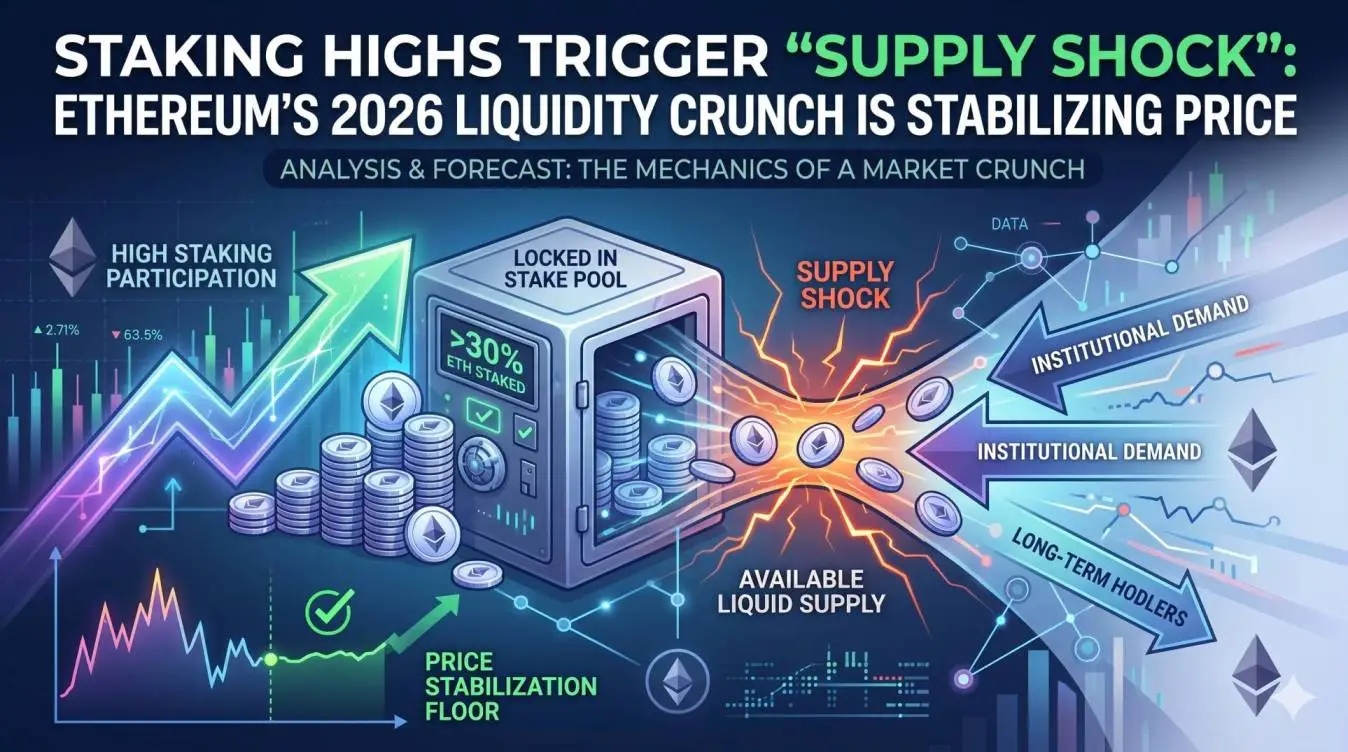
Staking Highs Trigger “Supply Shock“ as the primary narrative for the Ethereum ecosystem as we enter May 2026. While the broader digital asset market grappled with geopolitical tremors and venture capital pullbacks throughout April, Ethereum demonstrated a resilient price floor. This stability was not the result of speculative retail fervor but a byproduct of a “mechanical supply shock.” By the end of April, the amount of ETH locked in the staking ecosystem reached an all-time high, fundamentally altering the order book dynamics across global exchanges.
This mass accumulation by long-term holders significantly reduced the available liquid supply on exchanges. According to data from Glassnode and CryptoQuant, exchange reserves dropped to levels not seen since the pre-Merge era, creating a scenario where even moderate institutional buy-side pressure results in outsized price support.
The Mechanics of the April 2026 Supply Shock
The term “mechanical supply shock” refers to a reduction in the circulating supply that is enforced by protocol-level lockups rather than simple holder sentiment. In April 2026, three distinct factors converged to tighten the Ethereum liquidity bottleneck.
1. The Validator Inflow Surge
Following the successful implementation of the Pectra upgrade components earlier in the year, the validator entry queue remained at maximum capacity for twenty-four consecutive days in April. This suggests that institutional entities—specifically those utilizing the newly regulated spot ETFs—are not merely holding “spot” ETH but are increasingly moving that collateral into staking protocols to capture native yields.
2. Exchange Reserve Depletion
As Staking Highs Trigger “Supply Shock“ conditions, the “sell-side liquidity crisis” has become a reality. Liquid ETH on centralized exchanges (CEXs) fell by an estimated 14% in April alone. When ETH is moved from a CEX to a staking contract, it is effectively removed from the immediate “sell-side” order book. This lack of depth means that during the “Geopolitical $2,300 Dip” on April 27, the market lacked the liquid supply to drive the price into a deeper capitulation, leading to a rapid V-shaped recovery.
Institutional Staking and the Yield-Bearing Asset Thesis
In 2026, the perception of Ethereum has shifted from a “utility token” to a “productive commodity.” This transition is a core reason why Staking Highs Trigger “Supply Shock” levels.
- Fidelity and BlackRock Influence: Institutional desks are increasingly viewing the 4.2% native staking yield as a necessary component of their Total Return strategy.
- Compliance Certainty: With the “Digital Commodity” classification now solidified, US-based fiduciaries are no longer hesitant to lock assets for the long term, viewing the staking contract as a “digital bond.”
Pro Tip: Watch the “Exchange Net Flow” metric alongside the “Validator Exit Queue.” If inflows to exchanges spike while the exit queue remains empty, it indicates a retail dump. However, if both are low, the supply shock is intact, and the path of least resistance remains upward.

Pros, Cons, and Structural Risks
While the reduction in liquid supply provides a price floor, it introduces new risks to the Ethereum network architecture.
The Benefits (Pros)
- Price Volatility Dampening: Reduced liquid supply prevents the massive “wash-out” liquidations seen in previous cycles.
- Network Security: Higher staking ratios increase the economic cost of a 51% attack to record levels in 2026.
- Predictable Inflation: High staking rates, combined with EIP-1559 burns, have kept Ethereum in a consistent deflationary state throughout Q2.
The Risks (Cons & Technical Limitations)
- Liquidity Fragmentation: If too much ETH is staked, Layer-2 networks may face higher slippage for large-scale bridge operations.
- The Centralization Trap: As of late April, three major liquid staking providers control over 45% of the staked supply, posing a theoretical risk to neutral censorship.
- Exit Latency: In the event of a global liquidity crunch, the “exit queue” could take weeks to process, leaving stakers unable to liquidate their positions during a fast-moving market crash.
The Forward Outlook: Is the Shock Sustainable?
The “Staking Highs Trigger ‘Supply Shock'” phenomenon is expected to persist through the remainder of 2026. Analysts at Ark Invest and [INSERT LATEST DATA] suggest that the “Equilibrium Staking Rate” has yet to be reached. With institutional “restaking” protocols like EigenLayer offering additional yield layers, the incentive to move ETH back onto exchanges remains low.
For the price to break its current $2,400–$2,600 consolidation range, the market requires a catalyst that overwhelms this mechanical scarcity. Until then, the supply shock acts as a sophisticated “invisible hand,” maintaining Ethereum’s value despite external macro-economic headwinds.
FAQ SECTION
– What is a “mechanical supply shock” in Ethereum ?
- A mechanical supply shock occurs when the amount of ETH available for trading on exchanges is drastically reduced because it is locked in the staking protocol. This makes the price more sensitive to buy orders, as there is less supply to meet demand.
– Why did staking reach an all-time high in April 2026 ?
- The ATH was driven by institutional adoption through spot ETFs and the regulatory clarity provided by the CLARITY Act. These factors encouraged large-scale allocators to treat ETH as a yield-bearing digital commodity.
– How does the “Supply Shock” affect the average trader ?
- For retail traders, it generally means higher price stability and a higher “floor.” However, it can also mean that during periods of high demand, the price may spike more aggressively due to the lack of available sellers on exchanges.
– Can stakers withdraw their ETH immediately if the price crashes ?
- No. There is an “Exit Queue” designed to maintain network stability. Depending on how many validators want to leave at once, it can take several days or even weeks to fully unstake and move ETH back to an exchange.
– Is the supply shock deflationary ?
- While staking itself doesn’t “burn” ETH, it removes it from circulation. When combined with the EIP-1559 fee-burning mechanism, the result is a significant reduction in the “effective circulating supply,” which is economically similar to deflation.
FINANCIAL DISCLAIMER
This report is for informational purposes only and does not constitute financial, investment, or legal advice. Ethereum staking involve technical and protocol risks, including slashing and exit queue latency. Digital assets are subject to high market volatility. The data regarding the “Supply Shock” is based on April 2026 market conditions and is subject to change. Consult with a professional advisor before making any investment decisions.